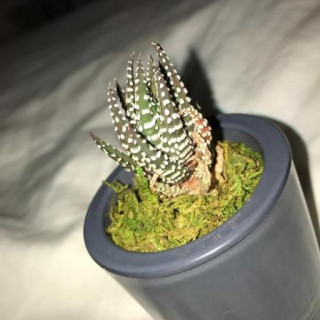
Haworthiopsis fasciata
Zebra plant · Lizard tail · Dragonclaw Aloe
Description
Source: leafsnapHaworthiopsis fasciata, formerly Haworthia fasciata, is a species of succulent plant from the Eastern Cape Province, South Africa. The species is rare in cultivation; most plants that are labelled as H. fasciata are actually Haworthiopsis attenuata.
🌳 The Zebra plant is an ornamental species often used in xeriscaping and rock gardens due to its unique appearance. Its pointed leaves feature white stripes, giving it a zebra-like look. In cooler climates, it is commonly grown as an indoor plant.
🎭 Suave, upbeat, sociable
Care Guide
💧 Water
The Zebra plant, native to South Africa, thrives in low humidity and can withstand drought conditions. To prevent overwatering, particularly during its dormant winter period, it should be watered every two weeks. Be sure to monitor the soil moisture closely to avoid root rot. This makes it an excellent choice as an indoor decorative plant.
☀️ Light Partial sun
The zebra plant prefers moderately bright light but can tolerate a broader range of lighting conditions. In the wild it grows in areas where light intensity fluctuates. Too much light can scorch the leaves, while too little may produce weak or leggy growth. It adjusts throughout its different growth stages.
🌡️ Temperature 20–37.8°C
The zebra plant is native to warmer regions and prefers temperatures of 68 to 100 ℉ (20 to 38 ℃). In the colder winter months, it is recommended to keep the plant slightly cooler, at 50 to 60 ℉ (10 to 15.5 ℃), to encourage blooming in spring.
💨 Humidity dry (<40%)
This plant prefers dry conditions, so don't mist it. However, watering it less often can also thrive in higher humidity.
🪴 Soil 6-7
🌱 Fertilizer
For Zebra plant, applying fertilizer once or twice a year during the growing season is sufficient. Do not fertilize in winter or summer while it is dormant. Cut back on feeding for recently repotted plants and wait a few months after repotting before resuming fertilization. Fertilizer promotes healthy growth and encourages blooming.
🪴 Pot & Repot Every 2 years
When repotting a Zebra plant, choose a pot only slightly bigger than the current one that provides good drainage. Use a gritty, fast-draining succulent or cactus potting mix. Gently remove the plant from its old container, brush off excess soil, and place it in the new pot at the same depth. Wait several days before watering so any root injury can heal. Repot in spring or autumn and situate the plant in a brightly lit spot.
✂️ Pruning
🌿 Propagating
🐛 Diseases & pets
☠️ Toxicity
Characteristics
- Plant Type
- Succulent, Herb
- Life Cycle
- Perennial
- Genus
- Haworthiopsis
- Family
- Asphodelaceae
- Hardiness Zone
- 9-11
- Mature Height
- 10 cm to 18 cm
- Mature Spread
- 15 cm
- Leaf Color
- Green, White, Orange, Brown
- Leaf Type
- Evergreen
- Flower Color
- White
- Flower Size
- 2.54 cm
- Bloom Time
- Spring, Winter
- Planting Time
- Spring, Summer, Autumn, Winter
- Harvest Time
- Spring, Early summer
- Native Area
- South Africa