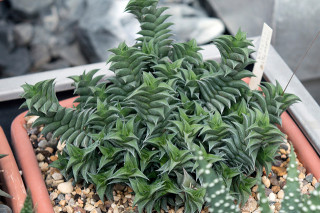
Haworthiopsis viscosa
Dragontail
Description
Source: leafsnapThe Haworthia Viscosa (Haworthiopsis viscosa) is a miniature perennial succulent endemic to southern Africa that grows to a height of 15 cm and has lateral suckers. Except for the blooms, it resembles a miniature aloe. It has triangular fleshy leaves that are organized into long rosettes and are dark green, olive green, or brown in color. They are widely used as garden and container plants. The plants may grow on their own or in clumps. Their blooms have six petals, are tiny, white, and seem fairly identical among species.
Care Guide
💧 Water Every 2-3 weeks
Haworthia viscosa is an exceptionally drought-tolerant plant that thrives in arid conditions. It requires watering only every three weeks, ensuring the soil dries out completely between waterings. Well-suited for lower indoor humidity, it is an ideal choice for container gardening. The plant maintains its shape with minimal care and watering.
☀️ Light Partial sun
Haworthia viscosa comes from habitats with dappled light, such as the forest understory or rocky locations that provide natural shade. It prefers partial sun but can also tolerate full sun.
🌡️ Temperature 20–37.8°C
Haworthia viscosa grows best in warm conditions and needs higher temperatures during the growing season to support growth and metabolic processes. It prefers plenty of sunlight, suitable moisture, and good air circulation. However, it is vulnerable to damage from very low temperatures and from overwatering. It is therefore important to maintain a balance and to avoid both excessive heat and overly dry conditions.
💨 Humidity
🪴 Soil 6-7
🌱 Fertilizer
Haworthia viscosa only needs light applications of fertilizer once or twice a year during the growing season. Do not fertilize in winter or in summer when the plant is dormant. Cut back on fertilizer for plants that have been repotted and wait a couple of months after repotting before applying fertilizer. Fertilizing helps maintain healthy growth and encourages blooming.
🪴 Pot & Repot Every 2 years
When repotting Haworthia viscosa, choose a pot slightly larger than the current one that has good drainage. Use a gritty, well-draining cactus or succulent mix. Gently remove the plant from its old pot, dust off any excess soil, and set it in at the same depth. Wait a few days before watering to allow any root damage to heal. Repot in spring or fall and place it in a brightly lit spot.
✂️ Pruning
Haworthia viscosa is a distinctive succulent featuring a rosette shape and textured leaves. It's best to prune it from early to late spring to remove any dead or damaged leaves and to reduce overcrowding, which improves airflow. When pruning, use clean, sharp tools, and be careful not to over-prune, as this can cause stress. Proper pruning will support healthy growth.
🌿 Propagating
🐛 Diseases & pets
☠️ Toxicity
Although the ASPCA does not consider Haworthias to be poisonous or toxic, you should not consume them or let your children or pets eat them. It may induce gastric distress if ingested in high doses. Their sap may cause redness or discomfort, which will eventually recover.
Characteristics
- Plant Type
- Herb, Succulent
- Life Cycle
- Perennial
- Genus
- Haworthiopsis
- Family
- Asphodelaceae
- Hardiness Zone
- 10-11
- Mature Height
- 20 cm
- Mature Spread
- 30 cm
- Leaf Color
- Brown, Green
- Leaf Type
- Evergreen
- Flower Color
- White
- Flower Size
- 0.51 cm to 0.76 cm
- Bloom Time
- Summer
- Planting Time
- Summer
- Harvest Time
- Late summer, Early fall, Mid fall
- Native Area
- South Africa