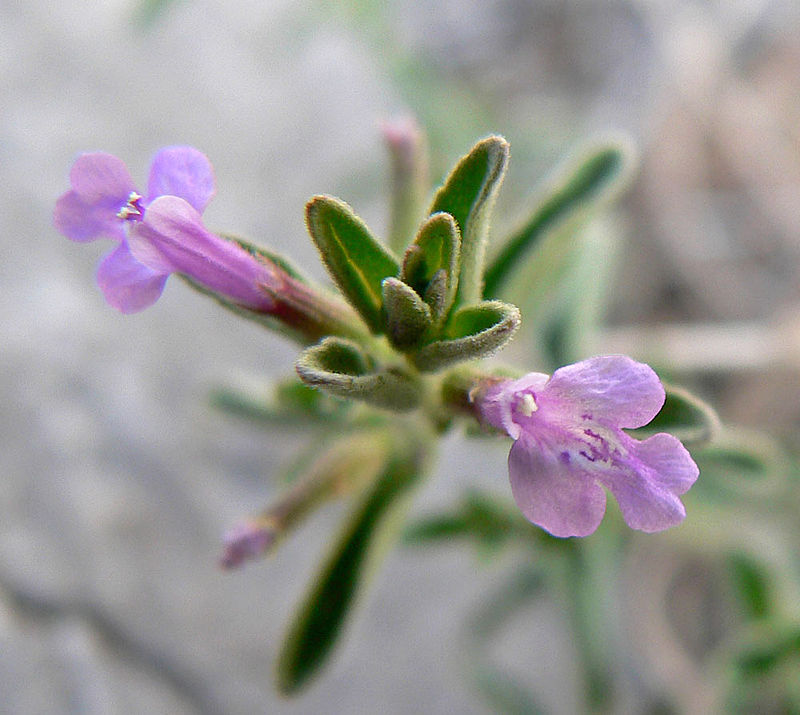
Hedeoma drummondii
New Mexico pennyroyal · Drummond's false pennyroyal · Drummond's pennyroyal
Description
Source: leafsnapHedeoma drummondii is a species of flowering plant in the mint family known by the common name Drummond's false pennyroyal. It is native to western North America, where it is distributed mainly in the United States west of the Mississippi River and adjacent Mexico. This is a hairy perennial herb with an erect mintlike form up to 45 centimeters tall. The oppositely arranged paired leaves are linear to narrowly oval in shape, pointed, and up to about a centimeter long. The leaves have a strong sweet mint scent when crushed. The herb tastes like peppermint and is used as a minty flavoring in parts of Mexico. The inflorescence arises from the axils of these leaf pairs, bearing three to seven flowers each between one and two centimeters in length on short pedicels. The flowers are generally light to deep lavender with some white markings. The fruit is a waxy, mucilaginous nutlet.
🎭 Strength, protection, peace. Regarded as a majestic and noble plant, it is used to improve one's status and stature.
Care Guide
💧 Water
Drummond's false pennyroyal is well-suited for arid environments due to its high drought tolerance. To replicate its natural conditions, it only needs to be watered about once a week. This makes it an excellent choice for outdoor gardening and xeriscaping, as it helps conserve water while providing year-round greenery with minimal maintenance.
How should I water my Drummond's false pennyroyal plant?
To water Drummond's false pennyroyal, you can use a garden hose with a spray nozzle, a watering can, or any other common watering tool. This plant is not too specific about its water source, so it can thrive with rainwater, tap water, or filtered water. Avoid watering it from above because this can harm the leaves and flowers and potentially cause disease. Instead, consider using a drip irrigation system to provide water evenly and directly to the soil. If you have a Drummond's false pennyroyal in a container, you can follow a similar approach but use a cup, watering can, or tap water to water it directly at the soil.
What should I do if I give my Drummond's false pennyroyal plant too much or too little water?
To remedy underwatering of Drummond's false pennyroyal, simply water it more regularly once you notice the lack of moisture. Overwatering, on the other hand, can be a serious issue that may lead to diseases and the plant's decline. To prevent this, choose a suitable location with plenty of sunlight to help dry the soil and good drainage to avoid waterlogging. If your potted Drummond's false pennyroyal is overwatered, consider changing it to a new pot with proper drainage and loose soils.
How often do I need to water my Drummond's false pennyroyal plant?
To properly care for Drummond's false pennyroyal, you'll need to water it regularly throughout the growing season. In the spring, once a week should suffice. As the weather gets warmer, you may need to increase your watering to two or three times a week. Be careful not to overwater, though, as this can harm the plant. Keep the soil moist but not wet. When it comes to potted Drummond's false pennyroyal, you'll need to water more frequently. Potted soil tends to dry out faster than ground soil, so plan to water your pot-grown plant a few times per week, compared to just once per week for a plant in the ground.
How much water does my Drummond's false pennyroyal plant need?
Determining the appropriate amount of water for your Drummond's false pennyroyal can be done in a few ways. One method is to judge the soil moisture by feeling it and watering until the top six inches are moist. Alternatively, you can use a general guideline of giving about two gallons of water per week, considering factors like temperature and soil dryness. However, strict adherence to this guideline may lead to overwatering if your plant needs less water. When growing Drummond's false pennyroyal in a container, a different approach is needed. Ensure all layers of soil are watered by testing the moisture with your finger or allowing excess water to trickle out of the drainage holes.
How can I know if I'm giving enough water to my Drummond's false pennyroyal?
Avoiding overwatering your Drummond's false pennyroyal can be tricky. While these plants need to be watered weekly due to their deep roots, they are also prone to root rot and browning if overwatered. Underwatering is not as much of a concern as these plants can survive without extra watering for a while. However, if you go too long without giving them water, they may wilt and develop dry leaves.
☀️ Light Full sun
Drummond's false pennyroyal does best when it receives plentiful sunlight during the day, although it can tolerate stretches of reduced light. Native to environments rich in sunlight, the plant's vigor and growth are enhanced under such conditions. Excessive shading or an overall lack of sunlight can hinder its growth and health.
What are the sunlight requirements for Drummond's false pennyroyal?
Drummond's false pennyroyal requires full sun, which means above 6 hours of sunlight daily, to thrive optimally. However, it can also tolerate partial sun, defined as about 3-6 hours of sunlight. The plant originates from environments that receive a significant amount of sunlight, and its health and growth rates improve under such conditions. While it can withstand some periods of lesser light, both excessive shading and insufficient sunlight can hinder its development and vitality. It's important to observe how sunlight moves through your garden to select spots that offer the right balance of light and shade, ensuring the plants' happiness.
How can artificial lighting be used for Drummond’s false pennyroyal indoors?
When natural sunlight is not sufficient, especially during winter or in areas that receive less sunlight, artificial lighting can be crucial for the growth of Drummond's false pennyroyal indoors. The use of artificial lights facilitates faster, healthier growth. LED lights are recommended due to their ability to be customized to provide specific wavelengths needed by the plants. For full sun plants, 30-50W/sq ft of artificial light is needed; partial sun plants require 20-30W/sq ft, and full shade plants need 10-20W/sq ft. The light source should be placed 12-36 inches above the plant to mimic natural sunlight, and most plants will need 8-12 hours of light per day.
What are the indications of insufficient or excessive light for Drummond’s false pennyroyal?
The plant may show signs of light deficiency when grown indoors with inadequate lighting. Symptoms include smaller new leaves, leggy or sparse growth, faster leaf drop, slower or no new growth, and lighter-colored new leaves. Excessive sunlight can lead to chlorosis (leaves turning yellow due to chlorophyll breakdown), sunscald (damage from intense light exposure), leaf curling (a defense mechanism against excessive sunlight), wilting (loss of turgor pressure due to water loss), and leaf scorching (brown, dry edges on leaves caused by too much sunlight). These symptoms reflect the plant's struggle to adapt to its lighting environment.
What solutions can improve Drummond’s false pennyroyal's growth in terms of lighting?
To optimize growth, adjust the plant's exposure to sunlight or supplement with artificial lighting. Indoors, gradually move the plant to receive at least 6 hours of direct sunlight daily, using a south-facing window or, for larger or immobile plants, consider artificial lighting. Keep a lamp on for a minimum of 8 hours daily or use professional plant grow lights. Outdoors, transition your plants to sunnier spots gradually to prevent sunburn. Remove any obstructions blocking sunlight, and for smaller plants, consider transplanting during dormancy (late winter or early spring) to a location with ample sunlight and good drainage. Note that while parts of the plant that suffered from insufficient light may not recover, new growth should be healthy with improved light conditions.
🌡️ Temperature 0–32.2°C
Drummond's false pennyroyal can tolerate a broad range of temperatures, but its distribution may still be restricted by various combinations of moisture and heat. It performs best in warm summer conditions with sufficient rainfall or watering. Extended periods of cloudy, rainy weather or sustained high temperatures can raise the chance of Drummond's false pennyroyal dying. In winter, adequate protection from cold can increase the plant's survival rate.
💨 Humidity
🪴 Soil 6-7
🌱 Fertilizer
When most of Drummond's false pennyroyal blooms are fully open, resume fertilizing. At the time the blooms are at peak production, apply fertilizer every three to four weeks, as weather permits. Then, once the plant begins to produce fewer new blooms, stop fertilizing; there's no need to fertilize when it can no longer produce more blooms.
🪴 Pot & Repot
✂️ Pruning
Drummond's false pennyroyal is a fragrant plant characterized by its aromatic leaves and low-growing habit. To encourage healthy growth and remove damaged stems, prune it between early and late spring. When trimming, cut just above a node to ensure robust regrowth, and avoid pruning in the fall. Using clean tools will result in better cuts, improving air circulation and reducing the risk of disease.
🌿 Propagating
🐛 Diseases & pets
☠️ Toxicity
Characteristics
- Plant Type
- Herb
- Life Cycle
- Annual, Perennial, Biennial
- Genus
- Hedeoma
- Family
- Lamiaceae
- Hardiness Zone
- 3-7
- Mature Height
- 46 cm
- Mature Spread
- 20 cm to 30 cm
- Leaf Color
- Green, Blue
- Leaf Type
- Semi-evergreen
- Flower Color
- Pink, Purple
- Flower Size
- 0.51 cm to 0.76 cm
- Bloom Time
- Mid spring, Late spring, Early summer, Mid summer
- Planting Time
- Spring, Summer
- Harvest Time
- Summer
- Native Area
- Mexico