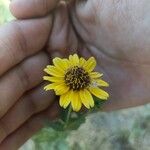
Helianthus laciniatus
Alkali sunflower · Jagged-edge sunflower
Description
Source: leafsnapHelianthus laciniatus is a North American species of sunflower known by the common name alkali sunflower. It is found in the southwestern United States (southeastern Arizona, southern New Mexico, western Texas) and north-central Mexico (Chihuahua, Coahuila, Nuevo León, Durango). It is fairly common in the Chihuahuan Desert.Helianthus laciniatus is a perennial herb up to 200 cm (almost 7 feet) tall. Most of the leaves are on the stem rather than clumped together close to the ground, each leaf is up to 9 cm (2.7 inches) long. One plant usually produces 1-9 flower heads. Each head has with 14–20 yellow ray florets surrounding 40 or more red or purple disc florets. The plant grows in dry, alkaline desert soils.
🌳 More than simply decorating landscapes, cutleaf coneflower acts as an important focal point for pollinators. Its plentiful nectar and pollen attract a range of bees, butterflies, and other insects, supporting biodiversity. Studies show its potential in rehabilitation sites to establish a thriving pollinator community, underscoring its use in conservation efforts and ecosystem restoration.
🎭 Support, drive, power, well-being
Care Guide
💧 Water
☀️ Light Full sun
The cutleaf coneflower thrives best with complete exposure to sunlight but also manages fairly well with a moderate level of shade. Sunlight is essential for its robust growth and influences various stages of its life span. Excessive or insufficient light exposure could hinder its growth or result in leaf discoloration. In its native habitat, it commonly receives a considerable amount of sunlight.
🌡️ Temperature 5–35°C
The cutleaf coneflower, a species that thrives in temperate climates, typically prefers a temperature spectrum of 41 to 95 ℉ (5 to 35 ℃), mirroring its native habitat in temperate zones. During winter, it could profit from cooler temperatures in the vicinity of 41 to 50 ℉ (5 to 10 ℃), which aids in facilitating suitable dormancy.
💨 Humidity
🪴 Soil 6-7
🌱 Fertilizer
The optimal period to fertilize a Cutleaf coneflower is early spring, as it transitions from dormancy to active growth. Fertilization supplies essential nutrients for its robust growth. While the Cutleaf coneflower doesn't require a lot of fertilization, yearly fertilization could improve its longevity and stimulate superior, more durable flowers.
🪴 Pot & Repot
✂️ Pruning
🌿 Propagating
🐛 Diseases & pets
☠️ Toxicity
Characteristics
- Plant Type
- Herb
- Life Cycle
- Perennial
- Genus
- Helianthus
- Family
- Asteraceae
- Hardiness Zone
- 4-9
- Mature Height
- 0.49 m to 2.13 m
- Mature Spread
- 0.61 m to 1.22 m
- Leaf Color
- Green
- Leaf Type
- Deciduous
- Flower Color
- Yellow, Gold
- Flower Size
- 6.35 cm to 10.16 cm
- Bloom Time
- Mid summer
- Planting Time
- Spring, Summer, Autumn, Winter
- Harvest Time
- Mid summer, Late summer
- Native Area
- Canada