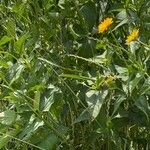
Heliopsis helianthoides
False sunflower · Oxeye · Jerusalem Artichoke · Smooth oxeye · Rough oxeye
Description
Source: leafsnapHeliopsis helianthoides, commonly known as false sunflower, is a perennial plant native to North America. Belonging to the Asteraceae family, this plant can reach heights of 3 to 5 feet. It displays a bushy growth habit with dark green, lance-shaped, and toothed leaves. The false sunflower is known for its bright yellow flowers, which bear a strong resemblance to those of the true sunflower. These blooms appear from mid-summer through fall, attracting bees, butterflies, and other pollinators. While Heliopsis helianthoides prefers full sun, it can tolerate partial shade, especially in hotter climates. The plant thrives in well-drained soil but can adapt to various soil types, provided they are neither too wet nor too dry. Low maintenance and easy to care for once established, the false sunflower benefits from deadheading spent blooms to encourage continued flowering throughout the season. In summary, Heliopsis helianthoides is an excellent choice for gardeners seeking a low-maintenance perennial with striking blooms that attract pollinators all season long.
💡 The false sunflower, also known as Heliopsis helianthoides, is a perennial plant admired for its beautiful yellow blooms and low-maintenance requirements. These striking flowers can reach heights between 91 and 244 cm. They are drought tolerant, making them an excellent choice for gardens, and they also hold up well in cut flower arrangements. Additionally, false sunflowers are resistant to both deer and rabbits.
🌳 Rich in both beauty and practical value, the false sunflower's golden blossoms draw important pollinators — such as bees and butterflies — that are essential for maintaining diverse ecosystems. Aside from their striking appearance, the seeds feed a range of bird species, a lesser-known but vital ecological role. In the past, indigenous communities used these bright flowers to make dye, a cultural practice that has mostly been lost over time.
🎭 Reproductive ability, Desires, Well-being
Care Guide
💧 Water Every 7 days
The false sunflower flourishes in prairie environments, demonstrating both drought resistance and a preference for consistent moisture. For optimal health, it should be watered weekly. Typically, it is grown outdoors in full sunlight to maximize its flowering potential.
When should I water my False Sunflower?
Proper watering is crucial for the health and growth of False Sunflower (Heliopsis helianthoides). The best time to water is when the top 1-2 inches of soil around the plant appears dry and crumbly. Inserting your finger into the soil can help determine dryness; if the soil feels dry to the touch, it's time to water. Look out for signs such as wilting or drooping leaves, a reduction in flowering, and stunted growth, as these indicate the plant may be dehydrated. Overwatering or underwatering can lead to root rot or dehydration, so it's important to water based on these indicators to ensure the plant's optimal health and vibrant blooms.
How should I water my False Sunflower?
Watering False Sunflower involves specific techniques and considerations for optimal hydration. It's recommended to water deeply and thoroughly, targeting the base of the plant to allow water to penetrate the root zone. Avoid excessive foliage wetness to prevent disease. Use a watering can with a narrow spout for precision, and consider employing a moisture meter to accurately gauge soil moisture. To avoid root rot, ensure proper drainage by removing standing water from any trays or saucers. Additionally, misting the foliage can increase humidity and benefit plant health, but it should not replace regular watering. Adjust the frequency and amount of water based on the plant's growth stage, and environmental conditions such as temperature and humidity.
How much water does False Sunflower really need?
The water requirement of False Sunflower depends on various factors including its size and the environmental conditions. Generally, the plant needs watering every few days to maintain moderately moist soil, especially for larger plants with deeper roots. A balanced approach of thorough watering rather than frequent shallow watering ensures that deep roots receive adequate hydration. Proper watering results in a lush, green plant with vibrant flowers, while signs of under-watering include wilting or browning leaves. Over-watering can cause susceptibility to disease and pests. The guide's validity is supported by research from the USDA and the University of Wisconsin-Madison.
What kind of water is best for False Sunflower?
False Sunflower is not particularly picky about the type of water used for irrigation - tap, distilled, rainwater, or filtered water are all acceptable provided they are free of harmful toxins and minerals. Despite being tolerant to chlorine and fluoride commonly found in tap water, it's recommended to let tap water sit out for 24 hours before use to allow excessive chlorine to evaporate. Avoid using water with high levels of salt or sodium as it can harm the plant. Room temperature water is optimal, and ensuring the water is free from harmful treatments helps maintain the plant's health.
How do False Sunflower's watering needs change with the seasons?
False Sunflower's watering needs vary with seasonal changes. In spring, as the plant resumes growth, increase watering to match its needs. Summers require the most water, especially during hot, dry periods, to keep the soil consistently moist. With autumn's cooler temperatures and slowed growth, reduce watering and ensure the soil isn't waterlogged. During winter, the plant's growth slows, and its watering needs decrease significantly; water sparingly, only when the soil is very dry, to prevent root decay.
☀️ Light Full sun
False sunflower does best when it receives a substantial amount of sun each day, though it can tolerate places that offer only moderate sun. It is adapted to environments with plentiful sunlight. Insufficient light can impede its growth, while excessive light may overwhelm it.
What are the sun requirements for False Sunflower?
The False Sunflower (Heliopsis helianthoides) flourishes when it receives sufficient sunlight. It is best suited for conditions of full sun, which means it thrives in areas receiving above 6 hours of sunlight daily. However, it can also adapt to partial sun, where it would get about 3-6 hours of sunlight. It’s important to observe your garden's sunlight patterns to find spots that offer the right balance of light and shade, ensuring the plant's optimum growth and happiness.
How essential is sunlight for the growth of False Sunflower?
Sunlight plays a crucial role in the growth and development of the False Sunflower. It is adapted to environments abundant in sunshine, thriving best when exposed to a substantial amount of daily sun. However, it can also tolerate moderately sunny locations. Insufficient light may hinder its growth, while excessive exposure can be overwhelming. For indoor plants, where natural light may be inadequate, especially during winter or in less sunny spaces, artificial lighting provides a vital alternative. This can include LED lights, which can be customized to the plant’s needs, with recommended wattages varying based on the light conditions—full sun plants require 30-50W/sq ft, partial sun plants need 20-30W/sq ft, and full shade plants need 10-20W/sq ft.
What symptoms indicate inadequate sunlight for False Sunflower?
Inadequate sunlight can cause a range of symptoms in False Sunflowers. New leaves might grow smaller than those of a mature plant. The plant could become leggy or exhibit sparse growth, with longer spaces between leaves or stems, leading to a weak, stretched-out appearance. It might experience faster leaf drop to conserve resources, slower or halted growth, or develop lighter-colored new leaves, indicating a lack of chlorophyll and essential nutrients. Conversely, excessive sunlight can lead to chlorosis (where leaves turn yellow), sunscald, leaf curling, wilting, and leaf scorching. These conditions emphasize the importance of monitoring and adjusting the plant's exposure to sunlight.
How can you address sunlight-related issues for False Sunflower?
To combat sunlight-related issues in False Sunflowers, you can take several steps. For indoor plants, gradually move them to sunnier locations, aiming for at least 6 hours of direct sunlight daily, or use artificial light if moving the plant isn’t feasible. Outdoor plants should also be moved gradually to sunnier spots to avoid shock, which could result in sunburn. If obstructions block sunlight, consider pruning or transplanting the plant during its dormant period to a location with better light. Note that parts of the plant already damaged by insufficient light might not recover, but new growth should be healthy once the lighting conditions improve.
🌡️ Temperature 0–35°C
False sunflower originates from temperate regions where temperatures range 68 to 95 °F (20 to 35 ℃). Comfortable within that heat range, false sunflower may need adjustments during colder seasons. Consider warming measures when temperatures drop.
What is the native climate for False Sunflower?
False Sunflower, also known by its botanical name Heliopsis helianthoides, is native to temperate climate environments where temperatures range between 68 to 95 °F (20 to 35 °C). It is comfortable in this range of heat but might require adjustments when temperatures drop in colder seasons.
Does False Sunflower need frost protection measures during winter?
False Sunflower has strong cold resistance and usually does not require special frost protection measures during winter. However, if temperatures are expected to drop below -35°C, it is important to provide cold protection by covering the plant with materials such as soil or straw. Additionally, watering the plant abundantly before the first freeze in autumn to ensure the soil remains moist is recommended to prevent drought and water scarcity for the plant during winter and early spring.
How does False Sunflower react to low temperatures?
False Sunflower is cold-tolerant and thrives best when the temperature is above 20°C. During winter, it should be kept above 0°C. If temperatures fall below -35°C, there may not be any noticeable changes during winter, but there could be a decrease in sprouting or even no sprouting during springtime. The solution in spring is to remove any parts that have failed to sprout.
What should be done if False Sunflower experiences high temperatures?
During summer, False Sunflower should be kept below 35°C to avoid heat stress. When the temperature exceeds 41°C, the plant's leaves might become lighter in color, prone to curling, susceptible to sunburn, and in severe cases, the entire plant may wilt and dry up. In such situations, it's advisable to trim away sunburned and dried-up parts, move the plant to a location with shade during the midday and afternoon sun, or use a shade cloth. Watering the plant in the morning and evening to keep the soil moist can also help mitigate high temperature stress.
💨 Humidity
🪴 Soil 6-7
🌱 Fertilizer
Generally, a single fertilizing in spring is enough for False sunflower, though additional feedings can boost growth. Apply fertilizer every 4 to 6 weeks. Fertilizing improves the leaves' appearance and function, helping maintain even color and a healthy texture. It also promotes root development and nutrient uptake for long-term plant health.
Why do I need to put plant food on my False sunflower?
The False sunflower's leaves are a significant part of its structure. Fertilization is key in ensuring that these leaves are both aesthetically pleasing and functional. It helps maintain consistent color and a healthy texture in the leaves. In addition, fertilization promotes the growth of new roots and the maintenance of existing ones beneath the soil's surface. This not only benefits the plant's immediate health but also increases its ability to absorb nutrients from the soil in the future.
When should I fertilize my False sunflower for best results?
When you grow False sunflowers outdoors, they will start sprouting new leaves in early spring. This is a signal to start fertilizing them for the year. Usually, a single application of fertilizer in spring is enough for False sunflowers to grow well. However, if you want them to grow even more, you can fertilize them multiple times during the spring and early summer. In this case, you can feed them every month to a month and a half.
When is it a bad idea to add fertilizer to my False sunflower plant?
During the late fall and winter, your False sunflower will go dormant and stop producing new growth. It is important to avoid fertilizing it during this time. In the spring and summer, if you decide to fertilize your False sunflower multiple times, gradually decrease the fertilization rate as summer approaches because the growth rate of the sunflower will also slow down. In general, it is not recommended to fertilize your False sunflower during exceptionally hot weather or when the soil is extremely dry. Fertilizing in these conditions can stress the sunflower and lead to premature death.
What kind of fertilizer does my False sunflower require?
Choosing the best fertilizer for a False sunflower is actually quite simple. These plants do well with a general-purpose garden fertilizer that contains equal amounts of nitrogen, phosphorus, and potassium. Look for a fertilizer with a ratio of 10-10-10 or something similar, as it will work effectively. It's best to steer clear of fertilizers high in nitrogen if unsure. When it comes to the form, most ideal fertilizers for False sunflowers are granular and slow-release. These are convenient to apply directly to the soil. Additionally, using an organic soil amendment like compost can be beneficial to nourish your False sunflowers.
How should I give nutrients to my False sunflower?
To ensure optimal growth for your False sunflower, wait until its first leaves sprout in early spring. Apply a granular slow-release fertilizer with a balanced formula to the soil around the base of the plant. If desired, you can repeat this process later in the season. When applying fertilizer, always target the soil at the base of the plant rather than the plant itself. Sometimes, you may need to gently move some leaves to access the soil above the roots. It's also a good idea to water the False sunflower before and after fertilizing.
🪴 Pot & Repot 2-3 years
When repotting False sunflower, select a pot 1-2 inches (2.5–5.1 cm) larger that provides good drainage. Use a well-draining potting mix. Repot in spring or fall, making sure the root ball sits slightly below the rim of the flower pot. Water thoroughly after repotting and place it in a warm location with indirect sunlight.
✂️ Pruning
To help your false sunflowers thrive, you should prune them from early to late spring. Start by removing any dead stems and thinning out congested areas to improve air circulation. Regularly cutting back the plants by one-third will help control their height and encourage bushier growth, which will, in turn, enhance flowering and overall vigor.
🌿 Propagating
🐛 Diseases & pets
☠️ Toxicity
Characteristics
- Plant Type
- Herb
- Life Cycle
- Perennial, Annual
- Genus
- Heliopsis
- Family
- Asteraceae
- Hardiness Zone
- 3-10
- Mature Height
- 0.4 m to 1.52 m
- Mature Spread
- 61 cm to 91 cm
- Leaf Color
- Green
- Leaf Type
- Deciduous
- Flower Color
- Yellow, Gold
- Flower Size
- 4.06 cm to 6.35 cm
- Bloom Time
- Early summer, Mid summer
- Planting Time
- Spring
- Harvest Time
- Mid summer, Late summer
- Native Area
- North America