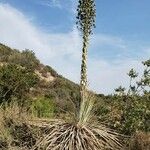
Hesperoyucca whipplei
Our Lord's-candle · Quixote yucca · Chaparral yucca
Description
Source: leafsnapHesperoyucca whipplei, commonly known as the chaparral yucca or Our Lord's candle, is a yucca species native to the southwestern United States and northern Mexico. This slow-growing perennial plant can reach heights of up to 10 feet and widths of up to 6 feet. It features a single trunk with multiple branches growing from the base, forming a dense rosette of stiff, sword-shaped leaves with sharp tips. The gray-green leaves can grow up to 3 feet long and 2 inches wide. From late spring through early summer, the plant produces tall spikes of creamy white flowers, which are fragrant at night and attract moths for pollination. Hesperoyucca whipplei is well-adapted to hot, dry climates with well-draining soil. It is commonly found on rocky slopes or in chaparral habitats at elevations ranging from sea level up to 6,000 feet. Native American tribes have historically used this plant for various purposes, including food (the flower buds were roasted or boiled), fiber (the leaves were used for weaving baskets), medicine (the roots served as antiseptics), and soap-making (the roots contain saponins). Overall, Hesperoyucca whipplei is an intriguing desert-adapted species, known for its striking appearance when it blooms in the spring. This makes it an excellent addition to any xeriscape garden design project!
🌳 For those familiar only with its role in the landscape, the chaparral yucca can be surprising. After its major flowering, the plant’s tall, sturdy flowering stalks—sometimes reaching up to 3 meters—can be turned into strong fibers used for basket-weaving, a practice deeply rooted in Native American traditions. The roots also contain saponins that have long been used as a natural soap and shampoo, once again showing the plant’s versatile uses beyond the obvious.
🎭 Transformation, Safeguarding, Cleansing
Care Guide
💧 Water Every 14 days
The chaparral yucca is well-suited to arid environments, thriving with very little moisture and low humidity. It only needs to be watered about twice a week. Commonly found in rocky desert areas, the chaparral yucca efficiently stores water in its succulent leaves, making it an excellent choice for xeriscaping.
How should I water my Chaparral yucca plant?
When watering your Chaparral yucca, you have a lot of flexibility in choosing the watering tool. Watering cans, hoses, and even cups will all work fine. The key is to apply the water directly to the soil and make sure all areas of the soil are equally moistened to support the root system. Using filtered water is recommended to avoid any harmful particles in tap water. It is also best to use water that is at or slightly above room temperature to avoid shocking the yucca. However, the Chaparral yucca typically responds well to any type of water you provide.
What should I do if I give my Chaparral yucca too much or too little water?
Outdoor plants, especially newly planted ones or seedlings, are often at risk of not getting enough water. It's important to remember to water them consistently for the first few months, while they are still small or recently planted. Once the roots are established, Chaparral yucca plants can usually rely on rainfall. When you have a Chaparral yucca in a pot, overwatering is more likely to occur. If you accidentally overwater your plant, it's important to address the issue promptly. First, stop watering the plant immediately to minimize the impact. Then, remove the yucca from its pot to inspect the roots. If you find no signs of root rot, you can put the plant back in its container. However, if you do see signs of root rot, trim away the affected roots and consider using a fungicide to prevent further damage. Finally, repot the Chaparral yucca in well-draining soil. On the other hand, underwatering a Chaparral yucca is easier to fix. When a plant is underwatered, its leaves may droop, dry out, and fall off. Once you water it sufficiently, the leaves will quickly regain their fullness. Make sure to adjust your watering frequency as soon as you notice underwatering.
How much should I water my Chaparral yucca?
If your area doesn't get much rainfall, you'll need to water your outdoor plants regularly. In spring and fall, watering every 2 weeks should be sufficient, while in summer you'll need to water more often. In winter, you can water less frequently, and sometimes not at all. If you have a young or newly planted Chaparral yucca, you should water it more frequently to help it establish and grow. For potted plants, there are two ways to determine how often to water your Chaparral yucca. One is to set a regular watering schedule, like once a week or every other week. However, this may not work well for your specific growing conditions. The other option is to check the soil moisture. Wait until the top two to four inches of soil have dried out completely before watering again.
How much water does my Chaparral yucca require?
To water your Chaparral yucca effectively, you don't always need a lot of water. If only a few inches of soil have dried since your last watering, give it about five to ten ounces of water each time. You can also gauge the water volume based on soil moisture. Keep track of how many inches of soil have dried out between waterings. To ensure your Chaparral yucca gets enough moisture, water it enough to moisten all the dry soil layers. If over half of the soil is dry, you may need to give more water than usual. Keep adding water until you see excess water draining from the pot's holes. If your Chaparral yucca is in an area that receives enough rainfall, it may not need extra watering. For young or newly planted yuccas, make sure they get 1-2 inches of rain per week. As they grow and establish, they can rely solely on rainwater. If there's a hot spell and no rain for 2-3 weeks, you can give them a full watering to prevent stress.
How do I know if I'm giving enough water to my Chaparral yucca?
The Chaparral yucca is more likely to be overwatered, and there are clear signs to watch for. An overwatered yucca will have yellowing leaves and may lose some. The plant's overall shape may shrink and root rot can occur. On the other hand, an underwatered yucca will wilt and have brown or brittle leaves. Whether you see signs of overwatering or underwatering, take action to restore your yucca's health.
☀️ Light Full sun
The chaparral yucca needs an environment that receives constant sunlight. A plentiful supply of light is essential for its health and successful growth at every stage. Because it comes from regions where the sun is abundant and constant, a lack of sunlight can impede its growth, while an excess does not pose a serious threat to the plant.
How much sunlight does the Chaparral Yucca require?
The Chaparral Yucca needs to be in an environment that is constantly bathed in sunlight, requiring above 6 hours of sunlight daily for optimal health and growth. It is essential for this plant, which comes from areas known for their abundant sunshine, to receive a generous amount of light throughout all stages of growth. An interesting note is to observe the sunlight movement in your garden to ensure spots are chosen that provide a balance of light and shade, fostering plant happiness.
What are the artificial lighting requirements for growing Chaparral Yucca indoors?
For indoor Chaparral Yucca, adequate artificial lighting is key, especially in less sunny spaces or during winter. LED lights, capable of providing specific wavelengths needed by the plant, are recommended. The amount of artificial light required varies by the plant's sunlight needs; full sun plants, like Chaparral Yucca, need 30-50W\/sq ft. The light source should be placed 12-36 inches above the plant to mimic natural sunlight, and plants most commonly need between 8-12 hours of light per day.
What symptoms indicate the Chaparral Yucca isn't getting enough sunlight?
Symptoms of insufficient sunlight in Chaparral Yucca include smaller new leaves, leggy or sparse growth, faster leaf drop, slower or no new growth, lighter-colored new leaves, chlorosis, sunscald, leaf curling, wilting, and leaf scorching. These signs suggest the plant is struggling with the amount of light it's receiving, potentially due to placement in rooms with suboptimal lighting or overexposure to intense sunlight.
How can I address sunlight-related issues with my Chaparral Yucca?
To address sunlight-related issues with Chaparral Yucca, consider these solutions: For indoor plants, gradually move them to sunnier spots to get at least 6 hours of direct sunlight daily, use a south-facing window, or employ artificial light sources like desk or ceiling lamps, or professional plant grow lights for 8+ hours daily. Outdoors, progressively move your plants to sunnier locations each week to avoid sunburn. If trees block sunlight, prune them to improve exposure. For ground plants, transplanting during the dormant period in late winter or early spring to a sunnier location with good drainage can help. Note that parts of the plant affected by insufficient sunlight may not recover, but new growth should be healthy with increased light exposure.
🌡️ Temperature 15–35°C
Chaparral yucca prospers in warm settings and requires elevated temperatures during the growing season to encourage growth and metabolic processes. It favors plenty of sunlight, correct moisture levels, and good air circulation. However, it can be damaged by temperatures that are too low and by excessive watering. Maintaining balance is crucial, avoiding both extreme heat and conditions that are too dry.
What is the Chaparral yucca?
The Chaparral yucca, known botanically as Hesperoyucca whipplei, is a species recognized for its distinctive appearance and ecological role. While this entry does not include detailed descriptions of its essentials or symptoms related to its care or conditions, the Chaparral yucca is noted for its prominence within certain habitats and its unique botanical characteristics.
💨 Humidity
🪴 Soil 6-7
🌱 Fertilizer
Chaparral yucca needs only light fertilizer applications once or twice a year during its growing season. Do not fertilize in winter or summer when the plant is dormant. Cut back on fertilizer for repotted plants and wait a couple of months after repotting before feeding. Fertilizing helps maintain healthy growth and encourages flowering.
Why should I put fertilizer on my Chaparral yucca?
To help your Chaparral yucca thrive, it is important to fertilize it for several reasons. Firstly, fertilizing will promote beautiful blooms. It is especially beneficial to fertilize the yucca in early spring to ensure abundant flowers. Additionally, fertilizer provides the yucca with extra energy that it can store in the ground during its dormant periods. By giving it nutrients during fall planting or late spring, the yucca will have more energy to utilize once it resumes active growth.
When should I fertilize my Chaparral yucca plant?
To effectively fertilize Chaparral yucca, it is important to get the timing right. Using fertilizer too early, when the yucca plant is still dormant, will result in ineffective use of the fertilizer as it will be washed away by rainwater, causing waste and pollution. The best time to start applying fertilizer is in the early spring. It is then recommended to continue fertilizing once a month until early summer.
When is the best time not to fertilize my Chaparral yucca?
To ensure proper blooming, be cautious with the nitrogen levels when fertilizing Chaparral yucca. Opt for a fertilizer that has a lower nitrogen content compared to other nutrients. Avoid fertilizing after early autumn, as this can promote excessive growth before winter. Similarly, refrain from fertilizing during hot and dry periods, as dry soil is not as effective at delivering fertilizer and excessive growth may require more water than is available. It is advisable to apply fertilizer when temperatures are cooler earlier in the season. Lastly, keep in mind that Chaparral yucca can absorb fertilizer from neighboring plants or lawns, so take care to avoid accidentally providing a surplus of fertilizer.
What kind of plant food does my Chaparral yucca require?
For the Chaparral yucca, the ideal fertilizer is one with a balanced mix of plant nutrients, but slightly more phosphorus. Alternatively, you can improve the soil by adding organic materials like compost, worm castings, and manure. Experienced gardeners may use water-soluble fertilizers containing phosphorus when the flower buds appear to improve flower development and size. There are various types of fertilizers that work well for Chaparral yucca, but liquid or powdered forms are often recommended. Regardless of the type, dilute the fertilizer and apply while watering the plant.
How can I feed my Chaparral yucca plant?
To properly fertilize your Chaparral yucca, it is crucial to follow the directions for the specific fertilizer you are using and do some research. Over-fertilizing can be harmful, so determining the correct amount is important. A general guideline is to use the age of the tree (if known) or the diameter of the trunk as a reference. Estimate using one-tenth of a pound of fertilizer per year or per inch of trunk, but no more than one pound. Apply granular or organic fertilizers, like blood meal, by sprinkling them around the tree's base, extending to the drip line. Avoid contact with the trunk. Over time, these granules will break down and be absorbed by the roots. After fertilization, spread a one-inch layer of compost around the base of the tree and water thoroughly.
🪴 Pot & Repot Every 12 months
✂️ Pruning
The chaparral yucca is characterized by a rosette of spiky leaves and tall flower spikes. To promote growth and prevent fungal diseases, it is best to prune the plant in early spring. This involves removing spent flowers and any damaged foliage. Because of the sharp edges of the leaves, it is advisable to wear gloves while pruning. Regular pruning also helps improve the plant's health and structure.
🌿 Propagating
🐛 Diseases & pets
☠️ Toxicity
Characteristics
- Plant Type
- Shrub
- Life Cycle
- Perennial
- Genus
- Hesperoyucca
- Family
- Asparagaceae
- Hardiness Zone
- 8
- Mature Height
- 3.05 m
- Mature Spread
- 2.13 m
- Leaf Color
- Blue, Green, Silver
- Leaf Type
- Evergreen
- Flower Color
- White, Cream
- Flower Size
- 3.05 cm
- Bloom Time
- Late spring, Early summer, Mid summer
- Planting Time
- Spring, Summer, Winter
- Harvest Time
- Mid summer
- Native Area
- Mexico