Hibiscus trionum
ختمی سه رنگ، · Flower-of-an-hour · Venice-mallow · Bladder ketmia · Flower Of An Hour
Description
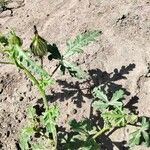
Source: leafsnapHibiscus trionum, commonly known as the flower-of-an-hour, is an annual plant in the Malvaceae family. Native to the Mediterranean, it is now found in many parts of the world. The plant can grow up to 60 cm tall, featuring branching stems adorned with green, velvety-textured, lobed leaves. The flowers of Hibiscus trionum are trumpet-shaped with five petals that are either white or pale yellow, accented by a dark purple center. These flowers bloom for just a few hours before closing, giving the plant its common name, "flower-of-an-hour." The plant produces fruit capsules containing numerous seeds. Often cultivated as an ornamental plant for its striking flowers, Hibiscus trionum thrives in well-drained soil with full sun exposure but can also grow in partial shade. Additionally, it has been used for medicinal purposes, such as treating skin conditions like eczema and psoriasis. Overall, Hibiscus trionum is an intriguing annual plant with unique flowering characteristics, making it a standout choice for gardens or landscapes.
🌳 The flower-of-an-hour plant is loved for its beautiful yet short-lived flowers that attract pollinators. Gardeners are also drawn to this plant because it readily reseeds and is generally hardy. It is an excellent choice for pollinator gardens, mixed flowerbeds, and a variety of container sizes.
🎭 Definitions
Care Guide
💧 Water Every 7 days
Flower-of-an-hour thrives in warm, humid conditions and requires consistent moisture. For optimal soil moisture, water it twice a week. When grown outdoors in full sun, it needs more frequent watering during its active growing season to promote vibrant flowering.
How should I water my Flower-of-an-hour?
You can water Flower-of-an-hour using a garden hose, watering can, or any other common watering tool. This plant is not picky about the type of water it receives - rainwater, tap water, or filtered water can all sustain it. Avoid watering from overhead, as this can damage the leaves and flowers and cause disease. Instead, consider setting up a drip irrigation system, which applies water evenly and directly to the soil. If you have a container-grown Flower-of-an-hour, simply use a cup, watering can, or tap to water it directly into the soil.
What do I do if I give my Flower-of-an-hour too much or too little water?
To prevent underwatering Flower-of-an-hour, simply water it more regularly when you see that it lacks moisture. Overwatering, on the other hand, can be more dangerous. It can lead to diseases that kill the plant. To avoid this, choose a proper location with sunlight and good drainage, so excess water can drain away. If your potted Flower-of-an-hour is overwatered, consider changing it to a new pot with better drainage. Use loose soils and a pot that drains efficiently when repotting.
How frequently should I water my Flower-of-an-hour?
Flower-of-an-hour requires regular watering throughout the growing season. In spring, it is recommended to water the plant once a week. As the season progresses and gets warmer, you may need to water it two to three times per week, but be careful not to exceed this rate as it can harm the plant. Regardless of the watering frequency, make sure the soil remains moderately moist but not overly wet. For potted Flower-of-an-hour, you'll need to water more frequently compared to plants in the ground. Generally, watering a container-grown Flower-of-an-hour a few times per week is necessary, as the soil in pots tends to heat up and dry out faster. In contrast, in-ground plants only need to be watered once a week.
How much water does my Flower-of-an-hour plant need?
Determining how much water to give your Flower-of-an-hour can be done in several ways. Some gardeners rely on feeling the soil for moisture, watering until the top six inches are moist. Others opt to use a specific measurement, typically around two gallons per week depending on temperature and soil dryness, recognizing that this guideline may result in overwatering. Container-grown Flower-of-an-hour requires a different approach. Water should be applied until all dry soil layers are moistened, determined either by feeling the soil with your finger or by observing a slight trickle of excess water from the pot's drainage holes.
How can I know if I'm giving my Flower-of-an-hour enough water?
Avoiding overwatering your Flower-of-an-hour can be a bit challenging. These plants have deep roots, so the soil needs to be moistened weekly. However, Flower-of-an-hour is highly susceptible to root rot, which can cause browning. Underwatering is less likely, as these plants can survive without supplemental watering for some time. However, if you wait too long to water, the plant may wilt and develop dry leaves.
☀️ Light Full sun
The flower-of-an-hour thrives in abundant light, reflecting its native environment which is bathed in plentiful sunlight. Adequate light exposure aids the plant in thriving, leading to robust growth and bright, vivid flowers. While it's able to survive in less sunlit locations, a scarcity of light can inhibit its complete growth and blossom capability, resulting in a dwarfed plant and less remarkable flowers.
What are the sunlight requirements for the Flower-of-an-hour?
The Flower-of-an-hour requires full sun, which means it needs more than 6 hours of direct sunlight daily to thrive best. It can also grow in partial sun, with about 3-6 hours of sunlight. The plant originates from habitats that receive an abundance of sunlight, making generous illumination crucial for its health and vibrant blooms. However, insufficient light can stunt its growth and flowering potential. It's important to observe the sunlight patterns in your garden to ensure you're planting in an area that provides the right balance of light for the plant.
How can artificial lighting be used for Flower-of-an-hour indoors?
For indoor growth, when natural sunlight is insufficient, artificial lighting can be a vital solution to provide the Flower-of-an-hour with the necessary light conditions. LED lights are a popular choice due to their flexibility in providing specific light wavelengths. The amount of artificial light needed varies by plant type: full sun plants require 30-50W/sq ft, partial sun plants need 20-30W/sq ft, and full shade plants need 10-20W/sq ft. The light source should be placed 12-36 inches above the plant, mimicking natural sunlight distance, and the plants generally need 8-12 hours of light per day.
What are some common symptoms of insufficient light in Flower-of-an-hour?
When Flower-of-an-hour does not receive adequate light, it may exhibit several symptoms of light deficiency. These include small new leaves, leggy or sparse growth, faster leaf drop, slower or no new growth, and lighter-colored or chlorotic new leaves. Additionally, excessive sunlight can cause symptoms like sunscald, leaf curling, wilting, leaf scorching, and even chlorosis, indicating the importance of balancing sunlight exposure.
How can you address insufficient or excessive sunlight exposure for Flower-of-an-hour?
To address insufficient sunlight, gradually move plants to sunnier spots, ensuring they receive at least 6 hours of direct sunlight daily, or use artificial light for indoor plants. A south-facing window can provide ample sunlight, and keeping curtains open during the day can also help. For plants suffering from excessive sunlight, it’s crucial to avoid sudden changes in light intensity to prevent sunburn. Outdoor plants can be gradually moved to optimal sunlight spots. If sunlight is blocked by trees or buildings, consider pruning or relocating smaller plants to areas with better sunlight and drainage. Note that parts of the plant damaged by insufficient light might not recover, but new growth will be healthy once proper light conditions are established.
🌡️ Temperature 10–37.8°C
The plant known as Flower-of-an-hour thrives best in a climate where the temperature ranges from 68 to 100 °F (20 to 38 ℃). For the plant's growth to reach its maximum potential, it's highly advisable to keep this temperature consistent throughout the year.
What is the optimal temperature range for the growth of Flower-of-an-hour?
The Flower-of-an-hour, or Hibiscus trionum, thrives best within a temperature range of 68 to 100 °F (20 to 38 °C). Maintaining this temperature range year-round is highly recommended for the plant's optimal growth. Despite its strong cold resistance, in areas where winter temperatures are expected to drop below -25°C, it is crucial to provide cold protection by covering the plant with soil or straw and watering it abundantly before the first freeze, to ensure the soil remains moist and enters a frozen state, helping the plant survive the winter and early spring.
How does cold weather affect Flower-of-an-hour, and what measures should be taken?
Flower-of-an-hour is cold-tolerant and generally thrives when the temperature remains above 20°C. During winter, it is advisable to keep the temperature above 0°C to prevent adverse effects. However, if the temperature falls below -25°C, Flower-of-an-hour may not show immediate damage but could experience a decrease in sprouting or even fail to sprout at all during the springtime. To mitigate this, it's recommended to remove any parts of the plant that have failed to sprout in the spring.
What should be done if Flower-of-an-hour experiences high temperatures?
During summer, it is essential to ensure that the Flower-of-an-hour's temperature does not exceed 38°C. Exposure to temperatures above 43°C could result in lighter leaf color, prone to curling, susceptibility to sunburn, and in severe cases, wilting and drying of the entire plant. To counteract these effects, trim away sunburned and dried-up parts of the plant. Move the plant to a location with shade from the midday and afternoon sun, or use a shade cloth. Additionally, watering the plant in the morning and evening will help keep the soil moist and protect the plant from heat stress.
💨 Humidity
🪴 Soil 6-7
🌱 Fertilizer
The Flower-of-an-hour plant can prosper from regular, mild applications of fertilizer to encourage the development of robust leaves. Roughly every month during the summer period, it's suggested to fertilize Flower-of-an-hour. Nitrogen plays a key role in leaf growth, and providing added nitrogen-intensive sources contributes positively to the flourishing of Flower-of-an-hour.
🪴 Pot & Repot Every 12 months
While transplanting the Flower-of-an-hour, choose a container that's 1-2 inches (2.5–5 cm) wider in diameter, with adequate drainage provision. Opt for a potting mixture that drains well, and think about incorporating perlite to boost drainage further. Carry out the repotting process in the spring or early summer, water it sufficiently, and keep it in a location with partial shade initially.
✂️ Pruning
The flower-of-an-hour plant generally requires minimal pruning, which is best done in early spring. When pruning, keep 2 to 4 buds on each branch and remove any unhealthy wood. To shape the plant, vary the trunk heights and trim the lower branches as needed. After the blooming season in the fall, prune to rejuvenate the older branches by shortening each trunk to 30-46 cm (12-18 inches). After pruning, apply a slow-release fertilizer to support healthy growth.
🌿 Propagating
🐛 Diseases & pets
☠️ Toxicity
Characteristics
- Plant Type
- Herb
- Life Cycle
- Annual, Perennial, Biennial
- Genus
- Hibiscus
- Family
- Malvaceae
- Hardiness Zone
- 6-11
- Mature Height
- 25 cm to 61 cm
- Mature Spread
- 30 cm
- Leaf Color
- Green
- Leaf Type
- Deciduous
- Flower Color
- White, Yellow
- Flower Size
- 2.03 cm to 3.05 cm
- Bloom Time
- Early summer, Mid summer
- Planting Time
- Spring
- Harvest Time
- Mid summer, Late summer
- Native Area
- Burkina Faso, Libya, Lesotho, Egypt, Turkey, India, Djibouti, Angola, Slovakia, Namibia, Madagascar, Montenegro, Pakistan, Eritrea, Slovenia, Morocco, Croatia, Yemen, Kenya, Uganda, Tanzania, Zimbabwe, Uzbekistan, Russia, Niger, Mali, Iraq, Belarus, Mozambique, Oman, Ethiopia, Romania, Botswana, Saudi Arabia, Tajikistan, Tunisia, South Africa, Zambia, Cyprus, Bulgaria, Armenia, Greece, Ukraine, Chad, Serbia, Lebanon, Afghanistan, Syria, Kyrgyzstan, Kazakhstan, Italy, Myanmar, Mongolia, Senegal, Eswatini, Iran, Azerbaijan, Algeria, Hungary, Albania, Turkmenistan