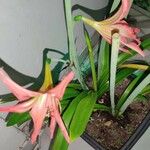
Hippeastrum striatum
Striped Barbados lily · Striped Hippeastrum · Barbados Lily · Striated Hippeastrum
Description
Source: leafsnapHippeastrum striatum, also known as St. Joseph's lily or the orange-striped amaryllis, is a bulbous perennial plant belonging to the Amaryllidaceae family. Native to South America, it can grow up to 60 centimeters tall. This plant features large, showy, trumpet-shaped flowers in shades of orange-red with yellow stripes. The flowers bloom in late winter or early spring and can last for several weeks. Hippeastrum striatum thrives in well-drained soil and partial shade but can also tolerate full sun. It requires regular watering during its growing season but should be allowed to dry out between waterings during its dormant period. Commonly grown as an ornamental plant for its attractive flowers and foliage, Hippeastrum striatum is easy to cultivate both indoors and outdoors, whether in containers or garden beds. This makes it a popular choice among gardeners. Overall, Hippeastrum striatum is a beautiful flowering plant that adds color and vibrancy to any garden with minimal care requirements.
💡 In a Greek legend, a beautiful shepherdess encountered a handsome shepherd in a small village. She fell in love with him at first sight, but initially, the shepherd was unmoved by her affection. Determined to win his heart, the shepherdess cultivated a bouquet of flowers with all her heart and soul. Touched by her dedication, the shepherd's feelings changed, and they fell in love with each other. The bouquet she gave him was of striped Barbados lilies.
🌳 Although the striped Barbados lily is chiefly valued for its decorative uses, it might also act as a bioindicator for certain metals in soil. Metals accumulating in plant tissues can point to increased levels of those elements in the environment, which is relevant for ecological monitoring. Yet using the striped Barbados lily in this role is still little studied and offers scope for future scientific research.
🎭 Wanting to be loved and to seek love
Care Guide
💧 Water Every 7 days
The striped Barbados lily, which originates from moderately moist environments, strikes a balance between needing hydration and tolerating drought. It should be watered every 1-2 weeks, allowing the soil to dry out slightly between waterings. As an indoor ornamental plant, the striped Barbados lily needs consistent moisture during its growing season to ensure vibrant flowering.
When Should I Water My Striped Barbados Lily?
Proper watering of the Striped Barbados Lily is key to its health and flowering. It's time to water when the top 1-2 inches of soil feels dry. Additionally, limp or wrinkly leaves and drooping are signs of needed hydration. Be cautious though; over or under-watering can lead to serious health issues like root rot or dehydration, affecting the plant's growth and ability to flower.
How Should I Water My Striped Barbados Lily?
The Striped Barbados Lily thrives on a consistent moisture level but dislikes over-watering, which can cause root rot. Bottom-watering is a beneficial technique where the plant absorbs water through the pot's drainage holes, reducing the risk of wet foliage. A narrow-spout watering can is recommended for precise watering. Utilizing a moisture meter can provide accurate soil moisture levels, helping to tailor your watering routine. Remember to avoid wetting the foliage to prevent fungal diseases and ensure good drainage to avoid waterlogging.
How Much Water Does Striped Barbados Lily Really Need?
The optimal watering amount for a Striped Barbados Lily varies with factors like pot size and plant size, given its shallow roots. Generally, watering every 7-10 days is sufficient, aiming to keep the soil moist but not waterlogged. Proper hydration is indicated by healthy foliage, sturdy stems, and active flowering, without any signs of pooling water or soil dryness. Preventing both over and under-watering is crucial to avoid root rot or dehydration. Using well-draining soil and pots with drainage holes can also help manage water levels effectively.
What Kind of Water is Best for Striped Barbados Lily?
The Striped Barbados Lily, sensitive to chlorine, flourishes with distilled water for its purity. Rainwater serves as a good alternative, provided it's clean. Filtered water is acceptable if distilled or rainwater isn't available. Tap water is the least preferred due to potential chlorine and chemical content, which can stress the plant. Letting tap water sit for 24 hours can dechlorinate it, making it safer. For best care, water at room temperature to avoid shocking the plant.
How Do Striped Barbados Lily's Watering Needs Change with the Seasons?
Seasons affect the Striped Barbados Lily's watering needs. Spring brings active growth, requiring evenly moist soil, whereas summer's heat demands increased hydration to maintain moist soil. Autumn, preparing for dormancy, calls for reduced watering, ensuring the soil stays slightly moist without being waterlogged. Winter significantly reduces the plant's watering needs due to dormancy. Overwatering during this time can cause root rot, so water sparingly, just enough to prevent complete dryness.
☀️ Light Full sun
The striped Barbados lily grows best in locations with abundant sunlight, though it also does well in spots that receive a moderate amount of sun. Because it comes from environments with similar light conditions, large fluctuations in light can slow its growth or cause leaf scorch.
What are the sunlight requirements for Striped Barbados Lily?
The Striped Barbados Lily, also known as Hippeastrum striatum, requires full sun, which means it thrives in conditions with above 6 hours of sunlight per day. It can also manage well in partial sun, about 3-6 hours of sunlight daily. Observing how sunlight moves through your garden and choosing spots that provide the right balance of light and shade is crucial for the happiness and health of your plants.
What are the essentials for growing Striped Barbados Lily?
The Striped Barbados Lily flourishes in abundant sunlight and can adapt to moderately sunny areas. Originating from such conditions, the plant may exhibit slower growth or suffer from leaf scorching if there's a significant change in light levels. For indoor plants, artificial lighting can be a vital solution when natural sunlight is insufficient, especially in winter or less sunny spaces. Indoor plants typically require specific artificial light conditions, including choosing the right type of light, such as LED, setting the correct distance (12-36 inches above the plant), and ensuring proper duration of light exposure (8-12 hours per day).
What symptoms indicate Striped Barbados Lily is receiving inadequate light?
Symptoms of inadequate light in Striped Barbados Lily include leggy or sparse growth, lighter-colored new leaves, potential impact on flowering and fruiting, chlorosis, sunscald, leaf curling, wilting, and leaf scorching. These symptoms reveal the plant's struggle with the current light conditions, indicating a need for adjustment to ensure better growth and health.
How can I address light-related issues in Striped Barbados Lily?
To address light-related issues in Striped Barbados Lily, consider gradually moving plants to sunnier locations to ensure they receive at least 6 hours of direct sunlight daily. For indoor plants, use south-facing windows for maximum sunlight or artificial lights for at least 8 hours daily. Outdoors, adapt plants to sunlight changes gradually to prevent sunburn. Removing obstructions and transplanting during the dormant period can also improve sunlight access. While parts of the plant damaged by insufficient light may not recover, new growth should be healthy with improved light conditions.
🌡️ Temperature 15–37.8°C
The natural habitat for the striped Barbados lily usually ranges from 59 to 100.4 ℉ (15 to 38 ℃). This plant favors a warm, humid setting with temperatures between 60 and 85 ℉ (15.5 to 29.4 ℃). For seasonal adjustments, during winter it is best to keep the striped Barbados lily at 55 to 65 ℉ (12.8 to 18.3 ℃). In summer it can withstand temperatures as high as 100 ℉ (37.8℃).
What is the native growth environment for Striped Barbados Lily?
The Striped Barbados Lily, or Hippeastrum striatum, thrives in its native growth environment when the temperature is between 59 to 100.4°F (15 to 38°C). It prefers a warm and humid environment, ideally within a temperature range of 60 to 85°F (15.5 to 29.4°C). To adapt to different seasons, it's recommended to maintain a winter temperature of 55 to 65°F (12.8 to 18.3°C), but during summer, it can tolerate temperatures up to 100°F (37.8°C). Striped Barbados Lily has a certain degree of cold tolerance and doesn't require additional measures if the temperatures are above its tolerable minimum. However, if temperatures are expected to drop below this threshold, protective measures like wrapping the plant in plastic film, fabric, or other materials should be taken, and once the temperature rises, these protections should be removed promptly.
How does Striped Barbados Lily react to low temperatures?
Striped Barbados Lily has a moderate tolerance to low temperatures and flourishes best when kept above its suitable growth minimum temperature. During the winter, it should be maintained above its tolerable growing minimum temperature. If the temperature falls below this plant's growth limit, the leaves may begin to droop, and in severe cases, they can wilt and eventually fall off. To manage frost damage, it's advised to trim off the damaged parts and wrap the plant with materials like non-woven fabric or cloth, and construct a wind barrier for protection against cold winds prior to encountering lower temperatures again.
What should be done when Striped Barbados Lily is exposed to high temperatures?
When exposed to high temperatures—specifically, during the summer months—it's critical to keep the Striped Barbados Lily below its suitable growth maximum temperature. Exceeding the tolerable growing maximum temperature can result in lighter leaf colors, dry and withered leaf tips, curling leaves, and increased susceptibility to sunburn. To remedy this, trim away the sunburned and dried-up parts of the plant. It’s also beneficial to move the plant to a shaded location away from the midday and afternoon sun or use shade cloth to create shade. Watering the plant in the morning and evening to keep the soil moist can also help mitigate the effects of high temperatures.
💨 Humidity dry (<40%)
This plant prefers dry conditions, so don't mist it. However, watering it less often can also thrive in higher humidity.
🪴 Soil 6-7
🌱 Fertilizer
The best time to fertilize a Striped Barbados lily is in early spring, as it is coming out of dormancy and starting active growth. Fertilization supplies essential nutrients needed for healthy growth. While the Striped Barbados lily has relatively low fertilizer requirements, feeding it annually can improve its survival and encourage better, longer-lasting blooms.
Why should I put plant food on my Striped barbados lily?
Fertilization is important for the Striped Barbados Lily for various reasons. Primarily, it provides essential nutrients that contribute to the plant's overall growth, both above and below ground. Despite having relatively low fertilization requirements, annual fertilization can greatly benefit the Striped Barbados Lily. It helps ensure the plant's survival and may also result in improved, longer-lasting flowers. Therefore, for those wishing to enhance the appearance of their Striped Barbados Lily, maintaining regular annual fertilization is recommended.
When should I fertilize my Striped Barbados Lily?
The best time to fertilize a Striped barbados lily is late winter to early spring when it is starting to grow again after being dormant. Fertilizing at this time will help promote healthy growth for the season. It is also possible to fertilize during the fall, but it is not recommended during summer or winter.
When is the best time to not fertilize my Striped barbados lily?
To properly care for your Striped Barbados Lily, it's important to know the right time to fertilize. Late winter and early spring are the only suitable times to fertilize this plant. It has low fertilization needs, so one feeding per year is enough. Overfertilizing during spring, summer, and fall can cause issues, unless you didn't fertilize in spring, in which case fall fertilization is allowed. During most of the growing season, it's best to not fertilize. Additionally, fertilizing during the winter is not recommended as the plant goes through a dormant phase and does not produce new growth.
What kind of fertilizer should I use for my Striped barbados lily?
To effectively fertilize a Striped barbados lily, most general-purpose fertilizers with balanced nutrients will suffice. However, some nutrient blends are especially beneficial. Many gardeners believe that higher phosphorus levels enhance root strength and flower quality, making a phosphorus-rich fertilizer a good choice for this flowering plant. Granular or liquid fertilizers are both suitable as long as they have ample nutrients. Alternatively, organic options like compost and manure can also promote a healthy growing medium.
How can I give my Striped barbados lily the right nutrients?
The best way to fertilize a Striped Barbados Lily is by applying granular or pellet fertilizer to the soil surrounding the plant. It's important to remember that the best time to fertilize is when the plant is coming out of its winter dormant phase and entering a period of active growth. In early spring, you should wait until the plant starts sending shoots through the soil before applying fertilizer. Alternatively, some people may choose to use liquid fertilizer instead of granular fertilizer. If you opt for liquid fertilizer, make sure to dilute it with water before applying. Regardless of the type of fertilizer you use, it's always a good idea to moisten the soil before, during, and after applying the fertilizer.
🪴 Pot & Repot Every 12 months
Repot Striped Barbados lily in early spring. Choose a pot that is wider than it is deep and provides good drainage. Use a loamy, well-draining potting mix enriched with compost. Carefully remove old soil from the bulb and plant it at a depth equal to the bulb's height. Water thoroughly after repotting and place the pot in a sunny spot. Avoid overwatering to prevent the bulb from rotting.
✂️ Pruning
The striped Barbados lily boasts stunning flowers and vibrant foliage. To ensure optimal growth, prune dead blooms after flowering and trim any damaged leaves from early to late spring. Regular pruning promotes plant health, prevents disease, and improves light and air circulation.
🌿 Propagating
🐛 Diseases & pets
☠️ Toxicity
Characteristics
- Plant Type
- Herb
- Life Cycle
- Perennial
- Genus
- Hippeastrum
- Family
- Amaryllidaceae
- Hardiness Zone
- 8-11
- Mature Height
- 20 cm to 61 cm
- Mature Spread
- 15 cm to 23 cm
- Leaf Color
- Green
- Leaf Type
- Deciduous
- Flower Color
- Red, Orange, White
- Flower Size
- 15.24 cm to 30.48 cm
- Bloom Time
- Mid spring, Late spring, Early summer
- Planting Time
- Spring
- Harvest Time
- Mid summer
- Native Area
- Brazil