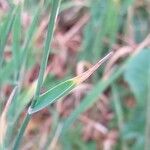
Holcus mollis
German velvet grass · Creeping soft grass · Creeping velvet grass · Creeping-fog · Creeping Softgrass
Description
Source: leafsnapHolcus mollis, known as creeping soft grass or creeping velvet grass, is a species of grass, native to Europe and western Asia.
Care Guide
💧 Water
Creeping velvet grass flourishes in moist environments but is also tolerant to drought conditions. For optimal growth, it should be watered twice a week. As an evergreen grass, it retains its lush appearance throughout the year, even when grown in containers, as long as it receives adequate hydration.
☀️ Light Partial sun
Creeping velvet grass grows naturally in habitats like forest understories and rocky sites, where it is exposed to natural shade. It prefers partial sun but can tolerate full sun or full shade, indicating its adaptable and hardy nature.
🌡️ Temperature 5–35°C
Creeping velvet grass can tolerate a wide range of temperatures, but its distribution may still be limited by particular combinations of moisture and heat. It grows best in warm summer climates with adequate rainfall or irrigation. Long stretches of cloudy, rainy weather or prolonged high temperatures can increase the likelihood of Creeping velvet grass dying. In winter, protecting the plant from cold can improve its survival rate.
💨 Humidity
🪴 Soil 5-6
🌱 Fertilizer
Creeping velvet grass needs extra nutrients to encourage healthy new growth. In spring, placing compost around the base of the plant can effectively supply the nutrition it requires. Fertilizing helps promote vigorous growth and assists the plant in resisting diseases and pests.
🪴 Pot & Repot
✂️ Pruning
Creeping velvet grass has a soft, spreading growth pattern and is easy to care for. It is recommended to prune it in early spring to trim back overgrown stems, encourage new growth, and maintain its shape. Regularly removing old foliage improves air circulation and reduces the risk of disease.
🌿 Propagating
🐛 Diseases & pets
☠️ Toxicity
Characteristics
- Plant Type
- Grass
- Life Cycle
- Perennial
- Genus
- Holcus
- Family
- Poaceae
- Hardiness Zone
- 4-9
- Mature Height
- 30 cm to 91 cm
- Mature Spread
- 20 cm to 49 cm
- Leaf Color
- White, Green
- Leaf Type
- Semi-evergreen
- Flower Color
- Green
- Flower Size
- 0.25 cm to 0.51 cm
- Bloom Time
- Summer
- Planting Time
- Spring, Autumn
- Harvest Time
- Late summer, Early fall, Mid fall
- Native Area
- Austria, Sweden, Slovakia, Montenegro, Croatia, Slovenia, Belarus, Russia, Germany, Estonia, Romania, Latvia, Belgium, Netherlands, France, Portugal, Tunisia, Czech Republic, Bulgaria, Poland, Greece, Ukraine, Serbia, Lithuania, Norway, Italy, Spain, Switzerland, Denmark, Albania, Ireland, United Kingdom, Hungary, Algeria