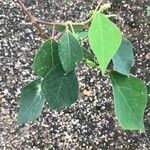
Homalanthus populifolius
Bleeding-heart-tree · Queensland-poplar · Native bleeding heart · Native-poplar · Bleeding-heart tree
Description
Source: leafsnapHomalanthus populifolius, commonly known as the bleeding heart tree or Queensland poplar, is a small to medium-sized tree native to Australia. Belonging to the Euphorbiaceae family, it can reach heights of up to 10 meters. Its leaves are large and resemble those of a poplar tree, hence its common name. The tree is called the bleeding heart tree due to the red sap that oozes from any cut or wound on its bark or leaves. This sap has been utilized by indigenous Australians for medicinal purposes for centuries. During spring and summer, the plant produces clusters of small greenish-yellow flowers, which are followed by small capsules containing seeds. These seeds are dispersed by wind and can readily germinate in moist soil. Homalanthus populifolius is commonly found along riverbanks, in rainforests, and in wet sclerophyll forests throughout eastern Australia. While it prefers well-drained soils rich in organic matter, it can tolerate a variety of soil types. Although it is often used as an ornamental species due to its attractive foliage, it should be handled with care. The sap of this plant is toxic and can cause skin irritation if it comes into contact with the skin or eyes. Overall, Homalanthus populifolius is a fascinating species that adds beauty and uniqueness wherever it grows. It also holds cultural significance for indigenous Australians because of their traditional use of its red sap for medicinal purposes.
Care Guide
💧 Water Every 7 days
Native to the understories of tropical forests, the bleeding heart tree thrives in environments with high humidity and consistent moisture. While it can endure short periods of dryness, it prefers soil that remains consistently moist, needing watering every 2-3 weeks. When grown outdoors, the tree flourishes in regions with frequent rain and humid air, which positively influences its growth cycles.
How should I water my Bleeding heart tree?
To water your Bleeding heart tree, you have flexibility in choosing your watering tool. Whether it's a watering can, hose, or even a cup, any common tool will do the job. When watering, it is important to directly apply the water to the soil. Make sure to evenly moisten all areas of the soil to ensure all parts of the root system receive enough water. If possible, use filtered water as tap water may contain harmful particles. Additionally, it is best to use water that is at or slightly above room temperature to prevent any shock to the tree. However, the Bleeding heart tree generally responds well to any type of water.
What should I do if I give too much or too little water to my Bleeding heart tree?
Outdoor plants, especially newly planted ones or seedlings, are often at risk of not getting enough water. It is important to consistently water them for a few months until they establish their roots and can rely on rain. When your Bleeding heart tree is in a pot, be careful not to overwater it. If you do accidentally overwater, there are steps to remedy the situation. First, stop watering the plant to minimize the effect. Then, inspect the roots by taking the tree out of the pot. If there is no root rot, you can put the tree back in its container. But if there is root rot, trim the affected roots and apply fungicide to prevent further damage. Finally, repot the tree in well-draining soil. On the other hand, underwatering is also a common issue, but it can be easily fixed by watering the plant more frequently. If you notice drooping, dry leaves, and leaf loss, water the plant and correct your watering frequency.
How often do I need to water my Bleeding heart tree?
To ensure your outdoor plants grow well, natural rainfall is usually sufficient. However, if your area lacks rain, you should water them adequately every 2 weeks in the spring and fall. In the summer, more frequent watering is necessary, while in the slower-growing winter months, less water is needed. Young or newly planted Bleeding heart trees require more frequent watering to help them establish and grow. For potted plants, there are two main approaches to determine watering frequency for your Bleeding heart tree. Setting a predetermined schedule of watering once a week or once every other week can be used, but it may not consider the specific conditions of your tree's environment. Another option is to assess the soil moisture and water when the top two to four inches of soil have completely dried out, which is usually about one-third to one-half the depth of the pots. This method is especially important during the high water needs of summer.
How much water does my Bleeding heart tree require?
When watering your Bleeding heart tree, keep in mind that it doesn't always require a lot of water. If only a few inches of soil have dried since the last watering, giving the tree about five to ten ounces of water each time will support healthy growth. You can also adjust the water volume based on soil moisture. Take note of how many inches of soil have dried out between waterings. To ensure the tree receives adequate moisture, water enough to moisten all the dry soil layers since the last watering. If over half of the soil has dried out, consider giving more water than usual. In such cases, continue adding water until excess water drains from the pot's drainage holes. If the Bleeding heart tree is situated in a rainy outdoor area, it may not require additional watering. When the tree is young or establishing, provide 1-2 inches of rain per week. As the tree grows and becomes established, it can rely solely on rainwater, except during hot weather with no rainfall for 2-3 weeks. In such cases, give the tree a full watering to prevent stress.
How do I know if I'm giving enough water to my Bleeding heart tree?
The Bleeding heart tree is most commonly affected by overwatering, and there are clear signs to watch out for. If your tree is overwatered, you may see yellowing leaves and even leaf loss. Overwatering can also cause the plant's structure to shrink and lead to root rot. On the other hand, an underwatered tree will also start to wilt and may have brown or brittle leaves. Regardless of whether you observe signs of overwatering or underwatering, it is important to take action and restore your Bleeding heart tree's health.
☀️ Light Partial sun
The bleeding heart tree tree grows best with a balance of sun and shade. It thrives beneath the canopy of taller trees where the light is filtered. Adaptable, it can also tolerate completely shaded conditions. Too much light may stress the plant, while too little can limit its growth.
How many hours of sunlight does the Bleeding heart tree need every day?
The Bleeding heart tree thrives in well-lit indoor spaces, so it's important to place it in a sunny area throughout the day. Remember, the amount of daylight available naturally changes with the season, but a general guideline is to provide at least 6 hours of light per day, which can include 3-6 hours of direct sunlight. While the tree can handle many hours of indirect sunlight without harm, be cautious of exposing it directly to the sun.
What kind of sunlight does the Bleeding heart tree need?
In the wild, bleeding heart trees receive ample sunlight all day long. However, this light is somewhat filtered and indirect as it passes through the leafy canopy of tall trees. When growing a bleeding heart tree indoors, it's important to provide it with bright indirect light either by placing it on a sunny windowsill or using grow lights.
Should the Bleeding heart tree be kept away from the sun?
The bleeding heart tree doesn't have to completely avoid the sun, but it should have the right kind of sunlight. It shouldn't get more than 6 hours of direct sunlight each day. Direct sun means the sunlight is hitting the plant directly. Indirect light could be reflected off nearby objects or filtered through something like a sheer curtain. So, it's important to protect the bleeding heart tree from too much direct sun exposure.
How can I keep the Bleeding heart tree safe from sun and heat harm?
If Bleeding heart trees are not used to direct sunlight, it can harm them. To shield your Bleeding heart tree from bright sunlight, there are a few strategies. Firstly, pick a spot that receives indirect light for most of the day. If the location is still too bright, you can move the plant deeper into the room, away from the window. Another option is to cover the window with a light curtain or blinds. Any of these methods will safeguard your Bleeding heart tree from sun scorching and excessive heat.
If the Bleeding heart tree gets too much sunlight, what will happen to it?
Direct sunlight can be harmful to the plant's leaves, especially the upper leaves that receive the most sun. When leaves get scorched, they develop brown and dry spots. Entire leaves may also wilt and turn brown. Growing the plant in full sun can lead to the soil drying out too quickly. In extreme situations, excessive sun exposure can even result in the plant dying.
🌡️ Temperature 20–37.8°C
The bleeding heart tree originates from areas where temperatures fall between 68 and 100 °F (20 and 38 °C). It favors a moderate to high heat level for optimal growth. Adjust its environment to maintain that temperature range, particularly during cooler seasons.
What temperature is best for a Bleeding heart tree?
To help your tropical plants thrive, it's best to maintain a temperature range of 75℉ to 90℉ (25-32℃). While different species can tolerate temperatures outside this range, sticking within a few degrees of these limits will ensure optimal growth. However, there are extreme temperature limits to be aware of. Anything below 50℉ (10℃) or above 95℉ (35℃) can hinder growth and cause issues with the leaves and stems. Low temperatures are particularly damaging, as even a light frost can lead to the death of your tropical plants. In fact, cellular death can occur rapidly, with some species dying within 12 to 24 hours.
Does the Bleeding heart tree need different temperatures for different stages of growth?
The Bleeding heart tree can transition between growing phases without needing changes in temperature, but it's important to maintain consistency. Any wild temperature fluctuations can slow down its growth, so it's best to keep the tree in a controlled environment. The optimal temperature range for the tree is between 75℉ and 90℉ (25-32℃), with staying above the lower limit being crucial. While temperatures exceeding 90℉ (32℃) aren't ideal, the tropical plant can tolerate them reasonably well. However, temperatures below 50℉ (10℃) (especially 40℉/5℃) will start to cause direct damage to this heat-loving plant species.
Does the Bleeding heart tree require different temperatures during different seasons?
The bleeding heart tree does not require different temperatures for different growing seasons. The key to seasonal care is to maintain optimal temperature levels. It is therefore recommended to keep this plant indoors, as it allows you to regulate the temperature regardless of the climate outside. In addition, light is important for tropical species, including these plants. They prefer a partial side level of sun exposure, meaning the light they receive should be dappled or filtered. Bright but indirect light is the best option when growing these plants indoors. Excessive direct sunlight can harm the leaves and hinder their growth.
What temperatures should you keep your Bleeding heart tree within to keep it healthy?
Here are three tips to help you take care of your plants: 1. Keep your plants away from windows during colder months: Cold air can leak into your home through cracks in the windows, and any plants placed near them will be affected. Move tropical plants to an area with bright but indirect light, while avoiding potential drafts. 2. Watch out for dry patches, which may indicate too much sunlight or heat: If you notice white or scorched leaves, your plant may be getting too much heat or sunlight. This can lead to dehydration and hinder growth. Dry spots can spread and eventually cause your plants to die if left unaddressed. 3. Be cautious of frost: Colder temperatures and frost can damage plants by disrupting their water circulation. This can lead to a lack of moisture in the stems and leaves. Look out for signs of hydrosis (a water-soaked appearance) and if the issue persists, the plant may shrivel and turn dark brown or black, eventually leading to death.
How can I keep my Bleeding heart tree at the perfect temperature?
To maintain the optimal temperature for the Bleeding heart tree, it is important to consider both the climate and humidity. If possible, place each species in a room with climate control to mimic its natural habitat. Monitoring and adjusting the humidity levels is also crucial as it affects the temperature. You can increase humidity by using a humidifier or lightly misting the leaves. If you plan to grow the tree outdoors, it can be challenging to maintain the right balance of temperature and humidity. In such cases, it is recommended to bring the plant inside your home where you can have better control over the climate. This will help the tree thrive and reach its full potential.
💨 Humidity
🪴 Soil 6-7
🌱 Fertilizer
The ideal time to fertilize a Bleeding heart tree is in early spring, when it breaks dormancy. This encourages overall growth and the development of flowers. Fertilizing improves the foliage, stems, and branches, and helps produce large, vibrant, long-lasting blooms. It assists in moving nutrients from the roots to the flowers and enhances the plant's health and resistance to disease.
🪴 Pot & Repot
✂️ Pruning
Prune the bleeding heart tree from early to late winter to shape its growth and remove dead or crossing branches. This practice promotes air circulation and improves the tree's health. Pruning during the tree's dormant phase reduces stress and encourages vigorous regrowth in spring, enhancing overall health, controlling size, and improving aesthetic appeal.
🌿 Propagating
🐛 Diseases & pets
☠️ Toxicity
Characteristics
- Plant Type
- Tree, Shrub
- Life Cycle
- Perennial
- Genus
- Homalanthus
- Family
- Euphorbiaceae
- Hardiness Zone
- 10-12
- Mature Height
- 7.92 m
- Mature Spread
- 15 cm
- Leaf Color
- Light Green, Medium Sea Green
- Leaf Type
- Evergreen
- Flower Color
- Red, Green
- Flower Size
- 0.25 cm to 0.51 cm
- Bloom Time
- Spring, Summer
- Planting Time
- Spring, Summer, Autumn, Winter
- Harvest Time
- Late spring, Summer, Early fall, Mid fall