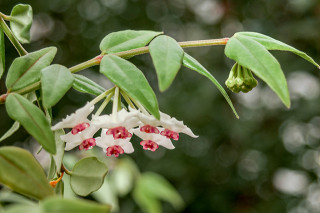
Hoya bella
Description
Source: leafsnapBeautiful Hoya commonly called 'wax flowers' is an herbaceous succulent plant, native to tropical regions of Asia and Australia. They are well known for their beautiful foliage and scented flowers, and gardeners are believed to love this plant because of its low maintenance. The Hoya grows to an average height of 12-20 ft, and their flowering season usually occurs between spring and autumn. They possess star-shaped, glossy wax-like flowers which form clusters and they come in a variety of colours that includes yellow, orange, pink, burgundy, white, and near black. Each individual flower grows to a size of about 1.5cm.
Care Guide
💧 Water Once a week
☀️ Light Partial sun
The wax plant originates from habitats like forest understories and rocky areas, where it grows under natural shade. It prefers partial sun but can adjust to full sun or full shade, showing a hardy, adaptable nature.
🌡️ Temperature 20–37.8°C
The wax plant comes from tropical areas where the climate is generally warm and humid. Consequently, it is adapted to high temperatures and moisture. It does not tolerate sudden temperature changes and prefers a steady thermal environment, so indoor temperature fluctuations should be avoided. It usually cannot endure cold and needs higher temperatures to grow. If the surrounding temperature falls too low, the plant may stop growing or even die.
💨 Humidity
🪴 Soil 6-7
🌱 Fertilizer
The best time to fertilize a Wax plant is in early spring as it comes out of dormancy. This encourages overall growth and supports flower development. Fertilizing improves foliage, stems, and branches, and promotes large, vibrant, long-lasting flowers. It also helps move nutrients from the roots to the flowers and enhances the plant's health and resistance to disease.
🪴 Pot & Repot 2-3 years
Repot the wax plant in early spring, selecting a container only slightly larger than the current pot that has proper drainage. Use a well-draining potting mix and position the root ball at the same level it was before. Gently loosen any roots that are root-bound. After repotting, water thoroughly and keep the plant in a warm, shady spot. Regular pruning will help control its size and encourage new growth.
✂️ Pruning
Hoyas do not need frequent pruning because they look great even when their growth is consistent and unwavering. However, a trim is necessary when the wax flowers spread too much. Once you notice excessive overspreading, use sharp scissors to cut the damaged stems and leaves a little above the axil. Also ensure to not cut the flower stalks along with the flowers because their presence ensures formation of new foliage.
🌿 Propagating
🐛 Diseases & pets
☠️ Toxicity
Beautiful Hoya are considered non-toxic to humans and animals, making it an excellent houseplant that is safe for humans and pets. However, the plant excretes a milky sap that may mildly irritate the skin of sensitive persons and cause redness or rashes, but this will not cause any complications in anyone who comes in near, direct contact with it.
Characteristics
- Plant Type
- Vine
- Life Cycle
- Perennial
- Genus
- Hoya
- Family
- Apocynaceae
- Hardiness Zone
- 10-12
- Mature Height
- 20 cm
- Mature Spread
- 49 cm
- Leaf Color
- Dark Green
- Leaf Type
- Evergreen
- Flower Color
- White, Pink
- Flower Size
- 1.02 cm to 1.52 cm
- Bloom Time
- Summer, Early fall, Mid fall
- Planting Time
- Summer, Autumn
- Harvest Time
- Late summer, Fall, Early winter
- Native Area
- Nepal, Philippines, Myanmar, India