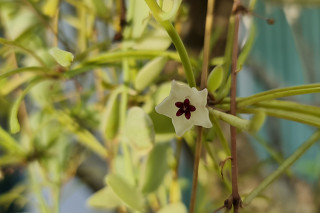
Hoya retusa
Grass-leafed hoya
Description
Source: leafsnapThe growers admire this plant because it is so beautiful. It is an evergreen flowering plant that has long, slender stems that resemble vines. The star-shaped, creamy, and pink flowers on the plant make it more beautiful. It gives a fresh element to your landscape and has a perfume that is similar to lemon. Native to India, the Hoya retusa plant is not sensitive to sunlight or temperature changes. To ensure that it blooms perfectly, you must take care of these major changes.
Care Guide
💧 Water 1-2 times a week
☀️ Light Partial sun
The grass-leafed hoya is native to habitats such as forest understories and rocky areas, where it grows in natural shade. It prefers partial sun but can adjust to full sun or full shade, showing its adaptable and hardy nature.
🌡️ Temperature 20–37.8°C
Grass leafed hoya comes from tropical regions, where the climate is generally warm and humid. Consequently, it is well suited to high temperatures and humidity. It does not tolerate sudden shifts in temperature and prefers a steady thermal environment, so avoiding indoor temperature fluctuations is important. It typically cannot endure cold temperatures and needs warmer conditions to grow. If the ambient temperature becomes too low, the plant may stop growing or even die.
💨 Humidity normal (40-60%)
This plant will thrive in moderate humidity, which is probably the level in your home. However, misting it a few times a week can be very beneficial. Make sure the room has good ventilation.
🪴 Soil 5-6
🌱 Fertilizer
Correct fertilization is vital for Grass leafed hoya's health and appearance. Fertilize the Grass leafed hoya during summer, applying fertilizer monthly throughout the season. Nutrients provide the fuel for growth and help sustain the plant's parts. Fertilizing improves the Grass leafed hoya's floral display, ensuring the best blooms.
🪴 Pot & Repot 2-3 years
Repot the grass-leafed Hoya in early spring, selecting a pot only slightly larger than the current one with good drainage. Use a well-draining potting mix and make sure the root ball sits at the same level as before. Gently loosen any root-bound roots. After repotting, water thoroughly and place the plant in a warm, shady spot. Regular pruning helps keep the plant’s size in check and encourages new growth.
✂️ Pruning
Hoya can get big and unmanageable, so it's okay to prune them if you need to. Cut back any brown, dead stems if necessary. Furthermore, if your stems are strong, you can either leave them alone to grow, wind them around a trellis or just cut them down to a node.
🌿 Propagating
🐛 Diseases & pets
☠️ Toxicity
Inside the plant is the usual Hoya milky latex. This has a poisonous nature. Severe allergic reactions can occur when skin-to-skin contact occurs. Additionally, swallowing can be quite harmful to both humans and animals. As a result, keep the plant away from children and pets at all times.
Characteristics
- Plant Type
- Vine, Herb
- Life Cycle
- Perennial
- Hardiness Zone
- 10-11
- Mature Height
- 0 cm to 6 cm
- Mature Spread
- 49 cm
- Leaf Color
- Green
- Leaf Type
- Evergreen
- Flower Color
- White
- Flower Size
- 1.02 cm to 1.52 cm
- Bloom Time
- Summer, Early fall, Mid fall
- Planting Time
- Spring, Summer
- Harvest Time
- Fall
- Native Area
- Indonesia, India