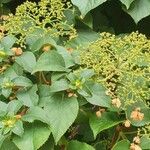
Hydrangea petiolaris
Japanese climbing hydrangea · Climbing hydrangea · Panicled hydrangea · Hydrangea
Description
Source: leafsnapHydrangea petiolaris, a climbing hydrangea (syn: Hydrangea anomala subsp. petiolaris), is a species of flowering plant in the family Hydrangeaceae native to the woodlands of Japan, the Korean peninsula, and on Sakhalin island of easternmost Siberia in the Russian Far East.Hydrangea petiolaris is sometimes treated as a subspecies of the closely related Hydrangea anomala from China, Myanmar, and the Himalaya, as Hydrangea anomala subsp. petiolaris. The Hydrangea anomala species differs in being smaller (to 12 metres (39 ft) ) and having flower corymbs up to 15 cm diameter. The common name Climbing hydrangea is applied to both species, or to species and subspecies.
🌳 Besides enhancing garden areas with its lush foliage and striking flowers, climbing hydrangea also serves an often-overlooked role as a host for pollinators. Although not widely used, its vigor and adaptability make it a candidate for study in horticultural breeding programs. Furthermore, because it can grow on a variety of surfaces without causing damage, it is well suited to living walls and urban green designs, which are vital for anti-pollution efforts in city landscapes.
Care Guide
💧 Water
☀️ Light Partial sun
Climbing hydrangea prefers filtered light and can tolerate complete shade as well as very bright conditions, making it adaptable to a variety of light situations. While it can endure intense light, excessive exposure may sometimes cause leaf scorching. Insufficient light can slow its growth. Native to habitats with variable sunlight, the plant can adjust to seasonal shifts.
🌡️ Temperature 5–32.2°C
Climbing hydrangea shows strong adaptability to a variety of climate conditions, from blazing summers to frigid winters. However, it does have an ideal temperature range for growth. If temperatures become too high, the plant is susceptible to heat and humidity stress, which can lead to its death. In areas where temperatures near the lower limit of its cold tolerance, it is important to use insulation to protect the plant.
💨 Humidity normal (40-60%)
This plant will thrive in moderate humidity, which is probably the level in your home. However, misting it a few times a week can be very beneficial. Make sure the room has good ventilation.
🪴 Soil 5-6
🌱 Fertilizer
It is essential to time the fertilization of Climbing hydrangea properly. You should fertilize it at the beginning of spring and continue on a monthly basis until the early part of the summer. Fertilizer is beneficial in creating beautiful flowers and supplying energy during both inactive and active growth stages.
🪴 Pot & Repot
✂️ Pruning
🌿 Propagating
🐛 Diseases & pets
☠️ Toxicity
Characteristics
- Plant Type
- Shrub
- Life Cycle
- Perennial
- Genus
- Hydrangea
- Family
- Hydrangeaceae
- Hardiness Zone
- 4-9
- Mature Height
- 14.94 m
- Mature Spread
- 4.88 m
- Leaf Color
- Green
- Leaf Type
- Deciduous
- Flower Color
- White
- Flower Size
- 15.24 cm to 25.40 cm
- Bloom Time
- Early summer, Mid summer
- Planting Time
- Spring, Autumn
- Harvest Time
- Mid summer
- Native Area
- Russia, Japan, South Korea