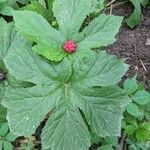
Hydrastis canadensis
Goldenseal · Orangeroot · Yellow-puccoon · Yellow Root
Description
Source: leafsnapFor the magazine from West Virginia see Goldenseal (magazine) Goldenseal (Hydrastis canadensis), also called orangeroot or yellow puccoon, is a perennial herb in the buttercup family Ranunculaceae, native to North America. It may be distinguished by its thick, yellow knotted rootstock. The stem is purplish and hairy above ground and yellow below ground where it connects to the yellow rhizome. Goldenseal reproduces both clonally through the rhizome and sexually, with clonal division more frequent than asexual reproduction. It takes between 4 and 5 years for a plant to reach sexual maturity, i.e. the point at which it produces flowers. Plants in the first stage, when the seed erupts and cotyledons emerge, can remain in this state one or more years. The second vegetative stage occurs during years two and three (and sometimes longer) and is characterized by the development of a single leaf and absence of a well developed stem. Finally, the third stage is reproductive, at which point flowering and fruiting occurs. This last stage takes between 4 and 5 years to develop.A second species from Japan, previously listed as Hydrastis palmatum, is now usually classified in another genus, as Glaucidium palmatum.
Care Guide
💧 Water
Goldenseal, a plant native to the moist woodland areas of North America, flourishes in soil that remains consistently moist yet drains well. It generally prefers to be watered every 1 to 2 weeks and can tolerate moderate drought conditions. Although typically cultivated outdoors, goldenseal requires care that replicates the moisture levels of its natural habitat.
How should I water my Goldenseal plant?
When watering your Goldenseal plant, it's important to use filtered water that is at room temperature. Tap water may have particles that can harm the plant, so filtering it is recommended. The reason for using room temperature water is that Goldenseal comes from warm environments and cold water can be a shock to its system. Avoid overhead watering as it can lead to problems with the foliage. Instead, simply apply your filtered room temperature water directly to the soil until it is completely soaked. This helps moisten the roots and supports their spread through the soil to gather nutrients.
What should I do if I give my Goldenseal plant too much or too little water?
Overwatering can harm your Goldenseal plant more than underwatering. When you overwater, the stems and leaves may wilt and turn yellow. It can also lead to diseases like root rot, mold, and mildew, which can kill the plant. Underwatering is less common for Goldenseal because it can tolerate drought. However, when it happens, the leaves become brittle and brown. It's important to notice the signs of overwatering early to prevent irreversible damage. Reduce watering immediately if you notice these signs and check the soil drainage. If the soil drains poorly, replace it with a well-draining potting mix. Conversely, if your Goldenseal shows signs of underwatering, simply water it more regularly until the signs disappear.
How often should I give water to my Goldenseal plant?
If your Goldenseal plant is in a pot, the most accurate way to determine if it needs water is by checking the moisture of the soil. Simply insert your finger into the soil and if the top two to three inches feel dry, it's time to water the plant. If you have planted your Goldenseal outdoors in the ground, you can use a similar method to test the soil. Once again, if you find that the first few inches of soil have dried out, it's a sign that it needs water. Normally, during the spring and early fall, you should water this plant about once a week using this method. However, in extremely hot weather, you may need to water it twice or even more frequently per week. It is important to note that mature and well-established Goldenseal plants have an impressive ability to withstand drought.
How much water does my Goldenseal plant need?
To ensure your Goldenseal is properly watered, don't be hesitant with the amount of water you provide. Wait until the top two to three inches of soil are dry, then give the plant a good, thorough watering. Make sure the soil is completely soaked. You'll know you've added enough water when it starts to overflow through the drainage holes at the bottom of the pot. If you don't see any excess water draining out, it means you haven't watered enough. However, be careful not to let water accumulate in the soil, as this can harm the plant. On the other hand, if water isn't draining properly, it could be due to poorly draining soil, which is not good for the plant's health. It's important to avoid this. If the Goldenseal is planted outside, providing 1 inch of rainwater per week should be sufficient.
How should I water my Goldenseal as it grows?
The water needs of Goldenseal can vary depending on its growth stages. In the early years or after transplanting, it requires more water because it focuses on developing new roots to support future growth. These roots perform better with extra moisture. As Goldenseal matures, it requires less water. Another stage that demands more water is the blooming period, as flower development requires a significant amount of moisture.
☀️ Light Partial sun
Preferring a moderate amount of sunlight, goldenseal grows best in partly sunny locations. It can also do well in full shade, which mirrors its native ecosystem. Excessive sun can be harmful, while too little light may restrict its vigorous growth.
What are the sunlight requirements for goldenseal?
Goldenseal thrives in conditions that mirror its natural habitat, requiring partial sun, which equates to about 3-6 hours of sunlight per day. It can also grow well in full shade areas, receiving less than 3 hours of sunlight. Observing the movement of sunlight through your garden to place plants in ideal light conditions is crucial for their growth and health. Inexcessive sunlight exposure may hinder goldenseal's growth or cause damage, hence the importance of finding a perfect balance between light and shade.
What are some essentials to know about goldenseal's growth?
Goldenseal favors ample sunlight but it can prosper in both partially sunny and full shade areas. This adaptability is in line with the ecosystem from which it originates. Despite its flexibility, too much sunlight could potentially harm the plant, while insufficient light may impede its development. When natural light is not enough, especially during winter or in less sunny locations, artificial lighting such as LEDs can be used to fulfill the plant's light requirements. These should be adjusted in terms of type, distance, and duration to suit the plant's needs and promote healthy growth.
What are the symptoms of insufficient or excessive light exposure in goldenseal?
Goldenseal can exhibit several symptoms when the lighting conditions are not optimal. Insufficient light may lead to smaller new leaves, leggy growth, early leaf drop, slower or halted growth, paler new leaves, and chlorosis. On the other hand, excessive light exposure can cause sunscald, leaf curling, wilting, leaf scorching, and a general decline in plant health. Observing these signs early on can help in adjusting the plant's environment to prevent further stress.
How can you optimize goldenseal's growth in terms of lighting?
To optimize goldenseal’s growth with proper lighting, gradually adjust your plant's exposure to sunlight to avoid shock and damage. For indoor plants, gradually move them to sunnier spots each week until they achieve 3-6 hours of direct sunlight daily. If the plant is large or not easily movable, consider using artificial lights, keeping them on for at least 8 hours daily. For outdoor plants, likewise, move them gradually to sunnier spots to prevent sunburn. Prune any obstructions like branches and leaves that block sunlight, and for smaller plants, consider transplanting them during their dormant period to a location with better sun exposure and good drainage.
🌡️ Temperature 0–32.2°C
Goldenseal naturally occurs in environments with temperatures ranging from 32 to 89.6 °F (0 to 32 ℃). Mostly a cool-weather plant, it favors cooler conditions. In hotter climates, shade or other cooler areas must be provided.
What are the ideal environmental conditions for Goldenseal?
Goldenseal (Hydrastis canadensis) thrives in environments where temperatures vary from 32 to 89.6 °F (0 to 32 °C), making it predominantly a cold weather plant. It prefers cooler conditions and is highly cold-tolerant, meaning it does not require additional frost protection during winter. However, in hotter climates, it's essential to provide shade or cooler areas to ensure the plant's health. Before the first freeze in autumn, watering the plant generously is advisable to keep the soil moist, which helps prevent drought and water scarcity during the winter and early spring.
How does low temperature affect Goldenseal, and what should be done?
Goldenseal is extremely tolerant to cold temperatures. However, if winter temperatures drop below a certain threshold -- not specified here but important for plant's vitality -- there might not be immediate noticeable changes, but a significant decrease in sprouting or a complete lack of it might be evident in spring. The recommended solution for such a scenario is to remove any parts of the plant that have failed to sprout in spring, allowing for potentially healthier regrowth.
What should be done if Goldenseal is exposed to high temperatures?
Goldenseal does not tolerate high temperatures well. Exceeding the maximum suitable growth temperature can halt its growth and make the plant more susceptible to rot. To mitigate the effects of high temperatures, it's advised to trim away any sunburned and dried-up parts of the plant. Moving the plant to a shaded location or using a shade cloth to protect it from the midday and afternoon sun can be helpful. Additionally, watering the plant in the morning and evening can maintain necessary soil moisture.
💨 Humidity
🪴 Soil 5-6
🌱 Fertilizer
A single fertilizer application in spring is typically sufficient for Goldenseal, though multiple feedings can maximize growth. Fertilize once every month to a month and a half. Fertilization improves leaf appearance and function, helping maintain consistent color and a healthy texture. It also promotes root development and nutrient absorption for long-term plant health.
Why do I have to add fertilizer to my Goldenseal plant?
Fertilizing your Goldenseal is crucial for both its appearance and function. The leaves of the Goldenseal are a significant part of its structure, and proper fertilization ensures that they retain consistent color and a healthy texture. Additionally, fertilization plays a vital role beneath the soil's surface by promoting the growth of new roots and maintaining the existing ones. This not only keeps the plant healthy in the present but also enhances its ability to absorb soil nutrients in the future.
When should I put fertilizer on my Goldenseal plant?
If you grow Goldenseal outdoors, it will start growing new leaves in early spring, indicating that it's time to fertilize. Typically, one application of fertilizer in the spring is sufficient for Goldenseal to thrive. However, if you want to maximize its growth, you can fertilize multiple times during spring and early summer, about once every month to a month and a half.
When is the best time to not add fertilizer to my Goldenseal?
During late fall and winter, your Goldenseal goes into a dormant phase and stops producing new growth. It's important not to fertilize your Goldenseal during this time. In spring and summer, if you choose to fertilize, gradually decrease the rate as summer approaches because the growth rate of your Goldenseal also slows down. It's never a good idea to fertilize your Goldenseal when the weather is unusually hot or when the soil is extremely dry. Fertilizing in these conditions can stress your Goldenseal and lead to its premature death.
What kind of fertilizer does my Goldenseal plant require?
Choosing the best fertilizer for a Goldenseal is actually quite simple. These plants do well with a general-purpose garden fertilizer that has equal amounts of nitrogen, phosphorus, and potassium. Look for a fertilizer with a 10-10-10 ratio or something similar, as this will be effective. Avoid fertilizers with high nitrogen content if you're not sure. In terms of form, most of the best Goldenseal fertilizers are granular. These are usually slow-release and easy to apply to the soil. Additionally, using an organic soil amendment like compost can be beneficial when feeding your Goldenseal.
How do I make my Goldenseal plant grow better?
To ensure the best growth for your Goldenseal, wait until its first leaves emerge in early spring. Then, apply a granular slow-release fertilizer with a balanced formula to the soil surrounding the plant's base. If desired, you can repeat this process later in the season. When applying fertilizer, remember to target the soil rather than the plant itself. You may need to move some leaves to access the soil above the roots. Additionally, it is recommended to water your Goldenseal before and after feeding it.
🪴 Pot & Repot
✂️ Pruning
Goldenseal, known for its distinctive yellow roots, thrives in shaded, moist forest areas. To promote growth, it is best to prune in early spring. Focus on removing only the damaged parts to improve air circulation and increase the plant's resilience. Minimal pruning during the plant's active growth period can also enhance its medicinal properties and boost root production.
🌿 Propagating
🐛 Diseases & pets
☠️ Toxicity
Characteristics
- Plant Type
- Herb
- Life Cycle
- Perennial
- Genus
- Hydrastis
- Family
- Ranunculaceae
- Hardiness Zone
- 3-7
- Mature Height
- 23 cm to 30 cm
- Mature Spread
- 23 cm to 30 cm
- Leaf Color
- Green
- Leaf Type
- Deciduous
- Flower Color
- White
- Flower Size
- 2.54 cm
- Bloom Time
- Early spring, Mid spring
- Planting Time
- Spring, Autumn
- Harvest Time
- Mid summer, Late summer