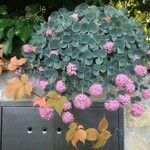
Hylotelephium sieboldii
Siebold's sedum
Description
Source: leafsnapHylotelephium sieboldii (syn. Sedum sieboldii), the October stonecrop, Siebold's stonecrop, Siebold's sedum or October daphne, is a species of flowering plant in the family Crassulaceae, native to Japan. Growing to 10 cm (4 in) high by 20 cm (8 in) wide, this trailing deciduous perennial produces its round glaucous leaves in whorls of 3 around the delicate stems. The hot-pink flowers appear in autumn (fall).The specific epithet sieboldii commemorates Philipp Franz von Siebold, a notable German plant collector of the 19th century.This plant requires some protection from low temperatures in winter, and is often seen in cultivation as a houseplant or in an alpine garden. The cultivar 'Misebaya-nakafu' has variegated green and cream leaves, and has gained the Royal Horticultural Society's Award of Garden Merit.
Care Guide
💧 Water
October daphne thrives in rocky, temperate environments and is known for its high drought tolerance due to its succulent leaves. It only requires watering about every three weeks. Ideal for rock gardens or as ground cover, October daphne provides a low-maintenance beauty for discerning gardeners.
☀️ Light Full sun
The october daphne does best in places that get strong sun for most of the day. It can tolerate areas with less sun, although this may slow its growth. Coming from sunny habitats, its health can suffer if it does not receive enough sunlight or is kept too much in shade.
🌡️ Temperature 5–35°C
October daphne does best in warm conditions and needs higher temperatures during the growing season to support growth and metabolic activity. It prefers plenty of sunlight, suitable moisture levels, and good air circulation. However, it can be damaged by very low temperatures and by overwatering. It's important to keep conditions balanced and to avoid both excessively high heat and overly dry conditions.
💨 Humidity dry (<40%)
This plant prefers dry conditions, so don't mist it. However, watering it less often can also thrive in higher humidity.
🪴 Soil 6-7
🌱 Fertilizer
For October daphne, light applications of fertilizer 1-2 times a year during the growing season are enough. Do not fertilize in winter or summer when the plant is dormant. Cut back on fertilizer for repotted plants and wait a couple of months after repotting before applying any. Fertilizing promotes healthy growth and encourages blooms.
🪴 Pot & Repot Every 2 years
October daphne is a succulent known for its round, blue-green leaves, making it an excellent choice for ground cover. Repot the plant every two years in early spring, choosing a pot that is slightly larger and has drainage holes. After repotting, place the plant in bright light and water sparingly until you notice new growth. This approach ensures optimal recovery and health for the plant.
✂️ Pruning
To maintain the shape of the October daphne, it is important to prune the plant, especially in the spring and autumn. Focus on removing dense or excess branches. For propagation, cut sturdy stems with 5-6 leaves, treat the cut ends with sulfur powder, and plant them once they have healed. Ensure that the soil for the cuttings remains slightly moist throughout this process.
🌿 Propagating
🐛 Diseases & pets
☠️ Toxicity
Characteristics
- Plant Type
- Succulent
- Life Cycle
- Perennial
- Genus
- Hylotelephium
- Family
- Crassulaceae
- Hardiness Zone
- 7-10
- Mature Height
- 5 cm to 25 cm
- Mature Spread
- 5 cm to 30 cm
- Leaf Color
- Green, Blue, Silver
- Leaf Type
- Evergreen
- Flower Color
- Pink
- Flower Size
- 1.02 cm to 1.52 cm
- Bloom Time
- Mid summer, Late summer
- Planting Time
- Spring, Summer, Autumn
- Harvest Time
- Late summer, Early fall
- Native Area
- Japan