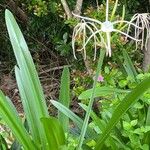
Hymenocallis latifolia
Cayman Islands spider-lily · Broadleaf spider-lily · Chrysolite-lily · Mangrove spider-lily · Perfumed spiderlily
Description
Source: leafsnapHymenocallis latifolia, commonly known as the spider lily or perfumed spider lily, is a perennial bulbous plant belonging to the Amaryllidaceae family. Native to Central and South America, it thrives in wetlands, swamps, and along riverbanks. This plant features long, green leaves that can grow up to 60 cm in length and 5 cm in width. Its flowers are white with a yellow center and have long, thin petals that resemble spider legs. These highly fragrant flowers emit a sweet scent that attracts pollinators such as moths. Hymenocallis latifolia blooms from late spring through the summer months, with each flower lasting several days before wilting. The plant prefers moist soil conditions but is also capable of tolerating periods of drought. In traditional medicine, Hymenocallis latifolia has been used for its medicinal properties to treat conditions such as fever, inflammation, and headaches, among others. Overall, Hymenocallis latifolia is an attractive ornamental plant due to its unique flower shape and sweet fragrance, making it an excellent addition to gardens or indoor spaces where it can be easily grown with proper care.
Care Guide
💧 Water Every 7 days
The perfumed spider lily flourishes in tropical climates and is well-suited to periods of both heavy rain and dryness. While it prefers consistent moisture, it can handle short droughts, so it typically needs watering every 1-2 weeks. Being an evergreen plant, it requires sufficient hydration to sustain its lush foliage, mirroring the humid conditions of its native environment.
☀️ Light Full sun
Perfumed spiderlily is a sun-loving, perennial herbaceous plant that comes from open habitats and is frequently found in meadows and grasslands. It prefers full sun but can also tolerate partial sun conditions.
What are the sunlight requirements for a Perfumed Spiderlily (Hymenocallis latifolia)?
The Perfumed Spiderlily (Hymenocallis latifolia) has specific sunlight requirements to flourish. For partial sun exposure, the plant needs about 3-6 hours of sunlight a day. If you aim for the plant to receive full sun, then it should be exposed to more than 6 hours of sunlight daily. It's important to observe the movement of sunlight through your garden carefully to find the ideal balance of light and shade. This ensures your Perfumed Spiderlily thrives, finding happiness in the perfect spot.
🌡️ Temperature 15–37.8°C
Perfumed spiderlily shows good adaptability to temperature, tolerating high heat and wide temperature fluctuations. In hot weather, it's important to monitor watering and provide appropriate shade to prevent sunburn. However, Perfumed spiderlily has relatively poor cold tolerance. Although it can endure some cold, excessively low temperatures can cause frost damage.
What is the common name of Hymenocallis latifolia?
The common name of Hymenocallis latifolia is Perfumed spiderlily.
💨 Humidity
🪴 Soil 6-7
🌱 Fertilizer
The best time to fertilize a Perfumed spiderlily is in early spring, when it is coming out of dormancy and starting active growth. Fertilizing supplies essential nutrients for healthy development. While the Perfumed spiderlily has relatively low fertilizer requirements, an annual application can improve its survival and encourage better, longer-lasting blooms.
🪴 Pot & Repot
✂️ Pruning
The perfumed spider lily boasts fragrant, spider-like flowers and requires only minimal pruning. To keep the plant healthy and encourage better blooms, perform a light annual pruning in early spring. Use sterilized tools to remove any dead foliage, which helps to prevent disease. This practice improves air circulation, reduces the risk of diseases, and maintains a healthy appearance for the plant.
🌿 Propagating
🐛 Diseases & pets
☠️ Toxicity
Characteristics
- Plant Type
- Herb
- Life Cycle
- Perennial
- Genus
- Hymenocallis
- Family
- Amaryllidaceae
- Hardiness Zone
- 8-11
- Mature Height
- 30 cm to 91 cm
- Mature Spread
- 0.91 m to 1.52 m
- Leaf Color
- Dark Green
- Leaf Type
- Evergreen
- Flower Color
- White
- Flower Size
- 15.24 cm to 20.32 cm
- Bloom Time
- Summer, Early fall
- Planting Time
- Spring, Summer, Autumn
- Harvest Time
- Late summer, Fall
- Native Area
- Bahamas, Cuba, Jamaica