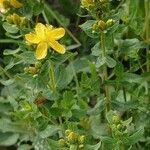
Hypericum maculatum
Imperforate Saint-John's-wort · Spotted St. Johnswort · Imperforate St John's-wort · Imperforate St. John's-Wort · Pojarniță; Sunătoare
Description
Source: leafsnapHypericum maculatum, commonly known as St. John's Wort, is a perennial flowering plant that belongs to the Hypericaceae family. It is native to Europe and Asia but has been introduced and naturalized in North America. The plant grows up to 1 meter tall and has a woody stem with opposite, oval-shaped leaves that are dark green with small black dots on the underside. The flowers are bright yellow, featuring five petals and numerous stamens. Hypericum maculatum is renowned for its medicinal properties, primarily due to the presence of hypericin. For centuries, it has been used as an herbal remedy for depression, anxiety, nerve pain, and various other ailments. Additionally, it possesses anti-inflammatory properties, making it useful in treating skin conditions such as burns and wounds. The plant thrives in moist soil conditions but can tolerate drought once established. It grows well in full sun or partial shade, making it suitable for gardens or naturalized areas. However, caution should be exercised when using Hypericum maculatum medicinally, as it can interact with certain medications such as antidepressants and blood thinners. Using it improperly, without medical supervision, can cause adverse health effects.
🌳 Spotted St. John's wort plays a notable environmental role as a bioindicator of certain pollutants because it is sensitive to changes in soil quality. Also, although not widely recognized, there is interest in its potential pharmacological properties for possible future medicinal use.
Care Guide
💧 Water Every 7 days
Imperforate St. John's Wort naturally grows in damp meadows and clearings, thriving best in moderately moist soil. To ensure proper hydration, it should be watered weekly. As an herbaceous perennial, it requires consistent moisture during the growing season to maximize its flowering potential.
How should I water my Imperforate St. John's wort plant?
To properly water the Imperforate St. John's wort, use filtered water at room temperature or slightly warmer. This is because tap water may contain harmful particles. The plant prefers warm environments, so cold water can be a shock. Avoid overhead watering to prevent foliage issues. Instead, thoroughly soak the soil with filtered room temperature water. This helps moisten the roots and allows them to spread and gather nutrients.
What should I do if I give my Imperforate St. John's wort too much or too little water?
Overwatering is a more common issue than underwatering for the health of your Imperforate St. John's wort. When overwatered, the stems and leaves may wilt and turn yellow, potentially leading to root rot, mold, and mildew. Underwatering is less likely, but can cause brittle and brown leaves. It's important to notice signs of overwatering early. If you see these signs, reduce watering and check the soil drainage. If the soil drains poorly, replace it with a well-draining potting mix. If signs of underwatering are present, simply water more regularly until the signs subside.
How often do I need to water my Imperforate St. John's wort plant?
If your plant is in a pot, the most precise way to check if your Imperforate St. John's wort needs water is by sticking your finger into the soil. If you feel that the top two to three inches of soil are dry, then it's time to water it. If you have your Imperforate St. John's wort planted outdoors in the ground, you can use a similar method to check the soil moisture. Once again, if the top few inches of soil have dried out, it's time to give it some water. Typically, during the spring and early fall, watering once a week is sufficient using this method. However, during extremely hot weather, you may need to increase your watering to twice or more per week. It's worth noting that mature and well-established Imperforate St. John's wort plants can handle drought conditions quite well.
How much water does my Imperforate St. John's wort plant need?
When watering your Imperforate St. John's wort, don't be afraid to give it a generous amount. Make sure the top two to three inches of soil are dry before watering. Give it enough water to thoroughly soak the soil, allowing excess water to drain out of the pot's drainage holes. If you don't see excess water draining, you may not have given enough water. However, be careful not to let water accumulate in the soil, as this can harm the plant. Additionally, if water doesn't drain properly, it could be a sign of poorly draining soil, which is bad for the plant's health. If the plant is outside, one inch of rain per week should be enough.
How do I water my Imperforate St. John's wort as it grows in different stages?
The water needs of the Imperforate St. John's wort can change depending on its growth stages. In the first few years of its life or after transplanting, it requires more water than usual. During these stages, the plant puts a lot of energy into developing new roots, which need extra moisture to support future growth. However, after a few seasons, the plant will need less water. Another stage that requires more water is during the bloom period, as flower development requires significant moisture. So, during this time, it's important to give the plant extra water.
☀️ Light Partial sun
The spotted St. John's wort prefers locations that receive a generous amount of sunlight each day. It can even withstand conditions of continuous sun. Regular sunlight encourages vigorous growth, though too much can cause problems like scorched leaves. Its native habitat also prepared it to handle a substantial degree of solar exposure.
What are the sunlight requirements for Imperforate St. John's Wort?
Imperforate St. John's Wort requires full sunlight for more than 6 hours a day to thrive, mimicking its native open habitat conditions. Partial sunlight, about 3-6 hours a day, is tolerable but may impede its healthy growth. Insufficient light exposure can stunt the plant's development, while too much exposure might scorch its leaves. It's essential to watch how sunlight moves through your garden to ensure the right balance of light and shade for the plant, keeping in mind that its sunlight needs remain consistent throughout different growth stages.
Can I use artificial lighting for Imperforate St. John's Wort?
Yes, artificial lighting can be a vital solution for growing Imperforate St. John's Wort indoors, especially when natural sunlight is insufficient, like in winter or less sunny spaces. LED lights are recommended because they can be customized to provide specific wavelengths needed by the plants. Full sun plants need 30-50W/sq ft of light, partial sun plants require 20-30W/sq ft, and full shade plants need 10-20W/sq ft. The light source should be placed 12-36 inches above the plant, mimicking natural sunlight conditions, and the lights should be on for 8-12 hours per day to promote faster, healthier growth.
What are the symptoms of inadequate lighting for Imperforate St. John's Wort?
Symptoms of inadequate lighting for Imperforate St. John's Wort include smaller new leaves, leggy or sparse growth, faster leaf drop, slower or no new growth, lighter-colored new leaves, chlorosis (yellowing leaves due to lack of chlorophyll), sunscald (damage from too much sun), leaf curling (a defense mechanism to minimize water loss), wilting from loss of turgor pressure, and leaf scorching with brown, dry, crispy edges from excessive sunlight. These signs indicate that the plant isn't getting the right amount of sunlight it needs to flourish.
How can I address lighting issues for my Imperforate St. John's Wort?
To address lighting issues for Imperforate St. John's Wort, for indoor plants, gradually move them to sunnier locations each week to receive at least 6 hours of direct sunlight daily. Use south-facing windows and keep curtains open. For additional lighting, consider using artificial lights like a desk lamp or professional grow lights for at least 8 hours a day if the plant is large or not easily movable. Outdoors, gradually acclimate your plants to sunnier spots to avoid sunburn. If sunlight is obstructed, consider pruning or transplanting to reduce obstructions and provide ample sunlight. Remember, parts of the plant affected by insufficient light may not recover, but new growth will be healthy with better light exposure.
🌡️ Temperature 0–35°C
Spotted St. John's wort comes from temperate regions and does best in a temperature range of 32 to 95 °F (0 to 35 ℃). As seasons change, slowly adjusting the temperature to replicate its native conditions is advised for optimal growth.
What is the native environment of Imperforate St. John's wort?
Imperforate St. John's wort, botanically known as Hypericum maculatum, is native to cool environments where temperatures range between 32 to 70 °F (0 to 21 °C). Its ideal temperature falls within this range, making it a plant that thrives in cooler conditions. To ensure optimal growth, it may be necessary to make seasonal adjustments.
Does Imperforate St. John's wort need frost protection measures?
Imperforate St. John's wort is highly cold-tolerant and does not require additional frost protection measures during winter. However, it is recommended that before the first freeze in autumn, the plant should be watered generously. This is to ensure that the soil remains moist and enters a frozen state, which helps in preventing drought and water scarcity for the plant during the winter and early spring months.
How does Imperforate St. John's wort respond to temperature extremes?
Imperforate St. John's wort exhibits extreme cold tolerance, capable of withstanding temperatures down to -45°C. Below this threshold, although the plant may not show noticeable changes during winter, a decrease in sprouting or even no sprouting may occur in spring. Conversely, the plant is not tolerant of high temperatures. Growth halts and the plant becomes susceptible to rot when temperatures exceed 21°C. For cold damage, the solution is to remove any parts that fail to sprout in the spring. For heat damage, trim away sunburned and dried-up parts, move the plant to a shaded location, or use a shade cloth, especially during midday and afternoon sun. Additionally, watering in the morning and evening helps keep the soil moist.
💨 Humidity
🪴 Soil 6-7
🌱 Fertilizer
The best time to fertilize a Spotted St. John's wort is in early spring, as it’s coming out of dormancy and starting active growth. Fertilization supplies essential nutrients for healthy development. Although Spotted St. John's wort has fairly low fertilizer requirements, an annual application can improve its survival and encourage better, longer-lasting flowers.
🪴 Pot & Repot
✂️ Pruning
Imperforate St. John's wort is a resilient shrub known for its vibrant yellow flowers and pointed leaves. To maintain its health and appearance, prune the plant in early to late spring. Focus on removing dead stems and thinning out overcrowded areas to improve airflow. Cutting the plant back by one-third encourages bushier growth, which enhances flowering and overall plant health. Always use clean tools during pruning to prevent the spread of disease.
🌿 Propagating
🐛 Diseases & pets
☠️ Toxicity
Characteristics
- Plant Type
- Herb
- Life Cycle
- Perennial
- Genus
- Hypericum
- Family
- Hypericaceae
- Hardiness Zone
- 3-10
- Mature Height
- 30 cm to 91 cm
- Mature Spread
- 30 cm
- Leaf Color
- Green
- Leaf Type
- Semi-evergreen
- Flower Color
- Yellow
- Flower Size
- 1.27 cm
- Bloom Time
- Early summer, Mid summer
- Planting Time
- Spring, Summer, Autumn
- Harvest Time
- Mid summer
- Native Area
- Mexico