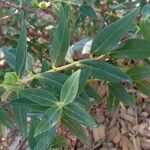
Hypericum patulum
Hypericum · Goldencup St John's-wort · Yellow mosqueta · Goldencup St. John's Wort · St. John's Wort
Description
Source: leafsnapHypericum patulum, commonly known as spreading St. John's wort, is a perennial flowering plant belonging to the Hypericaceae family. Native to East Asia, it can be found in regions of China, Japan, and Korea. The plant typically grows up to 1 meter in height and has a spreading habit with woody, reddish-brown stems. The leaves are opposite, ovate or elliptic in shape, with a glossy dark green upper surface and a paler green underside. From June to August, Hypericum patulum blooms with bright yellow flowers that have five petals each. The plant produces fruit in the form of a capsule, which contains numerous small seeds. Hypericum patulum has been used for centuries in traditional medicine due to its anti-inflammatory properties. It has also been employed as a herbal remedy for depression and anxiety disorders. Aside from its medicinal uses, this plant is commonly grown as an ornamental garden addition, admired for its attractive foliage and bright yellow flowers that add vibrant color during the summer months. Overall, Hypericum patulum is an intriguing perennial flowering shrub that offers both decorative appeal and potential health benefits through traditional medicinal practices.
💡 Goldencup St. John's Wort is a bushy shrub known for its large, vibrant yellow flowers that attract numerous pollinators. In milder climates, it grows as an evergreen, while in more temperate areas, it becomes a deciduous shrub. The flowers of this plant symbolize protection and rebirth. Historically, it was believed to have the power to ward off evil spirits.
🌳 Goldencup St. John's wort is a resilient shrub that brightens up gardens with its vibrant yellow flowers throughout the spring and summer. Its foliage remains evergreen in most climates, although it may shed its leaves to endure frost conditions. This versatile plant is often used in gardens as part of a flowering hedge, as an ornamental specimen, or in planters.
Care Guide
💧 Water Every 7 days
Goldencup St. John's Wort thrives best in well-drained soil with moderate humidity. While it appreciates consistent moisture, it becomes drought-tolerant once established. To maintain proper moisture levels, water it every two weeks. This plant grows excellently outdoors, where it benefits from seasonal rain patterns that align with its natural growth cycles.
How should I water my Goldencup St. John's wort plant?
Watering your Goldencup St. John's wort is not difficult. You can use any common watering tool like a watering can, hose, or cups to moisten the soil. It's important to water directly on the soil and make sure all areas get equal moisture for the root system. Using filtered water is helpful as tap water may have harmful particles. It's best to use water that is at or slightly above room temperature to avoid shocking the plant. However, the plant usually does well with any kind of water it receives.
What should I do if I give too much or too little water to my Goldencup St. John's wort?
Outdoor plants, including newly planted plants and seedlings, are susceptible to lack of watering. It is important to consistently water them for several months while they are small or newly planted. Once the roots are established, Goldencup St. John's wort can rely on rainfall most of the time. However, when planted in pots, overwatering is more likely. If you accidentally overwater your Goldencup St. John's wort, take immediate action to address the issue. Firstly, stop watering the plant to minimize the impact of overwatering. Next, remove the plant from its pot and check the roots for any signs of root rot. If no root rot is found, you can return the plant to its container. However, if root rot is present, trim the affected roots and apply fungicide to prevent further damage. Finally, repot the Goldencup St. John's wort in well-draining soil. On the other hand, if you underwater your Goldencup St. John's wort, the leaves will droop, dry out, and potentially fall off. Simply increase your watering frequency to resolve this issue. Correcting the watering frequency promptly is crucial when underwatering occurs.
How often should I water my Goldencup St. John's wort plant?
Most plants can grow naturally with rainfall, but if your area lacks rainfall, you need to water your plants every 2 weeks in the spring and fall and more frequently in the summer. In the winter, when plants don't need as much water, you should water them less often. You may not need to water them at all during the winter. If you have a young or newly planted Goldencup St. John's wort, you should water it more frequently to help it establish and grow. For potted plants, you can either set a scheduled watering routine, but this may not always work as it doesn't account for unique growing conditions. Alternatively, you can wait until the top two to four inches of soil have dried out before watering.
How much water does my Goldencup St. John's wort plant need?
When watering your Goldencup St. John's wort, remember that it doesn't always require a lot of water. If only a few inches of soil have dried out since the last watering, give it about five to ten ounces of water each time. You can gauge the amount of water needed based on the dryness of the soil. If more than half of the soil has dried out, give it more water until excess water drains from the pot's holes. If the plant is placed in an area with regular rainfall, it might not need additional watering. However, when it's young or establishing, make sure it receives 1-2 inches of rain per week. As it grows, it can rely on rainwater alone, except in hot weather with no rainfall for 2-3 weeks, in which case you should give it a thorough watering to prevent stress.
How do I know if I'm giving enough water to my Goldencup St. John's wort?
Overwatering is a common problem for the Goldencup St. John's wort. There are signs to look for: yellowing leaves, leaf dropping, shriveling plant structure, and potential root rot. On the other hand, an underwatered Goldencup St. John's wort will wilt, have brown or brittle leaves. If you notice signs of overwatering or underwatering, take action to restore your plant's health.
☀️ Light Partial sun
Goldencup St. John's wort is a plant that benefits most from continual sunlight exposure, although it is resilient enough to tolerate the midday sun. Originally, it grew in habitats where it was continually bathed in abundant sun. Too little light can inhibit its growth, while excess light, though bearable, may cause slight stress.
What are the sunlight requirements for Goldencup St. John's wort?
Goldencup St. John's wort requires constant exposure to sunlight to thrive, ideally in full sun conditions with more than 6 hours of direct sunlight daily. However, it can also tolerate partial sun, which is about 3-6 hours of direct sunlight. When planning your garden, be mindful of the different light requirements your plants may have and choose spots that offer the right balance of light and shade. This ensures optimal growth and health of your plants.
How does artificial lighting support indoor growth of plants?
For indoor plants, especially in scenarios where natural sunlight is not sufficient, such as during winter or in less sunny spaces, artificial lighting becomes crucial. It supports optimal growth by providing an essential alternative to sunlight. LED lights are particularly recommended for indoor plants, as they can be tailored to emit specific wavelengths needed by the plants. Full sun plants typically require 30-50W per square foot of artificial light, partial sun plants need 20-30W per square foot, and full shade plants should have 10-20W per square foot. The artificial light source should be placed 12-36 inches above the plant, mimicking natural sunlight conditions as close as possible. Also, maintaining a duration of 8-12 hours of light per day will further ensure healthier plant growth.
What symptoms indicate insufficient light for Goldencup St. John's wort when grown indoors?
When Goldencup St. John's wort does not receive adequate light indoors, a variety of symptoms can manifest signaling this deficiency. One might observe smaller new leaves, leggy or sparse growth, and faster leaf drop as the plant tries to conserve resources. There may also be a halt or significant slowdown in new leaf production, indicating the plant has entered a survival mode. Additionally, new leaves may exhibit lighter colors or irregular patterns, a sign of insufficient chlorophyll. Excessive sunlight exposure, on the other hand, can lead to chlorosis (yellowing of leaves), sunscald, leaf curling, wilting, and leaf scorching, which harm the plant's ability to photosynthesize efficiently and maintain overall health.
What solutions can help optimize plant growth in terms of sunlight?
To optimize plant growth for Goldencup St. John's wort, gradual adaptation to sunlight is key, especially if relocating plants from lower to higher light conditions. For indoor plants, incrementally moving them to sunnier spots within the home or using artificial lights like desk lamps or professional grow lights for at least 8 hours daily can provide sufficient light. Outdoors, plants should be gradually moved to sunnier spots weekly to avoid sunburn. Lesser-known solutions include reducing obstructions that block sunlight, such as pruning nearby tree branches, and transplanting smaller plants during their dormant period to locations with better sunlight and drainage. It's crucial to bear in mind that portions of the plant that suffered from low light might not recover, but new growth following these adjustments should be healthy.
🌡️ Temperature 0–32.2°C
Goldencup St. John's wort naturally occurs in areas where temperatures range from 32 to 90 °F (0 to 32 ℃). It prefers cooler conditions, and its growth can slow when temperatures exceed that range. In winter, protect Goldencup St. John's wort from freezing temperatures.
What is the native temperature range for Goldencup St. John's wort?
Goldencup St. John's wort thrives in environments with a temperature range of 32 to 90 °F (0 to 32 °C), preferring cooler climates for optimal growth. However, it possesses a strong cold resistance, allowing it to withstand temperatures much lower without needing special frost protection measures. To prepare for winter, it is advisable to water the plant abundantly before the first freeze in autumn, ensuring the soil is moist before entering a frozen state. This helps prevent drought and water scarcity for the plant during the colder months.
How should Goldencup St. John's wort be protected during very cold winters?
Although Goldencup St. John's wort typically does not require special frost protection measures due to its strong cold resistance, in instances where winter temperatures are expected to drop below -35°C, it is important to provide additional protection to prevent damage. Wrapping the trunk and branches with non-woven fabric or cloth can offer the necessary insulation against extreme cold. This extra layer helps ensure the plant remains healthy through winter and ready for growth in spring.
What are the effects of low and high temperatures on Goldencup St. John's wort and how can they be mitigated?
Low temperatures above 0°C are generally well-tolerated by Goldencup St. John's wort, but prolonged exposure to temperatures below -35°C can lead to brittleness and dryness in the branches, affecting new shoot emergence in spring. Pruning dead branches is a recommended solution to encourage new growth. Conversely, high temperatures above 32°C can cause the leaves to lighten, tips to become dry and withered, and increase susceptibility to sunburn. To mitigate heat stress, it's advisable to trim sunburned and dried-up parts, provide shade during the hottest parts of the day, and ensure the plant is adequately watered in the morning and evening.
💨 Humidity
🪴 Soil 5-7
🌱 Fertilizer
Timing is crucial for fertilizing Goldencup St. John's wort. Fertilize in early spring and continue monthly through early summer. The fertilizer promotes attractive blooms and supplies energy during both dormant and active growth phases.
Why do I have to give food to my Goldencup St. John's wort?
There are a few important reasons why you should fertilize your Goldencup St. John's wort. Firstly, fertilizer will help your plant produce beautiful blooms. It is recommended to fertilize in early spring for the best results during the blooming season. Additionally, fertilizer provides your plant with energy that it can store in the ground during its dormant phases. This extra nutrients during fall planting or late spring will help your plant store more energy to use when it starts growing again.
When should I fertilize my Goldencup St. John's wort plant?
To ensure effective fertilization of Goldencup St. John's wort, timing is crucial. Applying fertilizer too early when the plant is still dormant would be ineffective, as rainwater would wash it away, resulting in waste and pollution. It is recommended to apply the first round of fertilizer in early spring and continue with monthly applications until early summer.
When is the best time to not fertilize my Goldencup St. John's wort?
To ensure optimal bloom development, it is advisable to avoid using a fertilizer high in nitrogen for Goldencup St. John's wort. Instead, opt for a fertilizer that contains lower nitrogen levels compared to other nutrients. Additionally, refrain from fertilizing this plant after early autumn, as excessive growth before winter can occur. Furthermore, during hot and dry periods, it is not recommended to fertilize Goldencup St. John's wort due to the limited effectiveness of dry soil in delivering fertilizer and the subsequent growth stimulation that requires additional water. It is best to apply fertilizer during cooler temperatures earlier in the season. Lastly, bear in mind that nearby plants or lawns may unintentionally receive the applied fertilizer, potentially resulting in an overdose for the tree or shrub.
What kind of fertilizer should I use for my Goldencup St. John's wort?
To help your Goldencup St. John's wort thrive, it's best to use a fertilizer that contains a balanced mix of the three main plant nutrients, with slightly more phosphorus. Another option is to enhance the soil by adding organic materials like compost, worm castings, and manure. When the flower buds start to appear, experienced gardeners may choose to supplement with water-soluble fertilizers containing phosphorus. This will promote better flower development and result in larger and longer-lasting blooms. Fertilizers come in various forms, but for Goldencup St. John's wort, liquid or powdered fertilizers are recommended. Regardless of the form used, diluting the fertilizer and applying it while watering the plant is essential.
How can I fertilize my Goldencup St. John's wort?
To properly fertilize your Goldencup St. John's wort, it is important to follow the directions for the specific fertilizer type and do some research. Over-fertilizing can harm your plant, so it is crucial to determine the correct amount to use. One way to gauge this is by considering the age of the tree or the diameter of the trunk. Typically, you can estimate using one-tenth of a pound of fertilizer per year or per inch of trunk, with a maximum of one pound. When applying granular fertilizers or organic fertilizers like blood meal, sprinkle the substance around the base of the tree, extending it all the way to the drip line (the area below the farthest-reaching branches). Be careful not to let the fertilizer come into contact with the trunk. Over time, the granules will break down and filter into the soil, where the roots can absorb them. After fertilizing, spread a layer of compost around the base of the tree that is approximately one inch deep, and then remember to water thoroughly.
🪴 Pot & Repot
For Goldencup St. John's wort to thrive in pots, it's essential to provide excellent drainage. This prevents excess water from accumulating, which could otherwise lead to root rot and other problems.
✂️ Pruning
Goldencup St. John's Wort features bright yellow blooms and thrives when pruned in late spring after it has finished blooming. To encourage bushier growth, trim about one-third of the plant. Additionally, remove any dead stems to improve air circulation. Regular pruning not only enhances the plant's appearance but also promotes more abundant flowering in the following season.
🌿 Propagating
🐛 Diseases & pets
☠️ Toxicity
Characteristics
- Plant Type
- Shrub
- Life Cycle
- Perennial
- Genus
- Hypericum
- Family
- Hypericaceae
- Hardiness Zone
- 3-8
- Mature Height
- 0.3 m to 1.52 m
- Mature Spread
- 0.91 m to 1.52 m
- Leaf Color
- Green, Blue
- Leaf Type
- Evergreen, Semi-evergreen, Deciduous
- Flower Color
- Yellow, Gold
- Flower Size
- 2.54 cm to 4.06 cm
- Bloom Time
- Early summer, Mid summer
- Planting Time
- Spring, Autumn
- Harvest Time
- Mid summer
- Native Area
- Indonesia, Vietnam, Myanmar, Thailand, China