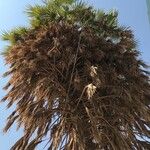
Hyphaene coriacea
Doum palm · Lala Palm · Real fan palm · Southern ilala palm · Ilala Palm
Description
Source: leafsnapHyphaene coriacea, commonly known as the Doum palm, is a palm tree species native to the African continent. This slow-growing tree can reach heights of up to 20 meters and is characterized by its thick trunk covered in rough bark. The Doum palm's leaves are large and fan-shaped, with long petioles that can extend up to 2 meters. The fruit of Hyphaene coriacea is oval-shaped and approximately 10 cm long. It has a hard outer shell that encases fibrous pulp, which surrounds one or two seeds. Indigenous people have used the fruit for centuries for both its medicinal properties and as a food source. The Doum palm thrives in hot and dry climates with well-drained soil, making it suitable for arid regions such as deserts or savannas. Additionally, its deep root system helps stabilize sand dunes, playing a crucial role in the ecosystem. Beyond its practical uses, Hyphaene coriacea holds cultural significance for many African communities, who incorporate it into traditional ceremonies and rituals. Its unique appearance and resilience make it a fascinating addition to landscape design projects and botanical garden displays.
Care Guide
💧 Water Every 7 days
The ilala palm is well-suited to semi-arid environments and is highly drought-tolerant. It only needs to be watered every two weeks. This palm thrives when planted outdoors in well-draining soil that mimics its natural sandy habitat. It efficiently stores water, enabling it to survive with minimal rainfall.
How should I water my Ilala palm tree?
Your Ilala palm is not particular about how you water it. You can use various tools like watering cans, hoses, or cups to moisten the soil. It is important to apply the water directly to the soil, ensuring that all areas are evenly moistened to provide adequate hydration to the entire root system. Filtered water is recommended to avoid any harmful particles present in tap water. Additionally, using water at or slightly above room temperature is beneficial as extremely cold or hot water may shock the Ilala palm. However, the Ilala palm generally responds well to any type of water provided.
What should I do if I give too much or too little water to my Ilala palm?
When it comes to outdoor plants, particularly newly planted ones or seedlings, it's common for them to not get enough water. It's important to consistently water them for a few months, especially while they're small or recently planted. This is because once the roots are established, Ilala palm can usually rely on rain. On the other hand, overwatering is more likely when the Ilala palm is in a pot. If you accidentally overwater your plant, it's important to act quickly. Stop watering it immediately to minimize the damage. Then, inspect the roots by taking the plant out of its pot. If there's no root rot, you can put it back in the pot. But if there are signs of root rot, trim affected roots and use a fungicide to prevent further damage. Finally, repot the Ilala palm in well-draining soil. In the case of underwatering, simply increase the frequency of watering. It's usually easy to fix underwatering as the leaves will droop and dry out, but they will bounce back after being watered properly. So, make sure to adjust your watering schedule as soon as you notice the symptoms of underwatering.
How often should I give water to my Ilala palm plant?
Most outdoor plants can rely on rainfall for normal growth. However, if your area doesn't have enough rain, you should consider watering your plants every 2 weeks in the spring and fall, and more often in the summer. In winter, when plants grow slower and need less water, you should water them sparingly or not at all. If your Ilala palm is young or newly planted, it's important to water it more frequently to help it establish and grow into a drought-tolerant plant. When it comes to potted plants like the Ilala palm, there are two main ways to determine how often to water them. The first is to create a set watering schedule, such as once a week or once every other week. However, this method may not take into account the specific conditions of your Ilala palm's environment. Another approach is to adjust your watering frequency based on the moisture level of the soil. It's generally best to wait until the top two to four inches of soil (about one-third to one-half depth of the pot) have completely dried out before watering again. Keep in mind that during the summer, your Ilala palm will likely need more water than what a predetermined schedule suggests.
How much water does my Ilala palm require?
To water your Ilala palm, you don't always need to use a lot of water. If only a few inches of soil have dried since your last watering, giving it about five to ten ounces of water should be enough for healthy growth. You can also judge how much water to give based on how dry the soil is. If more than half of the soil is dry, you should consider giving more water, making sure to moisten all the layers of soil that have dried since the last watering. Keep adding water until you see excess water draining from the pot's holes. If your Ilala palm is planted outside in an area that gets plenty of rain, it may not need additional watering. When it's young or establishing, make sure it receives 1-2 inches of rain per week. As it grows, it can rely on rainwater alone, except in hot weather with no rain for 2-3 weeks. In those cases, give your Ilala palm a full watering to prevent stress.
How can I know if I'm giving my Ilala palm enough water?
The Ilala palm is often affected by overwatering, which is a more common issue. When this happens, there are several signs to watch out for. Typically, the leaves of an overwatered Ilala palm turn yellow and may even fall off. Additionally, overwatering can cause the plant to shrivel and lead to root rot. Conversely, if the palm is underwatered, it will start to wilt and its leaves may turn brown or become brittle. Whether you notice signs of overwatering or underwatering, it is important to take action and restore the health of your Ilala palm.
☀️ Light Full sun
Ilala palm tends to thrive when exposed to abundant natural light throughout the day. It reaches optimal growth when it has unobstructed access to sunlight, mirroring the light-rich conditions of its native habitat. Both insufficient sunlight and overexposure can potentially harm the plant’s development, with either resulting in suboptimal growth.
What are the sunlight requirements for Ilala palm?
Ilala palm thrives when exposed to full sun, requiring above 6 hours of sunlight daily for optimal growth. It's essential to observe how sunlight moves through your garden to find spots that offer a balanced exposure to light and shade, ensuring the plants' well-being. In environments where natural light is insufficient, artificial lighting can be a beneficial supplement, especially for indoor plants. LED lights are recommended for their ability to mimic the specific wavelengths of light necessary for plant growth. For full sun plants, 30-50W per square foot is advised; partial sun plants need 20-30W per square foot, and full shade plants require 10-20W per square foot. The light source should be placed 12-36 inches above the plant and set to mimic natural daylight hours, usually 8-12 hours per day.
What are the common signs of inappropriate lighting for Ilala palm?
Ilala palm shows specific symptoms when exposed to insufficient or excessive light. Inadequate light may result in smaller new leaves, leggy or sparse growth, faster leaf drop, slower or completely halted growth, and paler leaves indicating a lack of chlorophyll. Excessive sunlight can cause chlorosis, sunscald, leaf curling, wilting, and leaf scorching. These symptoms highlight the plant's struggle under non-optimal lighting conditions, emphasizing the need for the right balance of sunlight exposure.
How can I address lighting issues for my Ilala palm?
For indoor Ilala palms with lighting issues, a gradual introduction to more sunlight is recommended, moving the plant to sunnier spots until it receives at least 6 hours of direct sunlight each day. South-facing windows are ideal, and keeping curtains open during the day helps. If the plant is too large or not easily movable, artificial lighting such as desk or ceiling lamps for at least 8 hours a day or professional grow lights can supplement light exposure. Outdoors, gradually acclimate your plant to sunnier locations to avoid sunburn, moving it weekly to increase light intensity. To enhance sunlight exposure, reduce obstructions by pruning nearby trees or relocate smaller plants to sunnier spots during their dormant period. Note that parts of the plant that have suffered from insufficient sunlight may not recover, but new growth should be healthy with better light exposure.
🌡️ Temperature 20–37.8°C
The ilala palm comes from tropical areas, where the climate is generally warm and humid. Consequently, it is well suited to high heat and moisture. It is sensitive to abrupt temperature shifts and prefers a consistently warm environment, so indoor temperature changes should be avoided. It typically cannot withstand cold and needs warmer conditions for growth. If the surrounding temperature becomes too low, the plant may stop growing or even die.
💨 Humidity
🪴 Soil 6-7
🌱 Fertilizer
The best time to fertilize an Ilala palm is in early spring as it comes out of dormancy. This encourages overall growth and supports flower development. Fertilization improves the foliage, stems, and branches, while encouraging large, vibrant, long-lasting flowers. It helps move nutrients from the roots to the flowers and boosts the plant’s health and resistance to disease.
🪴 Pot & Repot
✂️ Pruning
To promote healthy growth and improve the appearance of the Ilala palm, it is beneficial to prune it in early spring. During this time, remove any dead fronds and old flower stalks. This practice aligns with the palm's natural growth cycle, helps prevent pest problems, and ensures better air circulation. For the best results and optimal recovery, always use clean, sharp tools.
🌿 Propagating
🐛 Diseases & pets
☠️ Toxicity
Characteristics
- Plant Type
- Tree
- Life Cycle
- Perennial
- Genus
- Hyphaene
- Family
- Arecaceae
- Hardiness Zone
- 9-11
- Mature Height
- 10.67 m
- Mature Spread
- 3.05 m to 7.62 m
- Leaf Color
- Dark Green, Green
- Leaf Type
- Evergreen
- Flower Color
- Yellow, Green
- Flower Size
- 1.02 cm to 1.52 cm
- Bloom Time
- Late spring, Summer, Early fall, Mid fall
- Planting Time
- Spring, Summer
- Harvest Time
- Late summer, Fall, Early winter, Mid winter
- Native Area
- Malawi, Somalia, Mozambique, South Africa, Madagascar, Ethiopia, Kenya, Tanzania