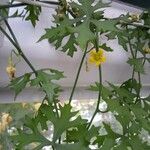
Ibervillea tenuisecta
Deer-apples · Slimlobe globeberry · Cut-leaved globe berry
Description
Source: leafsnapIbervillea tenuisecta, commonly known as the "Coyote Melon" or "Slimleaf Bitter Cucumber," is a perennial vine belonging to the Cucurbitaceae family. Native to the southwestern United States and northern Mexico, this plant features a slender stem that can grow up to 10 feet long, aided by tendrils that help it climb other plants or structures. The leaves of Ibervillea tenuisecta are deeply lobed with five to seven pointed segments. Its small, yellow-green flowers bloom in clusters from late spring through summer. The fruit is an oblong-shaped berry, up to 2 inches long, with a bitter taste. Ibervillea tenuisecta thrives in well-drained soil and can grow in full sun or partial shade. While it can tolerate drought conditions, regular watering during the growing season is essential for optimal growth. Historically, the Coyote Melon has been used for medicinal purposes by Native American tribes. It contains anti-inflammatory compounds and has been used as an analgesic to alleviate pain from arthritis, rheumatism, headaches, and more. Overall, Ibervillea tenuisecta is an intriguing plant species because of its distinctive appearance and traditional medicinal uses. It holds potential for further exploration both from a botanical research perspective and an ethnobotanical perspective, considering its cultural significance among Native American tribes who have relied on it for centuries as part of their traditional medicine practices.
Care Guide
💧 Water Every 7 days
☀️ Light Full sun
Slimlobe globeberry is native to open habitats — for example sunlit meadows and forest edges — that offer abundant light. It flourishes in Full Sun but can endure Partial Sun, adapting well to varying sunlight conditions.
🌡️ Temperature 20–37.8°C
Slimlobe globeberry comes from tropical areas, where the climate is generally warm and humid. For that reason it is well suited to high temperatures and humidity. It does not like sudden temperature shifts and prefers a constant thermal environment, so indoor temperature fluctuations should be avoided. It usually cannot tolerate cold and needs warmer conditions to grow. If the temperature falls too low, the plant may stop growing or even die.
💨 Humidity
🪴 Soil 6-7
🌱 Fertilizer
🪴 Pot & Repot
✂️ Pruning
To promote growth and boost fruit production, prune the slimlobe globeberry in early spring. Begin by removing any dead or diseased branches. Next, shape the plant to improve air circulation and light exposure. Be sure to use sterilized tools to prevent the spread of disease. For the best pruning practices, consult horticultural resources.
🌿 Propagating
🐛 Diseases & pets
☠️ Toxicity
Characteristics
- Plant Type
- Succulent, Vine
- Life Cycle
- Perennial
- Genus
- Ibervillea
- Family
- Cucurbitaceae
- Hardiness Zone
- 9-11
- Mature Height
- 2.13 m to 3.05 m
- Mature Spread
- 0.91 m to 2.13 m
- Leaf Color
- Green
- Leaf Type
- Deciduous
- Flower Size
- 1.02 cm to 2.03 cm
- Bloom Time
- Summer
- Planting Time
- Spring, Summer
- Harvest Time
- Late summer, Early fall, Mid fall
- Native Area
- Mexico