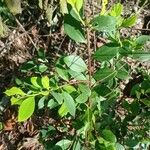
Ilex coriacea
Large gallberry · Sweet gallberry · Bay gallbush
Description
Source: leafsnapIlex coriacea, commonly known as the large-leaved holly or Chinese holly, is an evergreen shrub belonging to the family Aquifoliaceae. Native to China and Taiwan, this plant can grow up to 10 meters tall. It has a dense, bushy habit with glossy, leathery green leaves that can reach up to 15 cm in length. The oval-shaped leaves have spiny margins and are dark green on the top, with a lighter shade underneath. In late spring or early summer, Ilex coriacea produces small white flowers, which are followed by bright red berries in autumn. These berries provide a crucial food source for birds during the winter months when other options may be limited. The large-leaved holly thrives in well-drained soil and partial shade, though it can also tolerate full sun if it receives adequate water. It is often used as an ornamental plant due to its attractive foliage, particularly in winter when its glossy leaves offer a striking contrast against snow-covered landscapes. In traditional Chinese medicine, Ilex coriacea is valued for its medicinal properties, including treating fever, coughs, and sore throats, thanks to its anti-inflammatory characteristics. Overall, Ilex coriacea is an appealing evergreen shrub with both ornamental and medicinal benefits, making it a notable addition to any garden or landscape design project.
Care Guide
💧 Water Every 7 days
Large gallberry plants thrive in moist, acidic soils with high humidity and consistent moisture levels. To maintain healthy growth, water the plant every 2 to 3 weeks, ensuring the soil stays hydrated without becoming oversaturated. Being an evergreen, the large gallberry retains water in its foliage, which helps it withstand changes in temperature and precipitation throughout the seasons.
How should I water my big gallberry plant?
Your Large gallberry doesn't require any specific watering method. You can use common tools like watering cans, hoses, or cups to water it. Regardless of the tool you choose, make sure to water the soil directly. It's important to evenly moisten all parts of the soil to provide water to the entire root system. Using filtered water is recommended to avoid harmful particles found in tap water. Additionally, using water that is at or slightly above room temperature is beneficial, as extremely hot or cold water can be a shock to the plant. However, the Large gallberry typically responds well to any type of water.
What should I do if I give my Big gallberry plant too much water or too little water?
For outdoor plants, especially newly planted ones or seedlings, lack of watering can be a problem. It is important to keep watering them adequately for a few months, especially when they are small or just planted. Once the roots are established, Large gallberry plants can rely on rain most of the time. When your Large gallberry is in a pot, overwatering is more likely. If you accidentally overwater your plant, there are steps you can take to fix the situation. First, stop watering your plant immediately to minimize the effects of overwatering. Then, remove your Large gallberry from its pot to check its roots. If you find no sign of root rot, you can return the plant to its container. If there are signs of root rot, trim the affected roots and consider applying a fungicide to prevent further damage. Finally, replant your Large gallberry in well-draining soil. In the case of underwatering, the solution is to water the plant more frequently. It is usually a simple fix. When a Large gallberry is underwatered, its leaves will droop, dry out, and fall off, but they will regain fullness after sufficient watering. It is important to adjust your watering frequency as soon as you notice underwatering.
How frequently should I give water to my Large gallberry plant?
Natural outdoor plants typically do well with rainfall, but if your area lacks rainfall, give them adequate watering every 2 weeks in spring and fall. More frequent watering is needed in summer, while in winter, water sparingly as plants grow slower and require less water. Young or newly planted Large gallberry plants should be watered more frequently to help them establish and grow into drought-tolerant plants. For potted plants, there are two ways to determine watering frequency. The first is to create a regular watering schedule, such as once every week or every other week, but this may not account for the specific growing conditions of your Large gallberry. Watering frequency can also change with the season, and a set schedule may not suffice during the high water needs of summer. Alternatively, you can base your watering frequency on soil moisture. Wait until the top two to four inches of soil have dried out completely before giving more water.
How much water does my big gallberry plant need?
To water your Large gallberry, you don't always need a lot of water. If only a few inches of soil have dried since your last watering, give it about five to ten ounces of water. You can also determine how much water to give based on the soil moisture. Pay attention to how many inches of soil have dried out between waterings. To ensure the plant gets enough moisture, water until all the dry soil layers are moistened. If more than half of the soil is dry, give more water. Keep adding water until you see excess water draining from the pot's holes. If your Large gallberry gets plenty of rain outdoors, it may not need extra watering. When it's young or establishing, make sure it gets 1-2 inches of rain per week. As it grows and gets established, it can rely solely on rainwater. Only in hot weather without rain for 2-3 weeks should you consider giving a full watering to prevent stress.
How can I know if I'm giving my big gallberry plant enough water?
The Large gallberry is more commonly affected by overwatering. There are clear indicators to watch out for in these cases. Typically, an overwatered Large gallberry will have yellowing leaves and may shed some leaves. Additionally, this can cause the overall structure of the plant to shrink and potentially lead to root rot. Conversely, an underwatered Large gallberry will also start to droop. Its leaves may become brown and brittle. If you notice signs of either overwatering or underwatering, it is important to take action and restore the health of your Large gallberry.
☀️ Light Partial sun
Large gallberry does best with moderate sun exposure but can tolerate intense light if needed. As a native of woodland edges, it is adapted to situations where the canopy filters the sunlight. However, too much unfiltered exposure can stunt growth, while too little light produces weak plants with sparse foliage.
How much sunlight does Large gallberry need to grow?
Large gallberry needs 3-6 hours of direct sunlight daily. However, it also needs some shade during the hottest parts of the day to avoid sun damage. Morning sunlight is best, but it can also handle some afternoon sun if it's not too hot. To give it the right amount of sunlight, plant Large gallberry in a partially sunny spot, like under a tree or on the east side of a building.
What will happen if Large gallberry doesn't receive enough sunlight?
Large gallberry can experience negative effects if it receives excessive direct sunlight, such as yellowing, drying, and burning of its leaves. Another observable sign is when the plant starts to wilt or grows stunted. To avoid sun damage, it is essential to provide shade for Large gallberry during the hottest times of the day. This can be done by using a shade cloth or planting it near taller plants that can offer some natural shade.
What happens if Large gallberry plant gets too much sunlight?
If Large gallberry is not exposed to sufficient sunlight, it may become tall and thin, with sparse leaves. Additionally, the leaves might become yellow or pale green, indicating a lack of chlorophyll production due to insufficient sunlight. To address this issue, you can consider relocating Large gallberry to a sunnier area or trimming nearby foliage to enable more light to reach the plant.
🌡️ Temperature 10–35°C
Large gallberry grows naturally in areas with temperatures between 50 and 95 °F (10 to 35 ℃). The plant does well in these moderate conditions. For optimal growth, adjust temperatures with seasonal changes, especially during periods of extreme cold or heat.
What temperature is best for Large gallberry?
Large gallberry thrives best in temperatures ranging from 65 to 80℉ (18 to 27℃). During the primary growing phase, it can tolerate temperatures as high as 95℉ (35℃) and as low as 15℉ (-10℃). This species is specifically adapted to survive freezing winters and can tolerate low temperatures. The ideal temperature range for Large gallberry is 65 to 80℉ (18 to 27℃), with the highest acceptable range being 85 to 95℉ (30 to 35℃), and the lowest acceptable range being -5 to 15℉ (-20 to -10℃), or even lower.
Do I need to change the temperature for Large gallberry at different stages of growth?
According to research, Large gallberry plants may show signs of stunted growth when exposed to prolonged periods of high temperatures, especially during the development of axillary buds and main shoots. To promote healthy growth after germination or transplanting, it is recommended to maintain consistent and cooler temperatures of around 65℉ (18℃).
How can I make sure Large gallberry stays warm during cold seasons?
Large gallberry plants can tolerate freezing temperatures if planted in the ground in areas where the temperature doesn't fall below 15℉ (-10℃). However, if they are planted in pots or containers, their roots need protection from the cold. To do this, wrap the container in a blanket or bring it indoors to fully shield it from the winter weather.
If the temperature is too high or too low, what harm will Large gallberry experience?
Large gallberry is more adversely affected by consistently high temperatures than consistently low temperatures. When subjected to excessive heat, the plant experiences reduced seed germination and photosynthesis efficiency due to heat-induced hormone triggers. This is evident through signs of wilting, leaf browning, and potential death. On the other hand, if Large gallberry is exposed to extreme cold, it can cease vital functions like nutrient uptake and photosynthesis, potentially leading to plant death. Additionally, a single freezing event during the growing season can lead to a membrane phase transition, resulting in halted plant functions and eventual death.
What should I remember about temperature for Large gallberry?
To ensure the health of Large gallberry and promote successful budding, flowering, and new growth, it is crucial to maintain a consistent soil temperature. This can be achieved by regularly watering the plant, applying mulch to any bare soil areas, and selecting shade for planting.
💨 Humidity
🪴 Soil 5-6
🌱 Fertilizer
Fertilize your Large gallberry in early spring to promote healthy growth. Regular fertilization improves overall health, leading to vigorous growth, greater resilience to harsh conditions, and enhanced resistance to pests and diseases. Keep a consistent fertilization schedule for your Large gallberry to maintain vibrant foliage with deep color and a lush appearance.
🪴 Pot & Repot
✂️ Pruning
Pruning large gallberry in early to late winter helps it thrive by removing dead branches, which promotes health and a pleasing shape. Thinning the plant also enhances light penetration and air circulation, boosting its vitality. This practice reduces stress during the growth period, maintaining a bushy appearance and encouraging new growth, making it a vibrant feature in any garden.
🌿 Propagating
🐛 Diseases & pets
☠️ Toxicity
Characteristics
- Plant Type
- Tree, Shrub
- Life Cycle
- Perennial
- Genus
- Ilex
- Family
- Aquifoliaceae
- Hardiness Zone
- 6-9
- Mature Height
- 6.1 m
- Mature Spread
- 3.96 m
- Leaf Color
- Green
- Leaf Type
- Evergreen
- Flower Color
- White
- Flower Size
- 0.51 cm to 0.76 cm
- Bloom Time
- Mid spring, Late spring
- Planting Time
- Spring, Autumn
- Harvest Time
- Late summer, Fall