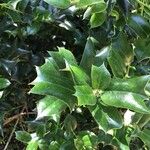
Ilex cornuta
Chinese holly · Burford's holly · Horned holly
Description
Source: leafsnapIlex cornuta, commonly known as Chinese holly or horned holly, is an evergreen shrub species that belongs to the Aquifoliaceae family. Native to China, Korea, and Japan, it is widely cultivated around the world for its ornamental value. Typically, the plant grows to a height of 10-20 feet and a width of 6-10 feet, exhibiting a dense growth habit. Its glossy, dark green leaves are oval-shaped with spiny margins, reaching up to 4 inches in length. The leaves are alternately arranged on the stem. In late spring or early summer, Ilex cornuta produces small white flowers that are followed by bright red berries, which persist throughout winter, providing food for birds. This plant prefers well-drained soil but is tolerant of a wide range of soil types, including clay soils, as long as they are not waterlogged. While it prefers full sun, it can also grow in partial shade. Chinese holly is often used for hedging due to its dense growth and spiny foliage, making it an effective barrier against intruders or animals. Overall, Ilex cornuta is an attractive evergreen shrub with significant ornamental value, thanks to its glossy foliage and bright red berries. It is a popular choice among gardeners seeking a low-maintenance plant that offers year-round interest in their gardens.
🌳 Chinese holly is widely known for its decorative appeal, but it also offers potential additional uses. Its leaves have been used historically to produce a black dye. Also, because the wood is dense and finely textured, it could be useful for making small specialized wooden items or detailed carvings.
🎭 Safety, Fortune
Care Guide
💧 Water Every 7 days
Chinese holly comes from regions with varying moisture levels and displays moderate drought tolerance. It thrives when watered every 1-2 weeks and is usually grown outdoors. As an evergreen plant, Chinese holly retains moisture in its leaves, making it well-suited for climates with sporadic rainfall.
When Should I Water My Chinese Holly?
To ensure the health and development of your Chinese Holly (Ilex cornuta), observe the soil's moisture and the plant's visual cues for watering needs. If the top 1 to 2 inches of soil are dry, it's time to water. Pay attention to leaf condition; wilted, lackluster, or inward-curled leaves indicate under-watering, whereas yellow leaves may suggest the same, and a vibrant green suggests ample water. Excessive leaf drop or rigid, brittle twigs also signal insufficient moisture, while flexible twigs indicate adequate hydration. Monitoring root health is crucial; white and firm roots are healthy, whereas brown, mushy roots suggest over-watering. Adjust your watering frequency based on temperature, weather, and the plant's growth stage. Avoid watering when the soil is moist to prevent root rot and related diseases, and be mindful not to delay watering to the point of plant stress or death.
How Should I Water My Chinese Holly?
Water your Chinese Holly effectively by considering its specific needs. The bottom-watering technique, where the plant absorbs water from a tray below, is recommended to avoid over-saturation and ensure the roots receive sufficient moisture. Choose a watering can with a narrow spout to direct water to the base and prevent foliage wetting. Utilizing a moisture meter can aid in maintaining the optimal soil moisture level. Watering frequency should be adjusted based on environmental conditions, soil type, and plant growth stage, ensuring the soil is not completely dry or waterlogged. Regularly check the top inch of soil and water when it feels dry.
How Much Water Does Chinese Holly Really Need?
Chinese Holly, adept at growing in partially shaded woodlands of East Asia, requires a consistent and appropriate amount of water reflecting its natural habitat's conditions. An outdoor-grown mature plant needs ample water for its deep roots and enough soil penetration. In pots, water should thoroughly dampen the soil without causing water-logging. The leaves' vibrant green color indicates proper hydration, while yellowing or dropping highlights over-watering issues, and wilting signifies under-watering. Striking the right balance in water quantity is essential to avoid root rot from over-watering and drought stress from under-watering.
What Kind of Water is Best for Chinese Holly?
For Chinese Holly, the best water types are distilled water, due to its purity and lack of contaminants, and rainwater, if collected cleanly and without pollution exposure. Tap water is an option but may contain elements that Chinese Holly is sensitive to, such as chlorine and fluoride, which can cause leaf burn and discoloration. If using tap water, let it sit for 24-48 hours to allow chlorine to dissipate or use a filter to remove additional contaminants. The plant prefers water at room temperature to avoid root shock from extreme temperatures.
How Do Chinese Holly's Watering Needs Change with the Seasons?
Throughout the seasons, Chinese Holly's watering needs vary. In spring, during its active growth phase, maintain consistent soil moisture with regular watering. Summer may bring a natural dormancy, requiring reduced watering frequency. In autumn, decrease watering frequency further as the plant prepares for winter dormancy, ensuring the soil stays lightly moist. During winter's dormant period, water sparingly, allowing the topsoil to dry out between waterings, as the plant requires minimal moisture.
☀️ Light Full sun
For healthy growth, chinese holly needs abundant sun exposure throughout the day. While it can persist with less light, inadequate exposure can result in suboptimal health. Native to habitats where it received sunlight all day, it is adapted to those conditions. Excessive shade could cause stunted growth, whereas excessive light does not adversely affect it.
What are the sunlight requirements for Chinese Holly?
Chinese Holly thrives best in conditions where it has a lot of exposure to the sun throughout the day, requiring more than 6 hours of sunlight to ensure healthy growth. While it can survive under less light, optimal health might not be achieved in insufficient light conditions. The plant is well adapted to full sun environments, traceable to its origins in sun-abundant habitats. Although excessive shade can lead to stunted growth and health issues, excessive light does not negatively impact the plant. It's crucial to observe the movement of sunlight through your garden to locate an ideal balance of light and shade that matches the needs of your plants, ensuring their well-being.
How does artificial lighting support Chinese Holly growth indoors?
Indoor Chinese Holly requires adequate lighting to maintain optimal growth, especially when natural sunlight is insufficient, like during winter or in less sunny areas. Artificial lights, particularly LED lights, can be a vital solution to this as they can be customized to provide specific wavelengths needed by the plant. For effective growth, full sun plants need 30-50W/sq ft of artificial light, partial sun plants require 20-30W/sq ft, and full shade plants need 10-20W/sq ft. The light source should be placed 12-36 inches above the plant, mimicking natural sunlight, with a duration mimicking natural daylight hours, generally 8-12 hours daily.
What are the symptoms of inadequate or excessive sunlight in Chinese Holly?
When Chinese Holly doesn't receive enough sunlight, it may exhibit symptoms like smaller new leaves, leggy or sparse growth, faster leaf drop, reduced or ceased growth, and paler leaves indicative of chlorophyll deficiency. Conversely, excessive sunlight can lead to chlorosis (leaf yellowing), sunscald (pale, bleached areas on tissue), leaf curling, wilting, and leaf scorching. These conditions visibly impact the plant's health, either by reducing its ability to photosynthesize efficiently or by direct damage to plant tissues.
What solutions can ameliorate sunlight-related issues for Chinese Holly?
To address sunlight-related issues in Chinese Holly, gradual adaptation to sunlight is key for both indoor and outdoor plants. Indoors, gradually move plants to sunnier locations until they receive at least 6 hours of direct sunlight daily or use artificial light for large plants. Outdoors, move plants to sunnier spots over weeks to avoid sunburn. Reducing obstructions, such as pruning trees that shade the plant, and transplantation during the plant's dormant period to sunnier spots with good drainage are effective strategies. It's important to note that parts of the plant damaged by poor light may not recover, but new growth will be healthy with proper light exposure.
🌡️ Temperature 15–35°C
As a temperate woody plant, chinese holly prefers temperatures between 59 and 95 ℉ (15 and 35 ℃). In its native habitat it can tolerate both humid, hot summers and cold winters when temperatures regularly drop below freezing. To ensure successful growth, it is recommended to adjust temperature conditions by providing shade or misting in extremely hot weather, and shelter or insulation during frosty seasons.
What are the essential growing conditions for Chinese Holly?
Chinese Holly (Ilex cornuta) thrives in temperate conditions, preferring temperatures ranging between 59 to 95°F (15 to 35°C). It is well-adapted to both humid and hot summers, as well as cold winters where temperatures can regularly drop below freezing. For optimal growth, it's crucial to adjust its environment according to the weather, such as providing shade or misting during extreme heat, and offering shelter or insulation through the frosty seasons. Even though Chinese Holly possesses some degree of cold tolerance, protective measures like wrapping the plant with plastic, fabric, or other suitable materials should be taken when temperatures are expected to plummet below its tolerable minimum. Once warmer temperatures return, it's important to remove these protections timely to prevent any potential damage.
How do you manage low temperature issues in Chinese Holly?
Chinese Holly has a moderate tolerance to low temperatures, faring best when conditions remain above its minimum suitable growth temperature. To prevent damage when winter temperatures dip below its tolerance threshold, it's advisable to trim off any frost-damaged parts. Additionally, to safeguard against future cold snaps, wrapping the plant in non-woven fabric or cloth and constructing wind barriers can be effective measures. These steps help to ensure the plant's resilience against the cold, allowing it to recover from mild exposure and mitigate severe damage that could lead to leaf loss.
What should you do if Chinese Holly experiences high temperatures?
During the summer season, it's important to keep the Chinese Holly below its maximum suitable growth temperature to prevent it from overheating. Exceeding this threshold can cause the leaves to lighten in color, dry out at the tips, curl, and leave the plant vulnerable to sunburn. To address these issues, it's recommended to prune away any sun-damaged or dried parts. Relocating the plant to a shadier spot or utilizing a shade cloth can protect it from the harsh midday and afternoon sun. Additionally, watering the plant in the morning and evening helps keep the soil moist and supports the plant's overall health in high temperatures.
💨 Humidity
🪴 Soil 5-7
🌱 Fertilizer
Feed your Chinese holly in early spring to encourage healthy growth. Consistent fertilizing boosts its overall health, promoting strong growth, better tolerance of harsh conditions, and greater resistance to diseases and pests. Follow a regular fertilization schedule to keep the foliage vibrant, richly colored, and lush in appearance.
Why should I put fertilizer on my Chinese holly plant?
If you have a Chinese holly, regular fertilization is important for its overall health. Proper nutrients will help it grow stronger, tolerate tough conditions, and resist diseases and pests. The foliage of your Chinese holly is attractive, so it's worth maintaining. By following a fertilization schedule tailored to your Chinese holly, you can ensure vibrant leaves and a lush appearance.
When should I fertilize my Chinese holly plant?
To keep your Chinese holly healthy and help it grow, fertilize it in late winter or early spring. This provides the necessary nutrients for growth when the weather warms up. If you live in a warm climate region, it's also beneficial to fertilize it again in early fall. This adds nutrients for the next growing season and makes the holly more resilient to winter cold. Fertilizing earlier in fall helps the new branches grow stronger before winter arrives.
When is it not a good idea to fertilize my Chinese holly?
There are a few specific times throughout the year when it is best to avoid fertilizing your Chinese holly. The first instance is during the early and mid-winter months when the plant is dormant and does not require any nutrients. Another period to avoid fertilization is late spring and all of summer, as the weather tends to be hotter and drier. Fertilizing during these times can have negative effects on the Chinese holly. To prevent any issues, it is recommended to fertilize only in early spring and early fall.
What kind of plant food does my Chinese holly need?
For a Chinese holly, nitrogen is usually the most important nutrient. However, phosphorus and potassium are still important. It is recommended to use a balanced fertilizer like a 10-10-10, which provides all three main nutrients in decent amounts. However, a more precise nutrient ratio can optimize the growth of a Chinese holly. Fertilizers with slightly higher nitrogen levels, like a 10-6-4 ratio, often work well. You can choose between a granular or liquid-based fertilizer for fertilizing.
How can I add fertilizer to my Chinese holly plant?
To fertilize your Chinese holly, you can choose either granular or liquid fertilizer. If you opt for granular fertilizer, simply sprinkle it on the soil at the right time. The slow-release nature of granular fertilizer ensures a gradual release of nutrients over time. It's recommended to lightly water the plant before applying fertilizer. Alternatively, you can use liquid fertilizer by mixing it with water and pouring the mixture around the base of the plant. However, this method is less commonly used. It may be helpful to perform a soil test beforehand to determine if any adjustments to pH levels are needed.
🪴 Pot & Repot 2-3 years
When repotting Chinese holly, select a pot 1-2 inches (2.5–5.1 cm) larger with good drainage. Use a well-draining potting mix. Repot in spring or fall, making sure the root ball sits slightly below the rim of the flower pot. Water thoroughly after repotting and place it in a warm spot with indirect sunlight.
✂️ Pruning
To promote optimal flowering and fruiting, Chinese holly should be pruned annually to encourage new branch growth. The ideal time for pruning is before early spring, preferably in winter. During this process, remove old leaves and cut back one-third of the older branches. In regions prone to heavy snow, consider bundling the remaining branches to protect them from damage caused by ice and snow.
🌿 Propagating
🐛 Diseases & pets
☠️ Toxicity
Characteristics
- Plant Type
- Shrub
- Life Cycle
- Perennial
- Genus
- Ilex
- Family
- Aquifoliaceae
- Hardiness Zone
- 8-10
- Mature Height
- 0.91 m to 10.06 m
- Mature Spread
- 1.83 m to 2.44 m
- Leaf Color
- Green
- Leaf Type
- Evergreen
- Flower Color
- White
- Flower Size
- 0.25 cm to 0.51 cm
- Bloom Time
- Mid spring, Late spring
- Planting Time
- Spring, Autumn
- Harvest Time
- Early spring, Mid summer, Late summer, Fall, Winter
- Native Area
- South Korea, China