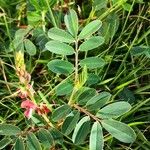
Indigofera spicata
Creeping indigo · Red nerinjy
Description
Source: leafsnapIndigofera spicata, the creeping indigo or trailing indigo, is a species of flowering plant in the family Fabaceae. It is native to Sub‑Saharan Africa, Madagascar, Mauritius, Réunion, and Yemen, and has been introduced to the southeastern United States, various Caribbean islands, Brazil and other locations in Latin America, various Pacific islands, and New South Wales and Queensland in Australia. It was considered to be a promising forage plant, and then shown to be toxic to nearly all livestock, but it is possible that the experiments were conducted on the similar Indigofera hendecaphylla, leading to some confusion.
Care Guide
💧 Water
Creeping indigo, native to moderate climates, thrives well with moderate drought tolerance. It prefers slightly dry soil between weekly waterings. During its active growing season, rainwater, combined with regular irrigation, significantly boosts its growth.
How should I water my Creeping indigo plant?
To water Creeping indigo, you have multiple options such as using a garden hose with a spray nozzle, a watering can, or any other common watering tool. Creeping indigo is not too picky about how it receives water, as it can thrive on rainwater, tap water, or filtered water. However, it is advisable to avoid watering this plant from overhead as it can harm the leaves, flowers, and even lead to diseases. Setting up a drip irrigation system is often the most effective way to water Creeping indigo, ensuring that water is evenly and directly applied to the soil. When watering a container-grown Creeping indigo, simply use a cup, watering can, or tap to directly apply water to the soil.
What can I do if I give my Creeping indigo too much or too little water?
To fix underwatering of your Creeping indigo, water it more often when you notice it lacks moisture. However, overwatering is a more serious issue that can lead to diseases and the plant's decline. To prevent overwatering, choose a sunny location with good soil drainage. If your potted Creeping indigo is overwatered, consider changing it to a new pot with better drainage and loose soil.
How many times a week should I water my Creeping indigo?
To keep your Creeping indigo healthy, here are some watering tips. During the growing season, which begins in spring, you should water the plant around once per week. As the weather gets warmer, increase the watering to two to three times per week. However, be careful not to exceed this rate, as it can harm the plant. Regardless of the watering frequency, make sure the soil is consistently moist but not overly wet. When it comes to potted Creeping indigo, you'll need to water more frequently compared to in-ground plants. Generally, watering a container-grown Creeping indigo a few times per week is necessary to prevent the soil from drying out too quickly.
How much water does my Creeping indigo plant need?
There are a few different ways to decide how much water your Creeping indigo needs. Some gardeners prefer to gauge the soil moisture by feeling it, and they suggest watering until the top six inches of soil become moist. Another option is to use a specific measurement, like giving your Creeping indigo about two gallons of water per week, taking into account temperature and how quickly the soil dries out. However, rigid guidelines like this can lead to overwatering if your plant requires less water. When growing Creeping indigo in a container, a different approach is necessary. In this case, make sure to water enough to moisten all the dry soil layers. You can check for moisture by sticking your finger in the soil or watering until you see a small amount of excess water coming out of the pot's drainage holes.
How can I know if I'm giving enough water to my Creeping indigo?
Creeping indigo can be tricky to water properly. These plants have deep roots that need moist soil, so it's important to water them weekly. However, they are also prone to root rot, so be careful not to overwater. Overwatering can cause browning in the leaves. On the other hand, underwatering is less likely to happen with Creeping indigo as they can survive without much watering. But if you go too long without watering, the plant may start to wilt and the leaves may dry out.
☀️ Light Full sun
Creeping indigo grows best in full sun but can tolerate environments with moderate sunlight. Its native habitat provides this type of lighting, which supports its strong growth. Too little light may hinder its development, while excessive brightness can stress the plant, though it is generally hardy in both situations.
What are the sunlight requirements for creeping indigo?
Creeping indigo requires full sun, characterized by more than 6 hours of sunlight daily, but it can also survive in partial sun, with about 3-6 hours of sunlight. It's important to observe how sunlight moves through your garden to find spots that provide an ideal balance of light and shade, ensuring the plants' well-being. Originally thriving in environments with ample sunlight, creeping indigo can withstand both insufficient and excessive light, although the latter might stress the plant, despite its general robustness.
How can artificial lighting be used for creeping indigo?
When natural sunlight is insufficient, particularly in spaces with limited sun exposure or during winter, artificial lighting can supplement the growth requirements of creeping indigo. LED lights are recommended due to their ability to provide specific wavelengths needed for plant growth. Full sun plants should have 30-50W/sq ft, partial sun plants 20-30W/sq ft, and full shade plants 10-20W/sq ft of artificial light. The light source should be placed 12-36 inches from the plant, mimicking the natural daylight conditions for about 8-12 hours per day.
What are common symptoms of incorrect light exposure in creeping indigo?
Symptoms of light deficiency in creeping indigo include smaller new leaves, leggy or sparse growth, faster leaf drop, slower or no new growth, and lighter-colored new leaves. On the other end, symptoms of excessive light include chlorosis, where leaves lose their green color; sunscald, which causes damaged tissues; leaf curling as a defense against water loss; wilting from excessive water loss; and leaf scorching characterized by brown, dry edges. These symptoms provide insights into the plant's need for adjustments in light exposure.
What solutions can help manage creeping indigo's light exposure?
To optimize light exposure for creeping indigo, indoors, consider moving the plants gradually to sunnier spots until they receive at least 6 hours of sunlight, use south-facing windows, and consider the use of artificial light if necessary. Outdoors, moving plants to sunnier areas gradually helps adapt without causing sunburn. If light is obstructed, trim or remove the objects blocking sunlight or consider transplanting to a sunnier location. These steps can help improve the health and growth of creeping indigo, especially new growth after adjustments in light exposure.
🌡️ Temperature 20–37.8°C
Creeping indigo comes from tropical areas, where the climate is usually warm and humid. Consequently, it is suited to high temperatures and humidity. It does not tolerate abrupt temperature changes and prefers a consistent temperature environment, so preventing temperature fluctuations indoors is important. It generally cannot endure cold and requires warmer conditions for growth. If the ambient temperature falls too low, the plant may halt growth or even die.
What is the botanical name of Creeping Indigo?
The botanical name of Creeping Indigo is Indigofera spicata.
💨 Humidity
🪴 Soil 6-7
🌱 Fertilizer
Creeping indigo benefits from regular, light applications of fertilizer to encourage healthy foliage growth. Fertilize Creeping indigo about once a month during the summer. Nitrogen is important for the leaves, and adding nitrogen-rich sources helps Creeping indigo thrive.
🪴 Pot & Repot
✂️ Pruning
Prune creeping indigo from early to late spring to manage its growth and encourage denser foliage. During this time, remove any dead stems and shape the plant. This will improve airflow and sunlight exposure, reducing the risk of disease and promoting strong new growth.
🌿 Propagating
🐛 Diseases & pets
☠️ Toxicity
Characteristics
- Plant Type
- Herb
- Life Cycle
- Annual, Perennial
- Genus
- Indigofera
- Family
- Fabaceae
- Hardiness Zone
- 9-11
- Mature Height
- 30 cm to 46 cm
- Mature Spread
- 46 cm to 91 cm
- Leaf Color
- Green
- Leaf Type
- Semi-evergreen
- Flower Color
- Pink, Purple
- Flower Size
- 0.25 cm to 0.51 cm
- Bloom Time
- Late spring, Summer, Early fall, Mid fall
- Planting Time
- Spring, Summer, Autumn
- Harvest Time
- Mid summer, Late summer, Fall
- Native Area
- Sri Lanka, Djibouti, Burkina Faso, Angola, Malaysia, Madagascar, Rwanda, Eritrea, Nigeria, Yemen, Kenya, Niger, Uganda, Tanzania, Zimbabwe, Mali, Guinea-Bissau, Fiji, Brunei, Benin, Indonesia, Cambodia, Equatorial Guinea, Liberia, Mozambique, Cameroon, Burundi, Brazil, Ghana, Ethiopia, Congo, Central African Republic, Malawi, South Africa, Zambia, Sudan, Philippines, Laos, Bangladesh, Guinea, Chad, China, Vietnam, Myanmar, Togo, Papua New Guinea, Senegal, Eswatini, Côte d'Ivoire, Congo (DRC), Thailand, Gabon