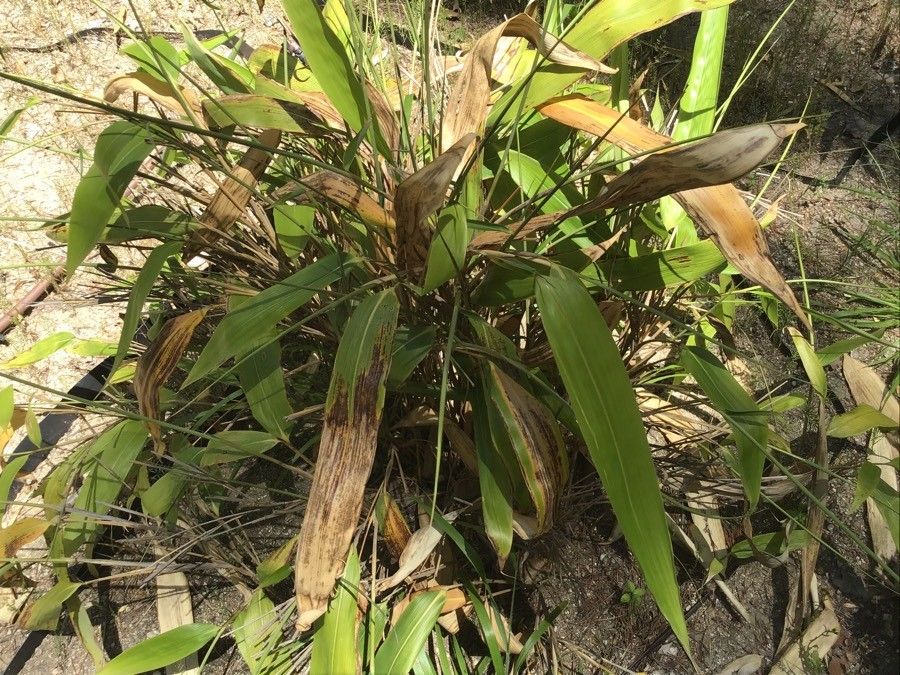
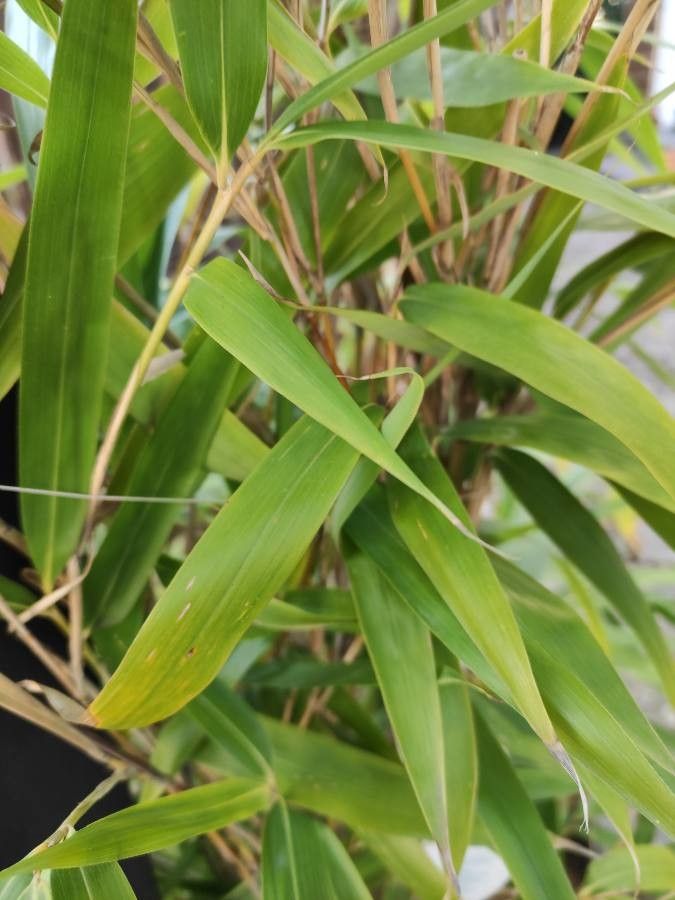
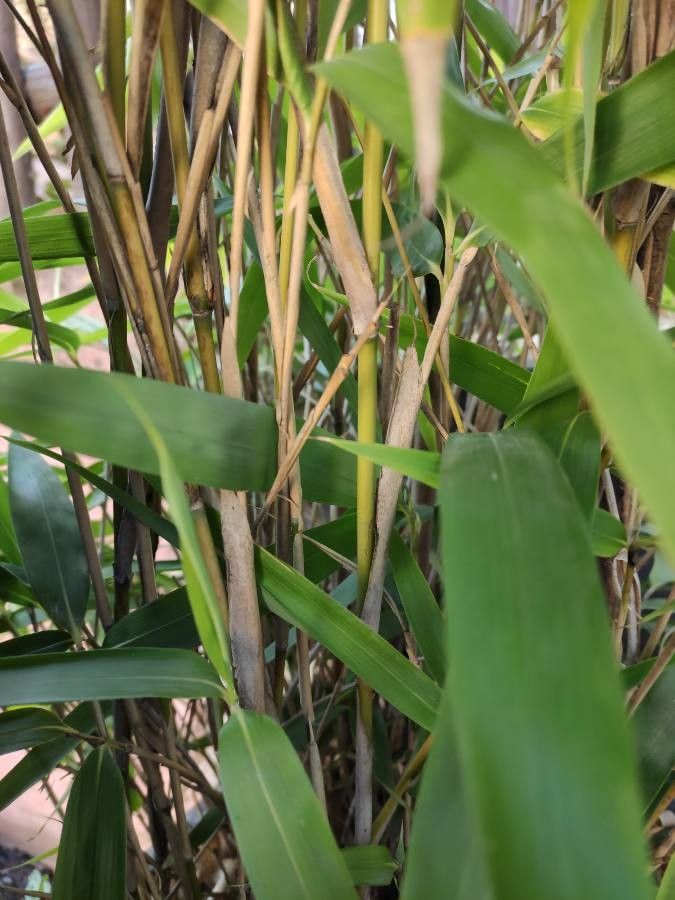
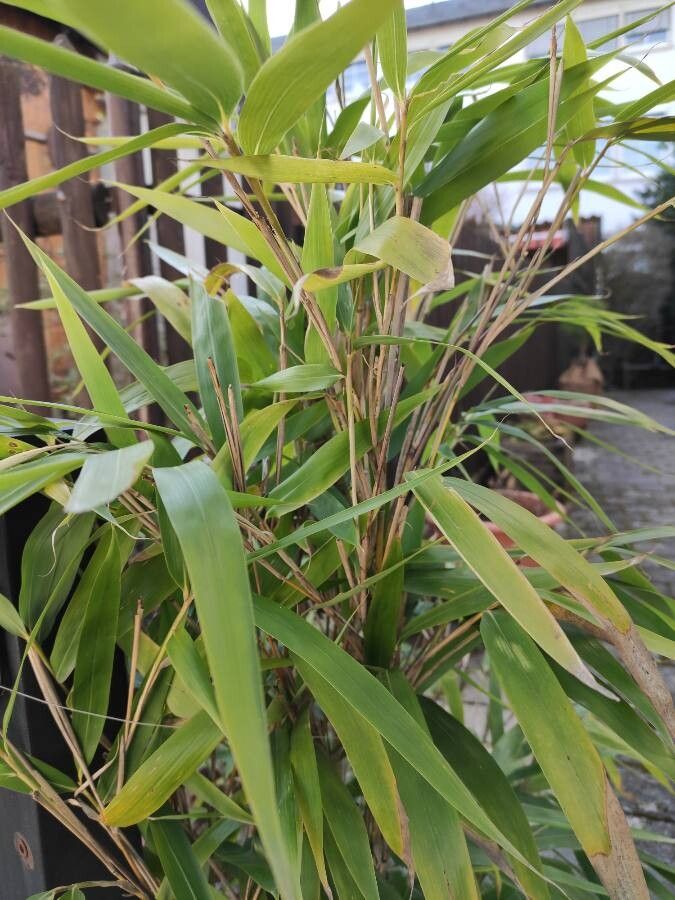
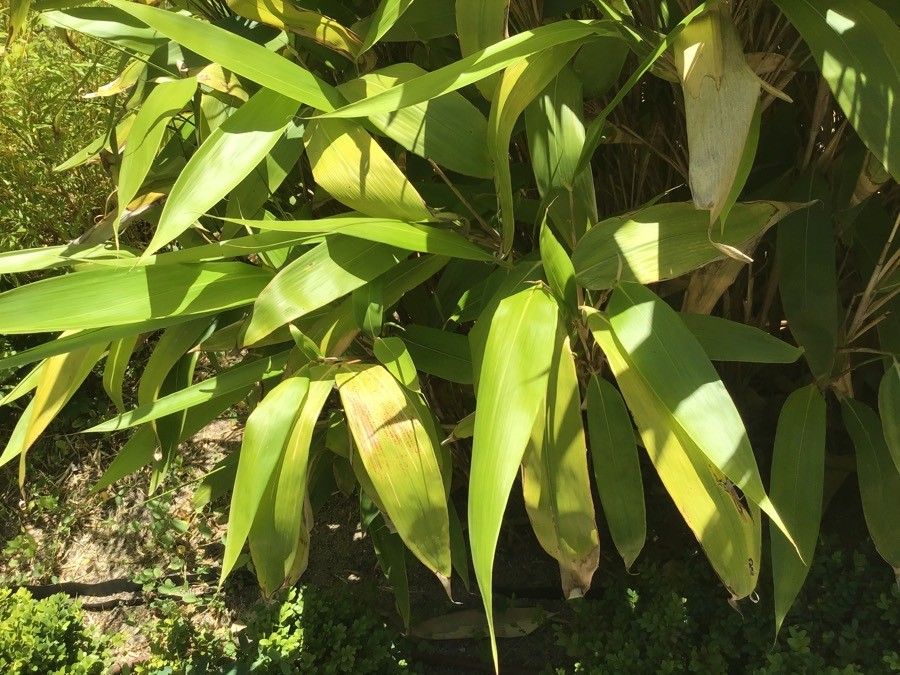
Indocalamus tessellatus, the large-leaved bamboo, is a species of flowering plant in the grass family Poaceae, native to China. A medium-sized, hardy evergreen bamboo growing to 2 m (6.6 ft), it forms a clump of broad leaves 60 cm (24 in) long and up to 10 cm (3.9 in) wide – the broadest of any bamboo – which cause the slender cane to bend under their weight. Though hardy down to −15 °C (5 °F) and able to survive conditions in most of the UK, it prefers a sheltered site in semi-shade with moist, rich soil. Given the best conditions possible, it will eventually form large thickets or groves, but can be kept in a large container. In cultivation in the UK it has gained the Royal Horticultural Society's Award of Garden Merit.
Large-leaved bamboo resists disease well and is generally not susceptible to illnesses. This plant is fairly low-maintenance. When grown outdoors, it needs only minimal watering, and larger specimens typically do not require pruning. Smaller plants, however, should be pruned after they have bloomed. Large-leaved bamboo is appropriate for anyone with outdoor space, like a garden or deck, and does not demand extensive care experience.
How to keep Indocalamus Tessellatus.
Light
Large-leaved bamboo needs a mix of sun and shade for healthy growth, tending toward environments sheltered from direct sunlight. In its natural setting it flourishes in the dappled light found in subcanopy areas. Although it prefers that condition, it can tolerate full sun; prolonged exposure may scorch the leaves, while insufficient light can lead to stunted growth.
Water
Large-leaved bamboo comes from humid forest understories, thriving in moist environments due to its high tolerance for humidity. To maintain healthy foliage, water the bamboo every 1–2 weeks. As an evergreen plant commonly grown outdoors, it benefits greatly from rainwater, which supports its optimal growth.
Temperature
Native to temperate regions, large-leaved bamboo is naturally adapted to temperatures between 59 and 95 °F (15 and 35 ℃). Seasonally, avoiding temperature extremes is necessary for its optimal growth.
Fertilizer
Fertilize your Large-leaved bamboo in early spring to encourage healthy growth. Regular feeding improves its overall health, leading to vigorous development, greater hardiness in difficult conditions, and enhanced resistance to pests and diseases. Keep to a consistent fertilization schedule for your Large-leaved bamboo to maintain rich, deeply colored foliage and a lush appearance.
Pruning
Large-leaved bamboo is characterized by its wide, expansive leaves and dense foliage. To maintain its health and appearance, prune in early spring, removing any damaged canes and controlling its growth. Thinning overcrowded sections helps improve air circulation. Always use clean tools for pruning to prevent disease, ensuring the plant remains strong and visually pleasing.
Pot & Repot
To ensure optimal growth, repot large-leaved bamboo every 2-3 years in the spring. Choose a larger pot to allow the roots to expand, and keep the soil consistently moist after repotting. For a few weeks, protect the bamboo from direct sunlight to help it recover and reduce stress.
Botanical profile.
- Plant Type
- Shrub
- Life Cycle
- Perennial
- Genus
- Indocalamus
- Family
- Poaceae
- Hardiness Zone
- 7-9
- Mature Height
- 61 cm to 91 cm
- Mature Spread
- 3.05 m
- Leaf Color
- Green, Gray
- Leaf Type
- Evergreen
- Flower Size
- 10.16 cm to 15.24 cm
- Bloom Time
- Early summer, Mid summer
- Planting Time
- Spring, Summer
- Harvest Time
- Late summer, Early fall
- Native Area
- China
Other names.
Reader questions.
How should I water my Large-leaved bamboo plant?
Your Large-leaved bamboo is not picky about how you water it. You can use any common watering tool, like watering cans, hoses, or cups. When watering, it's important to apply the water directly to the soil and make sure all areas are equally moistened. Filtered water is best to avoid harmful particles, and water at room temperature or slightly warm to avoid shocking the plant. However, the Large-leaved bamboo generally responds well to any kind of water.
Why should I put fertilizer on my Large-leaved bamboo?
If you own any type of Large-leaved bamboo, regular fertilization is important for its overall health. Providing the right nutrients helps it grow stronger and withstand tough conditions, as well as better fight off diseases and pests. Since the foliage of Large-leaved bamboo is attractive, it's important to maintain it. This involves following a fertilization schedule that suits your specific bamboo. By doing this, your bamboo will develop vibrant, lush leaves.
How much sunlight does Large-leaved bamboo need to grow?
Large-leaved bamboo thrives with 3-6 hours of direct sunlight daily. However, to avoid sun damage, it requires shade during the hottest times of the day. Ideally, morning sunlight suits it best, but if the temperature isn't too high, some afternoon sun is acceptable. For the perfect balance, consider planting it in a partially sunny area, like under a tree or on the east side of a building.
What temperature is best for Large-leaved bamboo?
Large-leaved bamboo thrives best in temperatures ranging from 65 to 80℉ (18 to 27℃). During its primary growing phase, it can tolerate temperatures as high as 95℉ (35℃) and as low as 15℉ (-10℃). This bamboo species can tolerate freezing winters and low temperatures. To summarize the optimal temperature range: the perfect range is 65 to 80℉ (18 to 27℃), the highest range is 85 to 95℉ (30 to 35℃), and the lowest range is -5 to 15℉ (-20 to -10℃) or below.
What should I do if I give my Large-leaved bamboo plants too much water or too little water?
Outdoor plants, especially newly planted ones or seedlings, can suffer from lack of watering. It is important to consistently water these plants for a few months until they are established and can rely on rain. Overwatering is more common when Large-leaved bamboo is planted in pots. If you accidentally overwater your bamboo, there are steps you can take to address the issue. First, stop watering the plant immediately to minimize the impact. Then, remove the bamboo from its pot to inspect the roots for signs of root rot. If no root rot is present, you can return the plant to its container. If you find root rot, trim away the affected roots and use a fungicide to prevent further damage. Lastly, repot the bamboo using well-draining soil. On the other hand, underwatered Large-leaved bamboo can be easily fixed by watering it more frequently. When underwatered, the leaves will droop and dry out, but they will regain fullness after sufficient watering. Make sure to adjust your watering frequency as soon as you notice underwatering.
When should I fertilize my Large-leaved bamboo plant?
To ensure healthy growth of Large-leaved bamboo, the first fertilization should take place in late winter or early spring. This provides the necessary nutrients for optimal growth once the weather warms up. If you live in a warm climate region, it is beneficial to provide an additional fertilizer feeding in early fall. This not only adds nutrients to the soil for the following growing season, but also helps the bamboo withstand winter cold without foliage damage. Fertilizing earlier in the year allows enough time for new branches to grow and withstand the cold winter.
What will happen if the large-leaved bamboo doesn't have enough sunlight?
Large-leaved bamboo can experience several problems when exposed to excessive sunlight. This includes yellowing, drying out, and even burning of its leaves. Additionally, the plant may wilt or become stunted. To avoid such sun damage, it is important to provide some shade for the bamboo, especially during the hottest periods of the day. This can be achieved by utilizing a shade cloth or positioning the bamboo near taller plants that can offer natural shade.
Do I need to change the temperature for Large-leaved bamboo as it grows?
According to research, when temperatures rise for extended periods of time, Large-leaved bamboo may show stunted growth. This is particularly noticeable during the development of axillary buds and the growth of main shoots. To promote healthy growth after germination or transplanting, it is recommended to maintain consistent and cooler temperatures, ideally around 65℉ (18℃).
How frequently do I need to water my Large-leaved bamboo?
Here are some tips for watering your plants based on different conditions: 1. Natural outdoor growth: Most plants can thrive with rainfall alone. However, if your area lacks rainfall, you should consider watering your plants adequately every two weeks in spring and fall, and more frequently in summer. In winter, when growth slows down and plants need less water, water sparingly or not at all. 2. Young or newly planted Large-leaved bamboo: If your bamboo is young or newly planted, water it more frequently to help it establish and grow into a more adaptable and drought-tolerant plant. 3. Potted plants: There are two main ways to determine how often to water your Large-leaved bamboo in a pot. - Predetermined watering schedule: You can set a schedule to water your plant once a week or once every other week. However, this approach may not work well as it doesn't consider the specific conditions of your bamboo's growing environment. - Soil moisture: Alternatively, you can gauge watering based on soil moisture. Wait until the top two to four inches of soil (about ⅓ to ½ depth of the pot) have completely dried out before watering again. This method allows you to adjust the watering frequency according to the season, as the plant's water needs may increase during summer.
When is it not a good idea to add fertilizer to my Large-leaved bamboo?
To properly care for your Large-leaved bamboo, avoid fertilizing it at certain times of the year. Firstly, during the early and mid-winter months, the plant is dormant and does not require any feeding. Secondly, it is not advisable to fertilize in late spring and throughout the summer as the weather is hotter and dryer, which can have a negative impact on the bamboo when fertilized. To prevent these issues, stick to a fertilization schedule that only involves feeding in early spring and early fall.
What will happen if the Large-leaved bamboo gets too much sunlight?
Large-leaved bamboo can become tall and thin with scarce foliage if it does not receive sufficient sunlight. Additionally, the leaves may become yellow or pale green, which means that the plant is not producing enough chlorophyll due to a lack of sunlight. To resolve this issue, consider relocating the Large-leaved bamboo to a brighter area or trimming nearby foliage to allow more light to reach the plant.
How can I protect Large-leaved bamboo from the cold weather?
Large-leaved bamboo can tolerate freezing temperatures when grown in the ground in areas where the temperature does not drop below 15℉(-10℃) during winter. However, if the bamboo is planted in pots or containers, it is crucial to protect the roots from the cold. This can be done by wrapping the container in a blanket or bringing it indoors to provide complete protection from the winter weather.