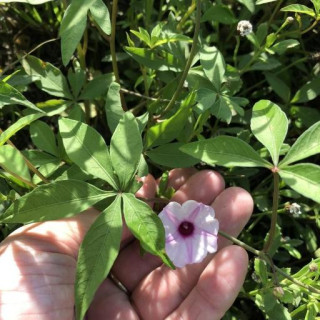
Ipomoea heptaphylla
Wright's morning glory · Palm-leaf morning glory · Willow-leaf morning glory
Description
Source: leafsnapIpomoea heptaphylla, sometimes known as Wright's morning glory in the United States, is a species of morning glory. It is incorrectly classified as I. wrightii in American publications, but is incorrectly known as I. tenuipes in Africa and India. It is an annual or short-lived perennial vine which climbs using twining stems, and has pink or purple flowers. The leaf shape is somewhat variable, with individuals possessing compound leaves palmately divided into five leaflets, and lanceolate-leaved individuals occurring in neighbouring populations. The name heptaphylla actually means 'seven-leaved'. This plant has a very extensive distribution, from Texas and adjacent states in the southeastern USA to Misiones in northern Argentina, the Greater Antilles of the Caribbean, India, Sri Lanka and East and Southern Africa. Despite its wide distribution it is uncommon throughout its range. The rediscovery of the presence of the species in India after an absence of over half a century was published in 2014. The species appears to favour dry subtropical to tropical habitats.
🌳 Mile-A-Minute Vine has revealed a previously hidden potential for ecological roles beyond its invasive reputation. Its dense growth can be used to control erosion on embankments or riverbanks. Furthermore, the vine could be employed as a green fertilizer or as a biofuel source because of its rapid growth and biomass accumulation. The plant also unexpectedly can indicate certain soil contaminations, showing its usefulness as a bioindicator.
🎭 Inebriating,
Care Guide
💧 Water
☀️ Light Full sun
Mile-A-Minute Vine does best with abundant natural light. It requires large amounts of sunlight to grow vigorously. The plant naturally prospers in places where sunlight is readily available. However, too much light can scorch the leaves and inhibit its growth. Insufficient light may prevent the plant from flowering.
🌡️ Temperature 15–37.8°C
Mile-A-Minute Vine is a climbing plant that does best at temperatures of 59 to 100 °F (15 to 38 ℃). Native to regions with moderate climates, it adapts well to seasonal changes. Because it prefers warmth, it may need protective measures during cooler months.
💨 Humidity
🪴 Soil 6-7
🌱 Fertilizer
The best time to fertilize a Mile-A-Minute Vine is in early spring, when it is coming out of dormancy and starting active growth. Fertilization supplies important nutrients needed for healthy development. Although the Mile-A-Minute Vine has fairly low fertilizer requirements, giving it fertilizer annually can improve its survival and encourage better, longer-lasting flowers.
🪴 Pot & Repot
✂️ Pruning
🌿 Propagating
🐛 Diseases & pets
☠️ Toxicity
Characteristics
- Plant Type
- Herb, Vine
- Life Cycle
- Perennial
- Genus
- Ipomoea
- Family
- Convolvulaceae
- Hardiness Zone
- 8-11
- Mature Height
- 3.96 m
- Mature Spread
- 91 cm
- Leaf Color
- Green
- Leaf Type
- Evergreen
- Flower Color
- Lavender, Purple, White
- Flower Size
- 7.62 cm to 10.16 cm
- Bloom Time
- Late spring, Summer
- Planting Time
- Spring, Summer, Autumn
- Harvest Time
- Summer, Early fall
- Native Area
- Sri Lanka, Burkina Faso, Somalia, Egypt, India, Angola, Madagascar, Eritrea, Nigeria, Yemen, Guinea-Bissau, Uganda, Benin, Jordan, Sierra Leone, Indonesia, Cambodia, Equatorial Guinea, Liberia, Mozambique, Cameroon, Burundi, Oman, Ghana, Congo, Nepal, South Africa, Sudan, Philippines, Mauritania, Laos, Bangladesh, Guinea, New Zealand, Lebanon, Vietnam, Myanmar, Israel, Togo, Senegal, Eswatini, Côte d'Ivoire, Gambia, Thailand, Gabon