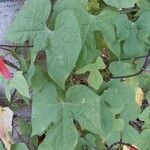
Ipomoea lobata
Spanish-flag · Exotic Love Vine · Fire vine · Mint lobata · Firecracker vine
Description
Source: leafsnapIpomoea lobata, the fire vine, firecracker vine or Spanish flag (formerly Mina lobata), is a species of flowering plant in the family Convolvulaceae, native to Mexico and Brazil.Growing to 5 m (16 ft) tall, Ipomoea lobata is a perennial climber often cultivated in temperate regions as an annual. It has toothed and lobed leaves (hence lobata) and one-sided racemes of flowers, opening red and fading to yellow, cream and white. These colours are graded down the length of the flower spike. The effect is like a firework, hence one of its popular names "firecracker vine". The colours vaguely resemble the red and gold of Spain's national flag, hence its other common name "Spanish flag". Ipomoea lobata requires a minimum temperature of 5 °C (41 °F), and a warm, sheltered spot in full sun (either equatorial-facing or west-facing). It has gained the Royal Horticultural Society’s Award of Garden Merit.It is closely related to two other popular, award-winning climbing plants, Ipomoea indica (blue dawn flower) and Ipomoea tricolor (morning glory). The name “Spanish flag” is also used for Lantana camara, an ornamental shrub.
Care Guide
💧 Water
Originating in tropical climates, the Spanish flag plant thrives in warm, humid environments. It requires consistent moisture and benefits from weekly watering to support its growth. During its growing season, rainwater can significantly enhance the vibrancy of its blooms.
☀️ Light Full sun
Spanish flag comes from open habitats, like sunny meadows and forest edges, that provide abundant light. It does best in full sun but can also tolerate partial sun, adapting well to various sunlight conditions.
What are the sunlight requirements for the Spanish flag (Ipomoea lobata)?
The Spanish flag (Ipomoea lobata) thrives in various sunlight conditions. It requires 'Full sun' conditions, which means it should receive above 6 hours of sunlight daily to flourish best. Alternatively, it can also grow in 'Partial sun' conditions, where it should get about 3-6 hours of sunlight. It's important to watch how sunlight moves through your garden throughout the day to find spots that offer a perfect balance of light and shade, ensuring the plants remain happy and healthy.
🌡️ Temperature 5–35°C
Spanish flag proviene de regiones tropicales, donde el clima suele ser cálido y húmedo. Por ello, está bien adaptada a temperaturas elevadas y a la humedad. No soporta bien los cambios bruscos de temperatura y prefiere un entorno con temperatura estable, por lo que es importante evitar fluctuaciones térmicas en el interior. Normalmente no tolera el frío y necesita temperaturas más altas para crecer. Si la temperatura ambiental desciende demasiado, la planta puede dejar de crecer o incluso morir.
What is the botanic name of the Spanish flag?
The botanic name of the Spanish flag is Ipomoea lobata. This name helps in specifically identifying the plant and differentiating it from others that may share common names but are botanically distinct.
💨 Humidity
🪴 Soil 6-8
🌱 Fertilizer
The best time to fertilize a Spanish flag is in early spring when it is coming out of dormancy. This encourages overall growth and the development of flowers. Fertilizing improves the foliage, stems, and branches, and helps produce flowers that are large, vibrant, and long-lasting. It also assists in moving nutrients from the roots to the blooms and enhances the plant’s health and resistance to disease.
🪴 Pot & Repot
✂️ Pruning
The Spanish flag is a vibrant climbing plant known for its colorful blossoms. To encourage healthy growth and abundant summer blooms, it's important to prune dead or poorly spaced stems in early spring. Regular pruning not only improves air circulation but also reduces the risk of disease. Be sure to use clean, sharp tools to prevent infections and maintain optimal plant health.
🌿 Propagating
🐛 Diseases & pets
☠️ Toxicity
Characteristics
- Plant Type
- Vine
- Life Cycle
- Perennial
- Genus
- Ipomoea
- Family
- Convolvulaceae
- Hardiness Zone
- 4-9
- Mature Height
- 4.88 m
- Mature Spread
- 2.44 m
- Leaf Color
- Green
- Leaf Type
- Deciduous
- Flower Color
- Red, Yellow
- Flower Size
- 2.03 cm to 3.05 cm
- Bloom Time
- Mid summer, Late summer, Fall
- Planting Time
- Spring, Summer, Autumn
- Harvest Time
- Fall, Early winter
- Native Area
- Honduras, Mexico, Guatemala, China