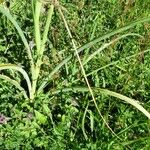
Iris latifolia
English iris · Iris · Süsen
Description
Source: leafsnapIris latifolia, commonly known as the English Iris or Broad-leaved Iris, is a perennial flowering plant belonging to the family Iridaceae. Native to Europe and Western Asia, it has gained popularity as an ornamental plant in gardens worldwide. The English Iris reaches up to 60 cm in height and features broad, sword-shaped leaves that are green-gray in color. It produces large, showy flowers with six petals arranged in a distinctive fan shape. These petals come in shades of blue, purple, white, or yellow, often adorned with intricate stripes or spots. Blooming from late spring to early summer, the English Iris thrives in well-drained soil and full sun exposure. It is a hardy plant that can tolerate cold temperatures but requires protection from excessive moisture during the winter months. Beyond its ornamental appeal, the English Iris has been valued for its medicinal properties for centuries, particularly for its anti-inflammatory benefits. Additionally, its roots have been used as a natural dye for textiles. In summary, this beautiful flowering plant adds color and elegance to any garden while offering potential health benefits through its medicinal properties.
🌳 Although often viewed merely as an ornamental plant, the bearded iris has a wide range of uses. Surprisingly, its roots yield "Irisol" or "Orris Oil," prized in both aromatherapy and the perfume market for a distinctive violet-scented note. It helps give rich, tempting aromas to luxury perfumes. Additionally, when dried, these rhizomes repel moths, making the bearded iris a practical presence in wardrobes as well as in gardens.
🎭 Belief, Courage, Insight, Optimism, Confidence
Care Guide
💧 Water Every 7 days
☀️ Light Full sun
The bearded iris flourishes in plentiful light, reflecting its natural environments. Such exposure substantially promotes its growth and bloom. Regardless of its growth stage, it prefers being bathed in light, despite tolerating a small amount of shade. Too much exposure can result in scorching of the leaves, whereas insufficient light can hinder its ability to bloom.
🌡️ Temperature 5–35°C
The bearded iris is a native plant in moderate-temperature areas where the usual temperatures range from 5 to 35 degrees Celsius (41 to 95 degrees Fahrenheit). This plant is inclined towards cool to mild temperatures and can endure mild freeze. When it comes to its growing period, the perfect temperatures are between 16 to 27 degrees Celsius (60 to 80 degrees Fahrenheit). If the climate is more heated, it's suggested either to grow them in semi-shade or offer shade during afternoons to maintain cooler soil and leaves.
💨 Humidity
🪴 Soil 6-7
🌱 Fertilizer
The optimal period to apply fertilizer to a Bearded iris is in the beginning of spring, when it transitions from dormancy to a phase of active growth. This supply of nutrients is essential for its healthy development. Despite the Bearded iris not requiring a large amount of fertilizer, its well-being and the enhancement of its flowers, making them better and longer-lasting, can be promoted through yearly fertilization.
🪴 Pot & Repot 2-3 years
When you are relocating Bearded iris to a different pot, opt for a pot that is 1-2 inches bigger and offers sufficient drainage. Employ a potting mix that drains well. The best time to carry out this task would be either in spring or fall, making sure the root ball is positioned a bit below the flower pot's edge. Once repotted, water the plant generously and place it in a warm location where it's exposed to indirect sunlight.
✂️ Pruning
🌿 Propagating
🐛 Diseases & pets
☠️ Toxicity
Characteristics
- Plant Type
- Herb
- Life Cycle
- Perennial
- Genus
- Iris
- Family
- Iridaceae
- Hardiness Zone
- 4-10
- Mature Height
- 0.61 m to 1.22 m
- Mature Spread
- 30 cm
- Leaf Color
- Green, Silver, Gray
- Leaf Type
- Evergreen, Deciduous
- Flower Color
- Purple, Blue, White, Yellow
- Flower Size
- 11.43 cm
- Bloom Time
- Late spring, Early summer
- Planting Time
- Spring
- Harvest Time
- Early summer, Mid summer