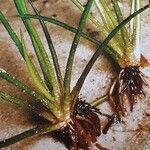
Isoetes echinospora
Spring quillwort · Spiny-spore quillwort · Spiny-spored quillwort · Spinyspore Quillwort · Stiff quillwort
Description
Source: leafsnapIsoetes echinospora, also known as spiny quillwort, spiny-spored quillwort or spring quillwort is a species of quillwort in the Isoetaceae family, and is the most abundant species in Canada. It can be found in shallow aquatic environments from Labrador and Newfoundland to Alaska, and south to Pennsylvania, Wisconsin, Colorado, and California. In Germany it is found in only two locations: the Feldsee and Lake Titisee, both in the High Black Forest.It bears 10–30 green to yellow leaves and a two-lobed corm. The velum covers one to three quarters of the sporangium, which are 10 millimetres (0.39 in) long. Round white megaspores are about 480 micrometres (0.019 in) in diameter and are covered with spines. Kidney-shaped microspores are about 26 micrometres (0.0010 in) long with smooth, fine spines. European populations of the plant lack the stomata present in North American populations. Isoetes muricata and Isoetes echinospora var. braunii refer to the North American plants, but are often considered synonyms of Europe's I. exhinospora.
Care Guide
💧 Water
☀️ Light Full shade
Spring quillwort is native to habitats such as forest understories or rocky areas that provide natural shade. It prefers Full Shade but can tolerate Partial Sun.
🌡️ Temperature 5–35°C
Spring quillwort grows best in forest thickets. It is very sensitive to temperature and humidity; high temperatures, dry conditions, and strong sunlight can all make it uncomfortable. In summer it needs adequate shade and a high-humidity environment. Typically it does not require special care in winter, but an extended winter drought can still be fatal to the plant.
💨 Humidity
🪴 Soil 6-7
🌱 Fertilizer
🪴 Pot & Repot
✂️ Pruning
Spring quillwort flourishes in aquatic environments and benefits from an early spring pruning to remove any dead or damaged leaves. To prevent infections, use sterile scissors for this task. Pruning not only improves the plant's health and vigor but also enhances its appearance, helps manage its size, and prevents overcrowding.
🌿 Propagating
🐛 Diseases & pets
☠️ Toxicity
Characteristics
- Plant Type
- Fern
- Life Cycle
- Perennial
- Genus
- Isoetes
- Family
- Isoëtaceae
- Hardiness Zone
- 5-9
- Mature Height
- 5 cm to 15 cm
- Mature Spread
- 10 cm to 20 cm
- Leaf Color
- Dark Green
- Leaf Type
- Semi-evergreen
- Planting Time
- Spring, Summer, Autumn
- Native Area
- Sweden, Austria, Czech Republic, Slovakia, Bulgaria, Poland, Morocco, Russia, Norway, Germany, Italy, Spain, Switzerland, Denmark, Iceland, Estonia, Netherlands, Finland, Ireland, United Kingdom, Latvia, France