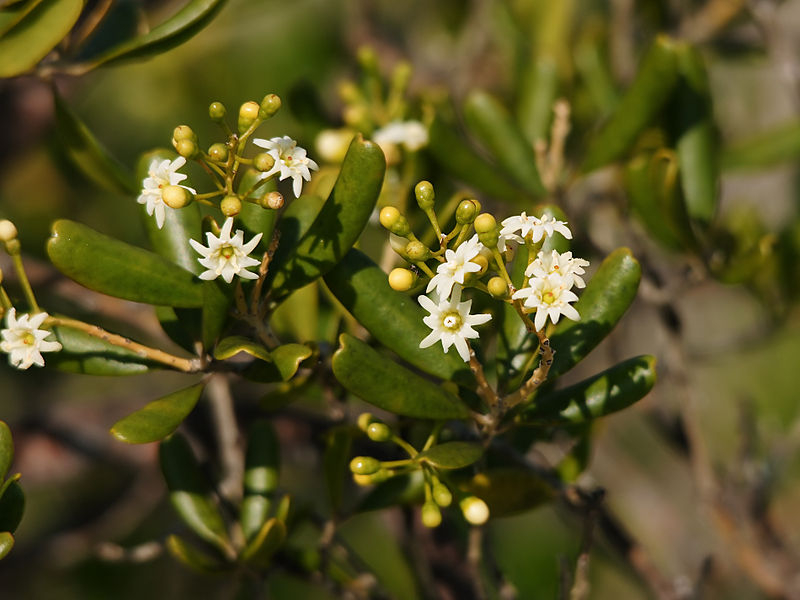
Jacquinia keyensis
Joebush · Joewood · Barbasco · Washwood · Ironwood
Description
Source: leafsnapJacquinia keyensis, commonly called Joewood, is a woody plant in the primrose family. It is native to the West Indies, where it is widespread on many islands. Its natural habitat is coastal strand, often on coral exposures with salt spray.It is a shrub or small tree with thick, saponaceous, evergreen leaves. It produces white flowers, primarily in the summer and fall.Jacquinia keyensis is listed as "Threatened" in the state of Florida.
Care Guide
💧 Water
Joewood flourishes in coastal areas where humidity is high and moisture is consistent. While it prefers to be watered weekly, it can endure brief periods of dryness. Joewood benefits greatly from rainwater, and it is usually cultivated outdoors to take advantage of natural climate conditions during its active growing season.
☀️ Light Full sun
Joewood comes from open habitats, such as sunlit meadows and the edges of forests, which offer plentiful light. It grows best in full sun but can tolerate partial sun, adjusting well to different light conditions.
🌡️ Temperature 20–37.8°C
Joewood comes from tropical areas where the climate is generally warm and humid. Therefore, it is well adapted to high temperatures and humidity. It is sensitive to abrupt temperature changes and prefers stable conditions, so preventing indoor temperature fluctuations is important. It usually cannot tolerate cold and requires warm temperatures for growth. If the environmental temperature drops too low, the plant may stop growing or even die.
💨 Humidity
🪴 Soil 6-8
🌱 Fertilizer
The best time to fertilize a Joewood is in early spring, as it comes out of dormancy. This encourages overall growth and flower development. Fertilization improves the foliage, stems, and branches, while encouraging large, vibrant, long-lasting flowers. It helps move nutrients from the roots to the flowers and enhances the plant's health and resistance to disease.
🪴 Pot & Repot
✂️ Pruning
Joewood is a coastal shrub known for its attractive flowers and dense foliage. To encourage growth and maintain its shape, it's best to prune the plant from early to late winter. When pruning, remove any dead branches and thin out dense areas to improve air circulation. This helps enhance the shrub's vigor and disease resistance, ensuring it will produce abundant blooms in the next season.
🌿 Propagating
🐛 Diseases & pets
☠️ Toxicity
Characteristics
- Plant Type
- Tree, Shrub
- Life Cycle
- Perennial
- Genus
- Jacquinia
- Family
- Primulaceae
- Hardiness Zone
- 10-11
- Mature Height
- 0.91 m to 3.05 m
- Mature Spread
- 0.91 m to 2.13 m
- Leaf Color
- Dark Green
- Leaf Type
- Evergreen
- Flower Color
- White
- Flower Size
- 0.51 cm to 0.76 cm
- Bloom Time
- Late winter, Early spring, Mid spring
- Planting Time
- Spring, Summer, Autumn
- Harvest Time
- Late spring, Early summer, Mid summer
- Native Area
- Bahamas, Cuba, Jamaica