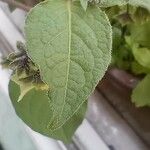
Jaltomata procumbens
Creeping false holly
Description
Source: leafsnapJaltomata procumbens, the creeping false holly, is a plant species native to Arizona, USA, Mexico, Central America, Colombia, Ecuador, and Venezuela. It grows as a weed in agricultural fields and other disturbed locations, but in many places the people protect it because of the edible fruits it produces.Jaltomata procumbens is a spreading, trailing to ascending herb forming many shoots from a single root. Leaves are broadly lanceolate, up to 20 cm long, dark green. Flowers are rotate, pale yellow-green with darker green spots toward the center. Berries are dark purple, spherical, about 1 cm in diameter, with a strong scent resembling that of grapes (Vitis spp.).
Care Guide
💧 Water
☀️ Light Full sun
Creeping false holly is a sun-loving perennial herbaceous plant native to open habitats, commonly thriving in meadows and grasslands. It prefers full sun but can also tolerate partial sun conditions.
🌡️ Temperature 20–37.8°C
Creeping false holly is fairly adaptable to temperature, able to withstand high heat and significant temperature swings. In hot weather, care should be taken with watering and providing proper shade to avoid sunburn. However, creeping false holly is not very tolerant of low temperatures. While it can handle some cold, extremely low temperatures can cause frost damage.
What is the common and botanical name of Creeping false holly?
Creeping false holly is commonly known by its name Creeping false holly, and its botanical name is Jaltomata procumbens.
💨 Humidity
🪴 Soil 5-7
🌱 Fertilizer
The Creeping false holly plant needs adequate nutrients to achieve optimal fruit production. Fertilize in early spring to encourage new growth and bloom development. Regular feeding keeps the plant healthy, produces more delicious fruit, and prevents nutrient-deficiency problems such as yellow leaves and poor fruit production.
🪴 Pot & Repot
✂️ Pruning
To ensure optimal health for creeping false holly, it is important to prune it in early spring. Remove any dead stems and thin out dense areas to improve airflow, which encourages fruit production. Be careful not to over-prune, as this can affect its natural shape. Always use clean, sharp tools to reduce the risk of disease.
🌿 Propagating
🐛 Diseases & pets
☠️ Toxicity
Characteristics
- Plant Type
- Herb
- Life Cycle
- Perennial
- Genus
- Jaltomata
- Family
- Solanaceae
- Hardiness Zone
- 9-11
- Mature Height
- 30 cm to 61 cm
- Mature Spread
- 30 cm to 49 cm
- Leaf Color
- Green, Dark Green
- Leaf Type
- Evergreen
- Flower Color
- White
- Flower Size
- 1.02 cm to 1.52 cm
- Bloom Time
- Late spring, Summer, Early fall, Mid fall
- Planting Time
- Spring, Summer, Autumn
- Harvest Time
- Mid summer, Late summer, Fall, Early winter
- Native Area
- Colombia, Honduras, Mexico, Bolivia, Venezuela, Peru, Ecuador, Costa Rica, Panama