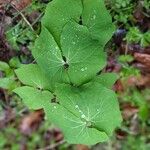
Jeffersonia diphylla
Rheumatism-root · Twinleaf · Bloodroot
Description
Source: leafsnapJeffersonia diphylla, commonly known as twinleaf, is a perennial herb native to eastern North America. The plant is named after Thomas Jefferson, an avid botanist who discovered it in Virginia. Twinleaf grows up to 30 cm tall and has two large, deeply lobed leaves that resemble butterfly wings. In spring, it produces delicate white flowers about 2 cm in diameter, with eight petals arranged in a star shape. These flowers eventually give way to small seed pods that split open when ripe. Twinleaf prefers moist woodland habitats with well-drained soil and partial shade. It is often found growing alongside other spring ephemerals, such as trilliums and bloodroot. Historically, Native American tribes used twinleaf for medicinal purposes to treat ailments such as fever, coughs, and digestive issues. However, it's important to note that any medicinal use of twinleaf should be done under the guidance of a healthcare professional. Overall, Jeffersonia diphylla is an attractive woodland wildflower with unique foliage, making it an excellent addition to any shade garden or naturalized area. Its delicate beauty can be appreciated up close by gardeners and nature enthusiasts alike.
Care Guide
💧 Water Every 7 days
Rheumatism-root, a plant native to the woodlands of eastern North America, thrives in consistently moist conditions. It grows best in soil that remains evenly damp, although it can handle short periods of dryness. For optimal health, water the plant weekly and use rainwater during its growing season. This makes rheumatism-root an ideal choice for outdoor cultivation as an herbaceous perennial.
How should I water my Rheumatism-root plant?
To ensure the health of the Rheumatism-root, it is recommended to water it with filtered water at room temperature. Tap water may contain harmful particles, so it is best to use filtered water. Since the Rheumatism-root is accustomed to warm environments, it is important to avoid using cold water, as this can be a shock to the plant. Additionally, overhead watering should be avoided to prevent foliage issues. Instead, gently apply filtered room temperature water directly to the soil until it is completely soaked. This method is beneficial as it helps to moisten the roots, allowing them to spread and absorb the necessary nutrients from the soil.
What should I do if I give my Rheumatism-root plant too much or too little water?
Overwatering is a common issue for Rheumatism-root plants and can have serious consequences. When this species receives too much water, its stems and leaves may wilt and turn yellow. Prolonged overwatering can lead to diseases like root rot, mold, and mildew, which can ultimately kill the plant. On the other hand, underwatering is less common for Rheumatism-root plants because they have good drought tolerance. However, it is still possible, and when it happens, the leaves may become brittle and brown. It's important to recognize the signs of overwatering early on when taking care of your Rheumatism-root plant. Some of the diseases caused by overwatering, such as root rot, may be irreversible if not addressed promptly. If you notice the early signs of overwatering, reduce your watering schedule immediately. It's also recommended to check the soil quality in which your Rheumatism-root plant grows. If the soil doesn't drain well, replace it with a loose, well-draining potting mix. Conversely, if you suspect your Rheumatism-root plant is not getting enough water, simply increase your watering frequency until the signs of dehydration disappear.
How often do I need to water my Rheumatism-root plant?
If your Rheumatism-root plant is in a pot, the best way to determine if it needs watering is by checking the soil moisture. Simply insert your finger into the soil and if you find that the top two to three inches are dry, it's time to water it. If you are growing your Rheumatism-root plant outdoors in the ground, you can use the same method to test the soil. Once again, if the top few inches of soil are dry, it's time to water. Typically, during the spring and early fall seasons, you will need to water this plant about once a week using this method. However, when the weather gets extremely hot, you may need to increase your watering frequency to two or more times per week. It's worth noting that mature and well-established Rheumatism-root plants have a remarkable ability to withstand drought.
How much water does my Rheumatism-root plant need?
To properly water your Rheumatism-root plant, it is important to water generously. Wait until the top two to three inches of soil are dry, and then give the plant a thorough watering, making sure to soak the soil completely. The amount of water should be enough to make excess water flow out of the drainage holes at the bottom of the pot. If you don't see excess water draining, it means you haven't watered enough. However, it's also important to avoid letting water accumulate in the soil, as this can be harmful to the plant. Additionally, if water doesn't drain well through the pot, it may indicate poorly draining soil, which should be avoided as it can negatively affect the plant's health. If the plant is outdoors, it typically only requires 1 inch of rain per week.
How do I water my Rheumatism-root plant as it grows?
The water needs of the Rheumatism-root can change depending on its growth stages. When it is in the first few years of its life or if you have recently transplanted it, you will need to give it more water than usual. During these stages, the Rheumatism-root focuses on sprouting new roots to support future growth, and these roots require more moisture. As the Rheumatism-root matures, it will require less water. Another growth stage that may require more water is during the bloom period when the plant is developing flowers. This is a time when the Rheumatism-root can benefit from additional moisture.
☀️ Light Partial sun
Rheumatism-root favors a middle ground between full exposure and deep shade, thriving most under a canopy that filters light, allowing brightness without becoming overpowering. It can tolerate spots with reduced light, but too much shadow or intense sunlight results in less vigorous growth. Its native habitat is characterized by dappled light.
What are the sunlight requirements for Rheumatism-root?
Rheumatism-root requires a specific balance of light to thrive optimally. It can tolerate both partial sun, which is about 3-6 hours of sunlight per day, and full shade, characterized by less than 3 hours of sunlight per day. It's important to observe how sunlight moves through your garden to find spots that offer the perfect balance for your plants. This ensures they receive adequate light without the risk of overexposure.
What are the essential growth conditions for Rheumatism-root?
Rheumatism-root flourishes best under conditions that mimic its native habitat, which includes a balance between sunlight and shade, often referred to as filtered light or dappled sunlight. This environment invites enough light without being too intense. It is adaptable to lower light levels, but both excessive shadow and intense light can hinder its growth. When natural light is insufficient, especially for indoor plants, artificial lighting can be utilized to promote better growth. LEDs are recommended due to their ability to be customized to plant needs, with full sun plants requiring 30-50W/sq ft, partial sun plants 20-30W/sq ft, and full shade plants 10-20W/sq ft of artificial light.
How can light deficiency affect Rheumatism-root, and what are the solutions?
Rheumatism-root can exhibit several symptoms when exposed to inadequate light, such as smaller new leaves, leggy growth, quicker leaf drop, delayed or halted growth, lighter-colored new leaves, chlorosis, sunscald, leaf curling, wilting, and leaf scorching. To address these issues, indoor plants can be moved to sunnier spots gradually or supplemented with artificial light for at least 8 hours daily. For outdoor plants, a gradual transition to sunnier locations is recommended to prevent sunburn. Pruning or transplanting may be necessary to ensure the plant receives sufficient sunlight. However, it's important to note that parts of the plant already damaged by poor light conditions may not recover, but new growth will be healthier with improved light exposure.
What are the specific artificial lighting guidelines for indoor Rheumatism-root plants?
For indoor Rheumatism-root plants not receiving enough natural sunlight, artificial lighting can be a crucial solution. It's advisable to use LED lights that can be adjusted to provide specific wavelengths needed for the plant's growth. Depending on the plant's sunlight needs, the intensity of artificial light should vary: 30-50W/sq ft for full sun plants, 20-30W/sq ft for partial sun plants, and 10-20W/sq ft for full shade plants. The light source should be placed 12-36 inches above the plant, simulating natural sunlight effectively. To mimic natural daylight hours, most plants require 8-12 hours of light per day.
🌡️ Temperature 5–32.2°C
Rheumatism-root is a native plant that does well in temperatures ranging from 41 to 90 °F (5 to 32 ℃). In colder seasons, it is advisable to provide sufficient insulation to keep it warm. Conversely, in hotter periods, providing shade will be advantageous.
What are the ideal growing conditions for Rheumatism-root?
Rheumatism-root, botanically known as Jeffersonia diphylla, is a plant that flourishes in temperatures ranging from 41 to 90 °F (5 to 32 °C). To promote its health and growth, during colder seasons, it is advisable to insulate the plant to keep it warm, while in hotter periods, providing shade is beneficial for its well-being. Although Rheumatism-root possesses significant cold resistance, in extreme winter conditions where temperatures are anticipated to fall below -25°C, protective measures such as covering the plant with soil or straw are recommended. Additionally, watering the plant abundantly before the first freeze in autumn to keep the soil moist can help prevent drought and water scarcity during the colder months.
How does Rheumatism-root react to low temperatures?
Despite its cold tolerance, Rheumatism-root best thrives when temperatures remain above 5°C. Through the winter, efforts should be made to ensure temperatures do not fall below -20°C. In cases where temperatures dip below -25°C, while immediate effects might not be noticeable, the plant may exhibit decreased sprouting or fail to sprout at all come spring. As a solution, it is advised to remove any parts of the plant that have not sprouted in the spring, allowing for rejuvenation and healthy growth in the coming season.
What should be done if Rheumatism-root is exposed to high temperatures?
In the summer months, it's crucial to keep the Rheumatism-root's surrounding temperature below 32°C. Exposure to temperatures above 35°C can cause the leaves to lighten in color, curl, and become susceptible to sunburn, with severe cases leading to the wilting and drying up of the entire plant. To mitigate these issues, removing sunburned and dried-up parts of the plant is recommended. Furthermore, relocating the plant to a shaded area or using a shade cloth to protect it from the midday and afternoon sun can be beneficial. Ensuring the soil remains moist by watering in the morning and evening can also help alleviate stress from high temperatures.
💨 Humidity
🪴 Soil 5-7
🌱 Fertilizer
The best time to fertilize a Rheumatism-root is in early spring, when it is coming out of dormancy and beginning active growth. Fertilizing supplies important nutrients needed for healthy development. Although Rheumatism-root has relatively low fertilizer requirements, annual fertilization can improve its survival and encourage better, longer-lasting flowers.
Why do I need to add plant food to my Rheumatism-root plant?
Fertilization plays a crucial role in the growth of Rheumatism-root and other plants. It provides essential nutrients that support both the aerial and underground parts of the plant. While Rheumatism-root can survive without fertilization, annual fertilization can greatly benefit the plant. It helps to keep the plant healthy and may even promote the production of longer-lasting and more beautiful flowers. Therefore, individuals who want their Rheumatism-root to thrive should consider regular fertilization.
When should I fertilize my Rheumatism-root for it to grow best?
The best time to fertilize a Rheumatism-root is in late winter to early spring when the plant is coming out of its dormant phase and starting to grow. Fertilizing at this time promotes healthy growth and ensures a good start for the season. While it's generally recommended to fertilize in early spring, it is also acceptable to fertilize in the fall. However, it is not advisable to fertilize during summer or winter.
When is the best time to not use fertilizer for my Rheumatism-root?
To properly fertilize your Rheumatism-root, it's important to follow a specific timetable. The best time to feed this plant is during late winter and early spring. Since this plant has low fertilization needs, a single annual feeding is sufficient. It's crucial to avoid fertilizing throughout spring, summer, and fall as it can easily result in overfertilization and its associated complications. However, there is an exception: if you missed fertilizing in spring, it is acceptable to feed the plant in fall. Additionally, refrain from fertilizing during winter when the Rheumatism-root enters a dormant growth phase and does not produce new growth.
What kind of fertilizer does my Rheumatism-root plant need?
A general-purpose fertilizer with balanced nutrients is recommended for Rheumatism-root. However, there are specific nutrient blends that can be even more beneficial. Some gardeners believe that higher levels of phosphorus help to strengthen roots and improve flower growth. As Rheumatism-root is a flowering plant, using a phosphorus-rich fertilizer may be the best option. Whether in granular or liquid form, the fertilizer should contain an adequate amount of nutrients. Additionally, organic methods such as compost and manure can greatly improve the soil quality for Rheumatism-root.
How should I fertilize my Rheumatism-root plant?
To fertilize a Rheumatism-root plant, the most common method is to use granular or pellet fertilizer. It's important to fertilize when the plant is transitioning from its dormant phase to active growth, usually in early spring. Wait for the plant to start sending shoots through the soil before applying the fertilizer. Alternatively, some people prefer using liquid fertilizer. If you choose this method, dilute the fertilizer with water before applying. Regardless of the type of fertilizer, it's essential to moisten the soil before, during, and after applying it.
🪴 Pot & Repot
✂️ Pruning
The rheumatism-root plant is known for its distinctive twin leaves and medicinal properties. Pruning in early spring helps promote healthy growth by removing dead stems. A light pruning in late spring is useful for shaping the plant. It's important to use clean tools to prevent infection. Regular pruning helps maintain the plant's size, improves airflow, and enhances its overall vigor.
🌿 Propagating
🐛 Diseases & pets
☠️ Toxicity
Characteristics
- Plant Type
- Herb
- Life Cycle
- Perennial
- Genus
- Jeffersonia
- Family
- Berberidaceae
- Hardiness Zone
- 5-8
- Mature Height
- 13 cm to 91 cm
- Mature Spread
- 30 cm to 40 cm
- Leaf Color
- Green
- Leaf Type
- Deciduous
- Flower Color
- White
- Flower Size
- 2.54 cm to 7.62 cm
- Bloom Time
- Early spring, Mid spring
- Planting Time
- Spring, Summer
- Harvest Time
- Late spring, Early summer
- Native Area
- Eastern North America