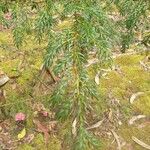
Juniperus brevifolia
Azores Juniper
Description
Source: leafsnapJuniperus brevifolia, the Azores juniper, is a species of juniper, endemic to the Azores (on Corvo, Faial, Flores, Pico, Santa Maria, São Jorge, São Miguel, and Terceira), where it occurs at altitudes of 240–800 metres (790–2,620 feet), rarely up to 1,500 m (4,900 ft). It is closely related to Juniperus oxycedrus (prickly juniper) of the Mediterranean region and Juniperus cedrus (Canary Islands juniper) of the neighboring Macaronesian islands. It is threatened by habitat loss.It is a shrub or small tree growing to a height of 6 m (20 ft) and a trunk diameter up to 50 centimetres (20 in). The leaves are evergreen, needle-like, in whorls of three, glaucous green, 4–10 millimetres (1⁄4–1⁄2 in) long and 1–3 mm broad, with a double white stomatal band (split by a green midrib) on the inner surface. It is dioecious, with separate male and female plants. The seed cones are berry-like, green ripening in 18 months to orange-red with a variable pink waxy coating; they are spherical, 6–9 mm diameter, and have three or six fused scales in one or two whorls of three, the three larger scales each with a single seed. The seeds are dispersed when birds eat the cones, digesting the fleshy scales and passing the hard seeds in their droppings. The male cones are yellow, 2–3 mm long, and fall soon after shedding their pollen in early spring.This is a vulnerable species in its native range due to a combination of historical felling for the valuable wood and competition from invasive introduced plants.
Care Guide
💧 Water
After planting, water Azores juniper every other day to help it adapt. After a week, you can reduce the watering frequency. Azores juniper is drought-tolerant and may struggle with overwatering, so be careful not to water it too much. During hot summers, increase the watering to prevent the plant from becoming dehydrated.
☀️ Light Full sun
The Azores juniper is native to open habitats, like sunny meadows and forest margins that supply abundant light. It performs best in full sun but can tolerate partial sun, adapting well to a variety of light conditions.
How much sunlight does the Azores juniper (Juniperus brevifolia) require?
The Azores juniper, also known by its botanical name Juniperus brevifolia, thrives in varying amounts of sunlight. For full sun exposure, it requires above 6 hours of direct sunlight daily. In conditions of partial sun, about 3-6 hours of sunlight per day is adequate. It's important to observe the way sunlight moves through your garden, selecting locations that offer a harmonious balance of light and shade, which is crucial for the well-being of your plants.
🌡️ Temperature 15–35°C
Azores juniper shows strong adaptability to a variety of climatic conditions, from very hot summers to cold winters. However, it has a preferred temperature range for healthy growth. If temperatures become excessively high, the plant is susceptible to heat and humidity stress, which can lead to its death. In areas where temperatures near the lower limit of its cold tolerance, it is important to provide insulation to protect the plant.
What is the Azores juniper's botanical name?
The botanical name of the Azores juniper is Juniperus brevifolia. This species is known specifically by this scientific name, which helps in its identification and classification.
💨 Humidity
🪴 Soil 6-8
🌱 Fertilizer
Azores juniper has specific nutrient needs and does not require heavy fertilization. Applying fertilizer in spring is best for achieving optimal growth. Providing nutrients enhances its health, strengthens its resistance to pests and diseases, and helps preserve its long lifespan.
🪴 Pot & Repot
✂️ Pruning
The Azores juniper is known for its dense, dark green foliage and its ability to withstand drought. To encourage growth and maintain its shape, it's best to prune in early spring. When pruning, focus on removing dead branches and thinning out crowded areas to improve air circulation. Be careful not to cut into old wood, as it recovers slowly. Regular pruning not only enhances the plant's vitality but also improves its overall appearance.
🌿 Propagating
🐛 Diseases & pets
☠️ Toxicity
Characteristics
- Plant Type
- Shrub, Tree
- Life Cycle
- Perennial
- Genus
- Juniperus
- Family
- Cupressaceae
- Hardiness Zone
- 7-10
- Mature Height
- 2.13 m to 4.88 m
- Mature Spread
- 1.52 m to 3.05 m
- Leaf Color
- Dark Green
- Leaf Type
- Evergreen
- Bloom Time
- Mid spring, Late spring
- Planting Time
- Spring, Summer, Autumn
- Harvest Time
- Late summer, Early fall, Mid fall