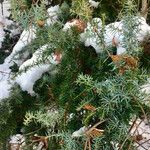
Juniperus communis
ارس · پیرو · Common juniper · Juniper · Malchangel
Description
Source: leafsnapJuniperus communis, commonly known as common juniper, is an evergreen shrub or small tree that belongs to the cypress family. It is widely distributed across the Northern Hemisphere and thrives in a variety of habitats including heathlands, moorlands, and rocky slopes. This plant has a distinctive look with its needle-like leaves arranged in whorls of three. The leaves vary in color from green to blue-green and have a waxy coating that helps retain moisture. Additionally, common juniper produces small berries that transition from green to blue-black as they ripen. Throughout history, common juniper has been utilized for various purposes. Its berries have been employed medicinally to treat digestive issues and respiratory infections. They are also used to flavor gin and other alcoholic beverages. The plant is hardy, capable of enduring harsh environmental conditions such as cold temperatures, drought, and poor soils. It is often planted for its ornamental value in gardens and parks due to its unique appearance. However, if not properly managed, common juniper can become invasive. It spreads through underground rhizomes, which can form dense thickets over time. In summary, Juniperus communis is a fascinating evergreen shrub with unique features, making it an important species both ecologically and economically around the world.
🌳 Common juniper has uses across several areas: its wood is valued for its fragrant character and resistance to decay, making it suitable for producing long-lasting furniture and small ornamental objects. Its berries are used in cooking and also act as natural flavoring agents in gin production. Additionally, essential oils obtained from its needles and wood are prized for their aromatic and therapeutic qualities.
🎭 Safeguarding, Anti-Theft Affection
Care Guide
💧 Water Every 7 days
Common juniper flourishes in dry environments and only needs to be watered every one to two weeks, highlighting its drought-resistant nature. As an evergreen plant, it efficiently retains moisture and keeps its foliage throughout the year, regardless of changes in seasonal rainfall.
How should I water my Common juniper plant?
Watering your Common juniper is a simple task. To water the tree, you can use a garden hose to slowly soak the soil. Large trees may require more water, so a garden hose is the best tool. However, for smaller trees, a watering can or other small tool can work. Avoid overhead watering as it can cause disease, especially for young trees.
What should I do if I give my Common juniper plant too much or too little water?
Overwatering can occur if the soil doesn't allow for proper drainage, causing the Common juniper to deteriorate. In this case, you can either improve the soil's drainage or relocate the plant to a more suitable area. If you're growing the juniper in a pot, you may need to repot it using looser soil that promotes better drainage. Overwatering can lead to diseases, so it's important to address any issues promptly. On the other hand, if your Common juniper is underwatered, simply watering it more frequently will help restore its health. To determine if you've overwatered the juniper, examine the foliage. New growth that is discolored or easily breaks may indicate excessive moisture. Standing water or slow drainage in the plant's vicinity may also mean the soil is too moist. Conversely, underwatered juniper trees will exhibit sparse, brown leaves. Considering recent rainfall and high temperatures can help you determine the appropriate course of action.
How often should I give water to my Common juniper plant?
A mature Common juniper is quite self-sufficient when it comes to water. It can survive solely on rainfall and typically doesn't require watering, except in the hottest months. Even then, watering once a week should suffice. The exception is for newly planted junipers; in that case, regular watering is needed to help the roots settle. However, be cautious not to overwater, as Common juniper does not like standing water. It's better to avoid watering unless necessary.
How much water does my Common juniper plant require?
During the height of summer, Common juniper typically needs to be watered about once a week with one inch of water. However, the amount may vary if it has rained one inch or more during that week. If it is a newly planted Common juniper, it will require more water during the establishment period, usually once every one to two weeks for the first few growing seasons.
How should I water my Common juniper throughout the year?
The Common juniper tree will need the most water during the hot summer months. During this time, you should water it about once per week if there is no rainfall. However, during other seasons, this plant can often survive without any water. In spring and fall, there might be a need for water if the weather is exceptionally hot, but this is rare. Unlike other plants, the Common juniper keeps growing during winter and does not go into full dormancy. However, water needs during winter will be low because the cool temperatures do not cause the soil to dry out quickly.
☀️ Light Full sun
Common juniper grows best in bright light, mirroring the sunny conditions of its native environment. It can also tolerate moderate light levels. Too much or too little light can harm the plant, especially causing discoloration and stunted growth.
What are the sunlight requirements for Common Juniper?
Common Juniper requires full sun exposure, defined as above 6 hours of sunlight, to thrive optimally but can also grow under partial sun, which is about 3-6 hours of sunlight. The essence of observing and understanding how sunlight moves through your garden cannot be overstated. Ensuring that your plants are placed in areas that offer a suitable balance of light and shade is crucial for their growth and happiness. This careful placement supports the plant's overall health, encourages vibrant coloration, and supports robust growth.
How does light affect Common Juniper's health?
Light plays a significant role in the health and growth of Common Juniper, mirroring the conditions found in its natural, sunny habitat. Adequate strong light is essential for the plant's flourishing, while it can still manage moderate light situations. Insufficient or excessive light exposure, however, might lead to health issues such as discoloration and weak growth. It's noteworthy that when natural light is scarce, especially during winter or in less sunny areas, artificial lighting can be employed as an effective supplement to promote healthy growth. Artificial lights, particularly LED, can be tailored to fulfill specific plant needs by adjusting the light type, distance to the plant, and duration of exposure.
What are some common symptoms of improper light exposure in Common Juniper?
Common Juniper, when not exposed to adequate light, may exhibit various symptoms indicating stress or poor health. Some signs include smaller new leaves, leggy or sparse growth, accelerated leaf drop, halted or no new growth, and lighter-colored or chlorotic leaves. Additionally, excessive sunlight can lead to sunscald, leaf curling, wilting, leaf scorching, and chlorosis. These symptoms reflect either a deficiency or excess of light, impacting the plant's ability to carry out photosynthesis effectively, maintain its structure, and overall well-being.
How can I address and prevent light-related issues in Common Juniper?
To address light-related issues in Common Juniper, gradual adaptation is key. For indoor plants, transitioning them to sunnier spots weekly until they receive at least 6 hours of sunlight or using artificial lighting like desk or professional grow lights can make a significant difference. Outdoors, similar gradual movement towards optimal sunlight positions is recommended to prevent sunburn. Additionally, managing obstructions by pruning or transplanting can improve sunlight access. It's important to note that while affected parts might not recover, new growth under improved lighting conditions should be healthy and vibrant.
🌡️ Temperature 0–35°C
Native common juniper grows in temperate regions with average temperatures between 32 and 64 ℉ (0 to 18 ℃). To thrive, common juniper typically prefers temperatures of 50 to 95 ℉ (10 to 35 ℃). In winter, it is recommended to lower temperatures to about 20 to 46 ℉ (-7 to 8 ℃) to replicate its natural winter conditions.
What are the essential growing conditions for Common Juniper?
Native common juniper thrives in temperate regions with average temperatures ranging from 32 to 64 ℉ (0 to 18 ℃), preferring conditions between 50 to 95 ℉ (10 to 35 ℃) for optimal growth. During winter, it's advised to reduce temperatures to around 20 to 46 ℉ (-7 to 8 ℃) to mimic natural winter conditions. Common juniper has a strong resistance to cold, and special frost protection is usually not required. However, in cases where winter temperatures are expected to drop below the growth limit, cold protection through materials such as non-woven fabric or cloth for the trunk and branches is important. Additionally, abundant watering before the first freeze in autumn ensures the soil remains moist and frozen, which helps prevent drought and water scarcity during winter and early spring.
What should I do if my Common Juniper is exposed to temperatures below its cold tolerance?
When Common juniper is exposed to temperatures below its cold tolerance limit, there might not be noticeable changes during winter, but the branches may become brittle and dry in spring, and no new shoots will emerge. To address this, prune away any dead branches that have failed to produce new leaves in spring.
How do I care for my Common Juniper during high temperatures?
During summer, it's crucial to keep Common juniper below its maximum tolerable growth temperature. Exceeding this temperature can cause the leaves to lighten in color, tips to become dry and withered, and the plant becomes more susceptible to sunburn. To protect the plant, trim away the sunburned and dried-up parts, move it to a location with shade from the midday and afternoon sun, or use a shade cloth. Watering the plant in the morning and evening helps keep the soil moist.
💨 Humidity dry (<40%)
This plant prefers dry conditions, so don't mist it. However, watering it less often can also thrive in higher humidity.
🪴 Soil 5-7
🌱 Fertilizer
Common juniper has particular nutrient needs and does not require heavy fertilization. Spring is the best time to apply fertilizer for optimal growth. Supplying nutrients improves its health, increases its resistance to pests and diseases, and helps maintain its long lifespan.
Why should I put fertilizer on my Common juniper plant?
By fertilizing Common juniper in the spring, you can promote its healthy growth and support its long lifespan. Adding nutrients to the soil not only enhances the plant's overall health but also boosts its resistance against common pests and diseases that can inhibit growth or reduce its lifespan.
When should I fertilize my Common juniper?
Common juniper is a little different from garden annuals and perennials when it comes to nutrient needs. It doesn't need a lot of extra nutrients to grow healthily. If you want to fertilize Common juniper, the best time to do so is in the spring before new growth emerges.
When is the worst time to fertilize my Common juniper?
Common juniper is different from other plants because it doesn't need frequent fertilization. In fact, too much fertilizer can harm it and cause it to die back. If you have a common juniper, only use fertilizer in the spring and avoid applying it during the summer, fall, and winter. Additionally, there's no need to add organic matter to the soil during these seasons either.
Which fertilizer should I use for my Common juniper?
Consider the age of your plant when choosing fertilizer. Keep in mind that Common juniper doesn't need a lot of extra nutrients. Look for a balanced plant food to promote healthy root development and growth, but avoid fertilizers high in nitrogen.
How can I add fertilizer to my Common juniper plant?
To ensure successful fertilizer application for Common juniper, remember that the timing and method are crucial. Apply the fertilizer once in the spring, focusing on the plant's base while being careful not to get any on the trunk. If using granulated fertilizer, cover the pellets with a thin layer of soil to enhance absorption into the soil.
🪴 Pot & Repot 2-3 years
When repotting Common juniper, select a pot 1-2 inches (2.5–5.1 cm) larger with good drainage. Use a well-draining potting mix. Repot in spring or fall, making sure the root ball is positioned slightly below the rim of the flower pot. Water thoroughly after repotting and place it in a warm spot with indirect sunlight.
✂️ Pruning
The common juniper is an evergreen shrub known for its needle-like leaves and berry-like cones. To maintain its health, prune it lightly in early spring. This helps improve air circulation and shape the shrub, while avoiding heavy pruning due to its slow growth. Regular light pruning promotes overall health and can help prevent disease.
🌿 Propagating
🐛 Diseases & pets
☠️ Toxicity
Characteristics
- Plant Type
- Shrub
- Life Cycle
- Perennial
- Genus
- Juniperus
- Family
- Cupressaceae
- Hardiness Zone
- 3-9
- Mature Height
- 10.06 m to 15.85 m
- Mature Spread
- 30 cm to 61 cm
- Leaf Color
- Green, Blue, Gray, Silver
- Leaf Type
- Evergreen
- Flower Color
- Yellow
- Flower Size
- 2.54 cm
- Bloom Time
- Late spring, Early summer
- Planting Time
- Spring, Autumn
- Harvest Time
- Early spring, Mid spring, Mid summer, Late summer, Fall, Winter
- Native Area
- Turkey, Sweden, Austria, Slovakia, Montenegro, Slovenia, Morocco, Croatia, Belarus, Russia, Germany, Iceland, Estonia, Koppen, Romania, Latvia, Belgium, Portugal, Nepal, Netherlands, France, Czech Republic, Bulgaria, Armenia, Poland, Greece, Ukraine, Serbia, China, Lithuania, Norway, Afghanistan, Kyrgyzstan, Kazakhstan, Italy, Spain, Switzerland, Denmark, Japan, Mongolia, Finland, Iran, Albania, Ireland, United Kingdom, Hungary, Algeria, Azerbaijan