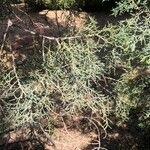
Juniperus pinchotii
Copper-berry juniper · Pinchot juniper · Redberry juniper · Pinchot's juniper
Description
Source: leafsnapJuniperus pinchotii, commonly known as Pinchot's juniper, is an evergreen shrub or small tree belonging to the cypress family. Native to the southwestern United States and northern Mexico, it thrives in arid and semi-arid regions. This plant is easily recognizable by its blue-green, needle-like leaves that grow in clusters of three, and its reddish-brown bark that peels off in thin strips. Pinchot's juniper can grow up to 20 feet tall, although it typically remains smaller. With a slow growth rate, it can live for hundreds of years under favorable conditions. The plant is dioecious, meaning individual plants are either male or female. Ecologically, Pinchot's juniper is significant as it provides habitat for various wildlife species, including birds, small mammals, and insects. Its deep root system helps prevent soil erosion by stabilizing the ground. Indigenous people have utilized Pinchot's juniper for numerous purposes, including medicine, food flavoring (the berries are edible), firewood (the wood burns slowly), and fence posts (the wood is durable). Overall, Juniperus pinchotii is an important native species with both ecological and cultural significance, having been used by indigenous communities for centuries.
Care Guide
💧 Water Every 7 days
Redberry juniper is highly drought-tolerant and thrives even with minimal moisture, thanks to its natural adaptation to irregular rainfall. It should be watered every 1-2 weeks, allowing the soil to dry out between waterings. As an evergreen, it requires consistent, moderate hydration to maintain its vibrant green needles throughout the year.
How should I water my Redberry juniper plant?
Watering your Redberry juniper is a simple and straightforward task. To do so, you can use a garden hose to slowly soak the soil. This is especially important for larger trees, as they may require a higher volume of water. However, if you have smaller trees, a watering can or another smaller tool will suffice. It's important to avoid overhead watering, as excessive moisture on the leaves can lead to disease, particularly when the tree is young.
What should I do if I give my Redberry juniper plant too much water or too little water?
Poor soil can cause overwatering issues for your Redberry juniper. If the soil doesn't allow water to drain effectively, your plant may start to decline. In this case, you have two options: amend the soil for better drainage or transplant your juniper to a more suitable location. If you have your juniper in a pot, you might need to repot it with looser soil and a container that allows for better drainage. Overwatering can lead to diseases, so it's important to treat them promptly. Underwatering, on the other hand, is easily resolved by watering more frequently. To determine if your juniper is overwatered, examine the foliage, particularly the new growth. Discolored or easily breakable new growth is a clear sign of too much moisture. Standing water or slow drainage in the plant's growing area also indicate excessive moisture in the soil. Underwatered junipers will have sparse, brown leaves. If you notice these symptoms, consider recent heavy rainfall or consistently high temperatures as possible causes.
How often should I give water to my Redberry juniper plant?
A mature Redberry juniper is incredibly drought tolerant and can survive solely on rainfall. During the hottest months, you may need to water it once a week, but in other seasons, watering may not be necessary. The only exception is for newly planted junipers, as they need regular watering to establish their roots. However, it is crucial to avoid overwatering, as this species does not tolerate standing water. When unsure, it's better to refrain from watering your Redberry juniper than to risk overwatering it.
How much water does my Redberry juniper plant need?
During the height of summer, your Redberry juniper may need watering. Usually, one inch of water per week is sufficient. However, if it has rained one inch or more, no additional watering is necessary. Newly planted Redberry junipers require more water during the establishment period, typically once every one to two weeks for the first few growing seasons.
How do I water my Redberry juniper all year round?
The Redberry juniper tree requires the most water in the summer when it is hottest. During this time, you should give it water about once a week if there is no rain. In other seasons, this plant can often survive without any water. In spring and fall, you may need to provide some water if the weather is exceptionally hot, but this is rare. Unlike other plants, the Redberry juniper does not go into full dormancy in winter, so it continues to grow. However, its water needs in winter are low since the cool temperatures do not cause the soil to dry out quickly.
☀️ Light Full sun
Redberry juniper prefers environments with moderated sunlight—neither excessive nor scarce. Native to areas where the sun is not intense, it does best in gentle light that avoids the harshness of full sun. Too little light can inhibit its growth, while too much can injure the foliage.
How much sunlight does Redberry juniper need to grow?
To thrive, the Redberry juniper needs 3-6 hours of direct sunlight daily, but it also requires some shade during the hottest parts of the day to avoid sun damage. Ideally, it benefits from morning sunlight and can tolerate some afternoon sun if it's not too hot. To provide the optimal amount of sunlight, planting the Redberry juniper in a partially sunny area, like under a tree or on the east side of a building, would be ideal.
What happens if Redberry juniper doesn't get enough sunlight?
Redberry juniper may suffer if it gets too much direct sunlight. This can cause its leaves to turn yellow, dry out, or even burn. You may also observe the plant wilting or becoming stunted. To avoid sun damage, give it some shade during the hottest times of the day. You can do this by using a shade cloth or planting it near taller plants that can offer some natural shade.
What happens if Redberry juniper gets too much sunlight?
If the Redberry juniper doesn't receive sufficient sunlight, it might grow tall and skinny and have only a few leaves. The leaves may also turn yellow or pale green, suggesting that the plant isn't producing enough chlorophyll because of the lack of sunlight. To fix this, consider relocating the Redberry juniper to a sunnier area or trimming surrounding foliage to allow more light to reach the plant.
🌡️ Temperature 0–35°C
Redberry juniper is best suited to climates with temperatures between 32 and 95 °F (0 to 35 °C). Native to temperate areas, it can struggle in extreme heat or cold. Adjust watering and consider providing shade or shelter during cooler or hotter months.
What is the best temperature for Redberry juniper?
The ideal temperature range for Redberry juniper to thrive is between 65-80℉(18-27℃). During the primary growing phase, it can tolerate temperatures as high as 95℉(35℃) and as low as 15℉(-10℃). This species can withstand freezing winters and is tolerant of low temperatures. The recommended temperature ranges are as follow: - Perfect: 65-80℉(18-27℃) - Highest: 85-95℉(30-35℃) - Lowest: -5~-15℉(-20~-10℃) or lower.
Should I change the temperature for Redberry juniper when it's growing in different stages?
Research indicates that prolonged periods of higher temperatures can cause stunted growth in Redberry juniper, particularly during axillary buds development and main shoots growth. To promote robust growth after germination or transplanting, it is recommended to maintain consistent and cooler temperatures, around 65℉(18℃).
How do I protect Redberry juniper during cold seasons?
Redberry juniper can survive freezing temperatures in ground plantings, as long as the area doesn't drop below 15℉ (-10℃) during the winter. However, if planted in pots or containers, their roots need to be shielded from the cold. This can be done by wrapping the container in a blanket or bringing it indoors for complete protection from the elements.
What will happen to Redberry juniper if the temperature is too high or too low?
Redberry junipers face greater harm from consistently high temperatures compared to low temperatures. When it gets too hot, heat stress triggers hormonal changes that reduce seed germination and photosynthesis efficiency. This can be observed through wilting, leaf browning, and potential death of the plant. On the other hand, if the juniper gets too cold, it may stop essential functions like nutrient uptake and photosynthesis, potentially leading to plant death. Even a single freezing event during the growing season can cause a membrane phase transition, which halts plant functions and can result in plant death.
What should I remember about temperature for Redberry juniper?
To ensure the health of Redberry juniper and promote successful budding, flowering, and new growth, it is crucial to maintain a consistent soil temperature. This can be achieved by regularly watering the plant, applying mulch to any exposed soil, and choosing a shady location for planting.
💨 Humidity
🪴 Soil 6-7
🌱 Fertilizer
Redberry juniper has specific nutrient needs and does not require heavy fertilization. Fertilizing in spring is the best time to encourage optimal growth. Supplying nutrients improves its health, enhances resistance to pests and diseases, and helps sustain a long lifespan.
Why should I put fertilizer on my Redberry juniper?
To support the healthy growth of Redberry juniper, it is advisable to fertilize it in the spring. Since this plant has a long lifespan, providing regular nutrients to the soil is essential. By enhancing the plant's health through fertilization, it becomes more resilient to common pests and diseases that can hinder growth or shorten its lifespan.
When should I fertilize my Redberry juniper plant for best results?
Redberry juniper is unique compared to garden annuals and perennials because it doesn't need an abundance of nutrients. However, the growing medium may not always provide enough nutrients for optimal growth. To ensure healthy growth, it is recommended to fertilize Redberry juniper in the spring before new growth emerges.
When is it not a good idea to put fertilizer on my Redberry juniper?
Not all plants require frequent fertilization, and Redberry juniper is one of them. It doesn't need a lot of nutrients, and too much fertilizer can harm it. It's best to only fertilize it in the spring and avoid doing so during summer, fall, and winter. It's also important not to add any fertilizer or organic matter to the soil during those seasons.
What kind of plant food does my Redberry juniper need?
Consider the age of your plant when choosing fertilizer. Keep in mind that Redberry junipers do not need a lot of extra nutrients. Aim for a balanced plant food that promotes healthy root development and growth. Avoid fertilizers with high levels of nitrogen.
How should I fertilize my Redberry juniper plant?
To successfully fertilize Redberry juniper, it is crucial to consider both the timing and method of application. In the spring, apply the fertilizer at the base of the plant, taking care to avoid contacting the trunk. If using granulated fertilizer, cover the pellets with a thin layer of soil to facilitate proper absorption into the soil.
🪴 Pot & Repot
✂️ Pruning
Prune redberry juniper during its dormant period, which occurs from early to late winter. Concentrate on removing dead branches, thinning crowded sections, and shaping the plant to encourage healthy growth. These steps improve the plant's health and appearance while also controlling its spread. Make sure to make clean cuts to prevent the entry of diseases.
🌿 Propagating
🐛 Diseases & pets
☠️ Toxicity
Characteristics
- Plant Type
- Tree, Shrub
- Life Cycle
- Perennial
- Genus
- Juniperus
- Family
- Cupressaceae
- Hardiness Zone
- 2-9
- Mature Height
- 0.91 m to 7.92 m
- Mature Spread
- 1.07 m
- Leaf Color
- Green
- Leaf Type
- Evergreen
- Flower Color
- Red, Brown
- Flower Size
- 0.51 cm to 1.02 cm
- Bloom Time
- Early spring, Mid spring
- Planting Time
- Spring, Summer, Autumn
- Harvest Time
- Late summer, Early fall, Mid fall
- Native Area
- Mexico