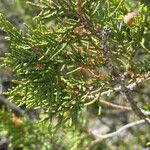
Juniperus thurifera
Incense juniper · Spanish juniper · French alpine juniper
Description
Source: leafsnapJuniperus thurifera (Spanish juniper) is a species of juniper native to the mountains of the western Mediterranean region, from southern France (including Corsica) across eastern and central Spain to Morocco and locally in northern Algeria.It is a large shrub or tree reaching 6–20 metres (20–66 feet) tall, with a trunk up to 2 m (6+1⁄2 ft) in diameter and a broadly conical to rounded or irregular crown. The foliage is strongly aromatic with a spicy-resinous scent. The leaves are of two forms: juvenile needle-like leaves 8–10 millimetres (5⁄16–3⁄8 inch) long on seedlings and irregularly on adult plants, and adult-scale leaves 0.6–3 mm long on older plants; they are arranged in decussate opposite pairs. It is dioecious with separate male and female plants. The cones are berry-like, 7–12 mm in diameter, blue-black with a whitish waxy bloom, and contain 1–4 seeds; they are mature in about 18 months. The male cones are 3–4 mm long, and shed their pollen in early spring.There are two varieties, regarded as distinct by some authors, but not by others: Juniperus thurifera var. thurifera. Spain, France. Mature cones 8–12 mm, with 2–4 seeds. Juniperus thurifera var. africana Maire. Morocco, Algeria. Mature cones 7–8 mm, with 1–2 seeds.Overall, the species is not considered threatened with healthy population in Spain; however, the African population is threatened by severe overgrazing, mainly by goats, and is listed as Endangered.The largest Spanish Juniper forest in Europe is in the Sierra de Solorio.
Care Guide
💧 Water Every 7 days
The French alpine juniper is ideal for arid highland environments due to its strong tolerance for drought conditions. It thrives in well-draining soil, which mimics its natural dry habitat, and typically requires watering every 1-2 weeks. This hardy plant is often grown outdoors, successfully balancing its need for hydration with its ability to adapt to scarce water availability.
How should I water my French alpine juniper plant?
Watering your French alpine juniper is a simple task. To water the tree, you can use a garden hose to slowly soak the soil. This method works well for mature trees that require a lot of water. If your tree is smaller, you can use a watering can or another small watering tool. It's important to avoid overhead watering, as too much moisture on the leaves can cause disease, especially when the tree is young.
What should I do if I give my French alpine juniper too much or too little water?
Overwatering can be caused by poor soil that doesn't drain well. This can make your French alpine juniper plant decline. To fix this, you can improve the soil's drainage or move the plant to a better location. If your juniper is in a pot, you may need to use looser soil and a container with better drainage. Overwatering can also lead to diseases, which should be treated promptly. If your juniper is underwatered, simply water it more often and it will recover. To determine if you've overwatered your juniper, check its foliage, especially new growth. Overwatered plants may have discolored or easily broken new growth. You can also look for standing water or slow drainage in the plant's growing area. If your juniper is underwatered, its leaves may become sparse and brown. Consider recent heavy rain or high temperatures as potential causes for these symptoms.
How frequently do I need to water my French alpine juniper?
A mature French alpine juniper is highly drought tolerant and can survive solely on rainfall. It typically only needs to be watered once a week during the hottest months of the year, and may not require any additional watering during other seasons. The only time you should water regularly is if the tree has been recently planted, as this helps the roots establish themselves and maintain consistent soil moisture. However, it's important to note that French alpine juniper does not handle standing water well. Therefore, it's better to avoid overwatering and err on the side of underwatering if unsure.
How much water does my French alpine juniper plant require?
During the height of summer, you will usually need to give your French alpine juniper about one inch of water per week. However, this can vary if it has rained enough during that week. If it has rained one inch or more, you don't need to water your French alpine juniper. Additionally, newly planted French alpine junipers require more water during the establishment period. Usually, you should water them once every one to two weeks for the first few growing seasons.
How do I water my French alpine juniper at different times of the year?
The French alpine juniper tree requires the most water in the summer when it's hottest. During this time, water the plant once per week if there is no rain. However, throughout the rest of the year, the tree can often survive without any water. In the spring and fall, you might need to water it if the weather is exceptionally hot, but this is rare. Unlike many other plants, the French alpine juniper doesn't go into full dormancy in the winter, so it continues to grow during the coldest months. Nevertheless, the tree's water needs during winter are low because the cool temperatures don't cause the soil to dry out quickly.
☀️ Light Full sun
The French alpine juniper prefers a spot that gets ample sunlight during the day while allowing for periods of partial shade. Its habitat typically consists of areas with abundant sunshine. Excessive sun can scorch the leaves, whereas insufficient light may cause poor growth.
What are the sunlight requirements for French alpine juniper?
French alpine juniper requires full sun, defined as above 6 hours of sunlight a day, or partial sun, which is about 3-6 hours of sunlight. It's crucial to observe how sunlight moves through your garden to ensure you place your plants in areas that offer the right balance of light and shade, guaranteeing their health and happiness. In its natural habitat, the French alpine juniper enjoys sunny areas but can be susceptible to leaf scorching from too much sun or poor growth from insufficient light.
How should I use artificial lighting for French alpine juniper indoor plants?
For optimal growth of indoor French alpine juniper plants, when natural sunlight is insufficient, especially during winter or in less sunny spaces, artificial lighting is a great solution. It’s recommended to choose LED lights, which can be customized to provide the specific light wavelengths needed by the plants. Full sun plants require 30-50W/sq ft, partial sun plants need 20-30W/sq ft, and full shade plants require 10-20W/sq ft of artificial light. Place the light source 12-36 inches above the plant to mimic sunlight, and ensure plants get 8-12 hours of light per day to simulate natural daylight hours.
What are the key symptoms of insufficient sunlight for French alpine juniper?
When French alpine juniper doesn't receive enough sunlight, it may show symptoms such as smaller new leaves, leggy or sparse growth, faster leaf drop, slower or no new growth, and lighter-colored or chlorotic leaves. Too much sunlight, on the other hand, can cause symptoms like sunscald (pale or bleached areas on leaves), leaf curling (to reduce sunlight exposure and minimize water loss), wilting (from water loss due to high transpiration), and leaf scorching (brown, dry, crispy leaf edges). These symptoms highlight the plant's struggle with adapting to suboptimal lighting conditions.
What solutions can help the French alpine juniper thrive in indoor, outdoor, and ground settings with insufficient sunlight?
To support French alpine juniper in various settings, consider the following solutions: Indoor, gradually acclimate the plant to receive at least 6 hours of sunlight by moving it closer to a south-facing window each week. Supplement natural light with artificial light for large plants or those in less movable positions, ensuring 8 hours of light daily. Outdoors, adjust plant placement gradually to prevent sunburn and encourage adaptation to brighter spots. For ground plants, prune obstructing trees or transplant smaller plants to sunnier locations with good drainage during their dormant period, usually late winter or early spring. While parts of the plant that suffered due to low light may not recover, new growth should be healthy with better light conditions.
🌡️ Temperature 10–35°C
French alpine juniper is highly adaptable to a variety of climatic conditions, whether experiencing hot summers or cold winters. It does, however, have a preferred temperature range for healthy growth. If temperatures rise too much, the plant can undergo heat and humidity stress that may cause its death. In locations where temperatures approach the lower boundary of its cold tolerance, providing insulation to safeguard the plant is necessary.
💨 Humidity
🪴 Soil 6-7
🌱 Fertilizer
French alpine juniper has specific nutrient needs and does not require heavy fertilization. Fertilizing in spring is best for promoting optimal growth. Supplying nutrients enhances its overall health, increases resistance to pests and diseases, and helps sustain its long lifespan.
🪴 Pot & Repot
✂️ Pruning
The French alpine juniper is a hardy, slow-growing conifer known for its aromatic foliage, making it an excellent choice for xeriscaping. To prune, focus on removing dead branches and preserving its natural shape. The best time for pruning is from early to late winter. Be cautious not to over-prune, as this can hinder the plant's ability to regrow. For more detailed guidance, consult reliable horticultural sources.
🌿 Propagating
🐛 Diseases & pets
☠️ Toxicity
Characteristics
- Plant Type
- Tree
- Life Cycle
- Perennial
- Genus
- Juniperus
- Family
- Cupressaceae
- Hardiness Zone
- 6-9
- Mature Height
- 6.1 m to 20.12 m
- Mature Spread
- 3.05 m
- Leaf Color
- Green
- Leaf Type
- Evergreen
- Flower Size
- 0.25 cm to 0.51 cm
- Bloom Time
- Early spring, Mid spring
- Planting Time
- Spring, Summer, Autumn
- Harvest Time
- Late summer, Early fall, Mid fall
- Native Area
- Morocco, Spain, Algeria, France