Justicia americana
Water-willow · American water-willow · Common Water-willow · American waterwillow
Description
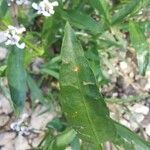
Source: leafsnapJusticia americana, the American water-willow, is a herbaceous, aquatic flowering plant in the family Acanthaceae native to North America. It is the hardiest species in the genus Justicia, the other members of which being largely tropical and subtropical, and it is able to survive as far north as USDA zone 4. It is common throughout its range. The grows partially submerged in still or flowing water, reaching up to 40 cm (16 in) tall from a creeping rhizome. The leaves are 10 cm (3.9 in), opposite, sessile, linear or lanceolate, and slightly crenulated. The flowers are bicolored, born in opposite arrangement on spikes 3 cm (1.2 in) long coming off a peduncle 10 cm (3.9 in) long. Color ranges from white to pale lavender with the upper corolla lip pale violet or white, arching over the lower lip mottled in dark purple. The lateral lobes are unadorned or slightly blushed. The anthers are purplish-red rather than the usual yellow. Flowering is from May to October. The fruit of this plant is a small brown capsule. The creeping rhizome allows Justicia americana to form large colonies on or near the shorelines of still or slow waters in lakes and rivers, and on rocky riffles and shoals in faster flowing rivers. Its rhizomes and roots provide important spawning sites for many fish species and habitat for invertebrates.
Care Guide
💧 Water Once per day
☀️ Light Full sun
American water-willow grows best with a full spectrum of light but can withstand partly shaded conditions. Its natural habitat reflects this preference. Too little light can restrict its growth, while too much exposure may be harmful, emphasizing its need for balanced lighting conditions.
What are the sunlight requirements for American water-willow?
American water-willow requires full sunlight exposure of above 6 hours daily or partial sun, which means about 3-6 hours of sunlight. Observing how sunlight moves through your garden is crucial to find spots that provide a balanced light and shade environment, essential for the plant's health. This species thrives best under a full spectrum of light but can tolerate partially shaded conditions, given its adaptive nature to various light environments.
What essentials should I keep in mind for American water-willow's growth?
For optimal growth, American water-willow should be exposed to adequate light, whether natural or artificial. Indoor plants may require artificial lighting, especially when natural sunlight is insufficient, like in winter or less sunny spaces. LED lights, favored for their ability to provide specific light wavelengths, are recommended. The lighting intensity should vary based on the plant's sunlight needs: 30-50W/sq ft for full sun plants, 20-30W/sq ft for partial sun, and 10-20W/sq ft for full shade. Proper placement (12-36 inches above the plant) and duration (8-12 hours per day) of light exposure are vital for mimicking natural daylight conditions.
What symptoms indicate insufficient light for American water-willow and how can I address them?
Symptoms of insufficient light in American water-willow include small or lighter-colored new leaves, leggy growth, faster leaf drop, and halted growth. In cases of excessive light, symptoms like chlorosis, sunscald, leaf curling, wilting, and leaf scorching might occur. To address these, gradually move your indoor plant to a sunnier spot, ensuring at least 6 hours of direct sunlight daily. If outdoors, avoid sudden light intensity changes to prevent sunburn. If necessary, prune surrounding trees to reduce sunlight obstruction. Using artificial light or transplanting the plant to a sunnier location can also help mitigate these issues.
🌡️ Temperature 0–35°C
American water-willow occurs naturally in habitats where temperatures range from 32 to 95 °F (0 to 35 ℃). It thrives in the gentle climates common to many temperate zones. When seasonal conditions become extreme, appropriate climatic adjustments should be implemented to mirror its native environment.
What is the ideal temperature range for American water-willow?
American water-willow, botanically known as Justicia americana, thrives in temperature ranges between 32 to 95 °F (0 to 35 °C). This plant is native to temperate regions and prefers milder temperatures. In its natural habitat, American water-willow exhibits strong cold resistance, eliminating the need for special frost protection measures in most winter conditions. However, additional protection is advised when temperatures are expected to fall below -35°C, which can include covering the plant with soil or straw. It is also beneficial to water the plant abundantly before the first freeze of autumn to ensure the soil remains moist and enters a frozen state, which helps in preventing drought and water scarcity for the plant during the winter and early spring.
How does the American water-willow react to low temperatures?
The American water-willow is cold-tolerant and fares best when temperatures stay above 0°C. Although it can generally withstand winter conditions without significant visible damage, if temperatures drop below -35°C, the plant might experience a decrease in sprouting or fail to sprout at all come spring. To mitigate these cold temperature effects, any parts of the American water-willow that have failed to sprout in spring should be removed to promote new growth and maintain plant health.
What should be done if the American water-willow experiences high temperatures?
In the case of high temperatures, particularly during summer when temperatures should ideally remain below 35°C, the American water-willow may exhibit signs of stress such as leaves becoming lighter in color, prone to curling, susceptible to sunburn, and in severe cases, the entire plant wilting and drying. To assist the plant in these conditions, it's advisable to trim away sunburned and dried-up parts. Moving the plant to a shaded location or using a shade cloth can provide protection from the harsh midday and afternoon sun. Additionally, watering the plant in the morning and evening can help keep the soil moist and further alleviate stress from high temperatures.
💨 Humidity
🪴 Soil
🌱 Fertilizer
🪴 Pot & Repot
✂️ Pruning
The American water-willow has long, lance-shaped leaves and delicate flowers, and it thrives in moist environments. To maintain its health and appearance, prune the plant from early to late spring to remove dead stems and encourage growth. Thinning overcrowded areas improves air circulation, while regular pruning helps maintain its shape and encourages new growth, enhancing both its health and visual appeal.
🌿 Propagating
🐛 Diseases & pets
☠️ Toxicity
Characteristics
- Plant Type
- Herb
- Life Cycle
- Perennial
- Genus
- Justicia
- Family
- Acanthaceae
- Hardiness Zone
- 3-10
- Mature Height
- 30 cm to 91 cm
- Mature Spread
- 61 cm
- Leaf Color
- Green, Dark Green
- Leaf Type
- Deciduous
- Flower Color
- Lavender, Purple
- Flower Size
- 2.54 cm
- Bloom Time
- Late spring, Early summer, Mid summer
- Planting Time
- Spring
- Harvest Time
- Mid summer, Late summer, Early fall
- Native Area
- Mexico, Canada