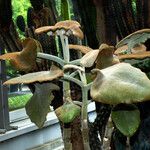
Kalanchoe beharensis
Donkey's ear · Fang Kalanchoe · Feltbush · Velvet bush · Elephant's ear Kalanchoe
Description
Source: leafsnapKalanchoe beharensis, commonly known as Velvet Leaf or Felt Plant, is a succulent native to Madagascar. It is a popular houseplant, admired for its unique appearance and low maintenance needs. The plant features large, fuzzy leaves that are green on top and brownish-red underneath. These leaves are covered in tiny hairs, giving them a velvety texture. Under ideal conditions, Kalanchoe beharensis can grow up to 3 feet tall and 2 feet wide. It prefers bright, indirect light but can also tolerate some direct sunlight. The plant requires well-draining soil and should be watered sparingly, allowing the soil to dry out between waterings. Besides its ornamental appeal, Kalanchoe beharensis holds medicinal value in traditional African medicine, where it is used to treat various ailments such as wounds and respiratory infections. In summary, Kalanchoe beharensis is an attractive succulent with unique foliage, making it a fantastic addition to any indoor garden or houseplant collection.
💡 Felt bush has developed a defense mechanism against insect predators by incorporating amorphous silica into its leaves. This silica is harder than both tooth enamel and insect mandibles. As a result, when insects attempt to chew the leaves, the silica can damage their chewing surfaces, making it difficult and uncomfortable for them to consume the plant.
🌳 Because its leaves are felt-like and it has a firm structure, felt bush has been used as an alternative to animal leather for making sustainable, cruelty-free craft items. Artisans and designers are examining plant-based materials, and felt bush has shown promise in producing a durable textile for fashion and upholstery, with the potential to transform material sourcing across various industries.
Care Guide
💧 Water Every 7 days
The felt bush, native to the highlands of Madagascar, is well-suited for environments with minimal moisture thanks to its drought tolerance. Its thick, felt-like leaves are designed to retain water effectively. To care for this evergreen plant indoors, water it every 2-3 weeks and use well-draining soil to prevent root rot.
What's the best way to water my Felt bush?
To water this species effectively, it is recommended to water from the bottom. This ensures that the water is absorbed by the roots and can distribute nutrients throughout the plant. It is important to avoid spilling water on the top part, as this can lead to diseases and fungi. If you have irrigation systems, use small sprinklers, specifically revolving ones that allow you to adjust water delivery patterns. On windy days, avoid using sprinklers. Regardless of whether the Felt bush is in a pot or garden, it is recommended to use the soak and dry method to evenly distribute moisture and promote healthier growth. Some owners may opt for a built-in drainage system using porous materials like recycled glass or hydro stones under the soil. These act as a reservoir for excess water, but it is crucial not to overwater these systems.
What do I do if I give my Felt bush too much or too little water?
If you notice that your Felt bush turns yellow, it could be due to overwatering or underwatering. Too much moisture in the soil can lead to fungal infections, so it's important to let everything dry out and avoid overwatering. On the other hand, if your Felt bush starts to brown and drop leaves, it may be getting too much water. Yellow tips on the stems and branches can also indicate insufficient water. Before purchasing a Felt bush, make sure to ask if the soil drains properly or if it's sandy. Poor drainage can lead to water deprivation in the plant. Overwatering and excessive rain can cause the Felt bush to die, so it's best to use rainwater or distilled water, as they contain fewer minerals that the plant dislikes. If you see squishy stems, drooping growth, or discolored parts, it's a sign of excessive moisture. Give the plant time to recover by allowing the pot to dry out. If it's planted outside, you can transfer it to a pot, particularly during winter, to aid its recovery and prevent root rot.
How frequently do I need to water my Felt bush?
Watering frequency for succulents can vary depending on the season. In the summer and spring, you typically only need to water them once every two to three weeks. However, during the winter and fall, it's best to reduce or avoid watering altogether since these plants become dormant. It's important to let the soil dry completely before watering again. It's better to slightly underwater than to overwater. When potted, deep watering at intervals promotes healthier soil growth. When planted outdoors, avoid watering lightly as this encourages shallow root growth. Instead, wait a few weeks and only water when the surrounding soil is too dry.
How much water should I give my Felt bush?
To efficiently water this succulent, follow these steps: 1. Cover the entire pot with water, making sure to water thoroughly. 2. Place a saucer at the bottom of the pot to ensure the roots receive enough moisture. 3. As soon as you notice the soil becoming saturated, remove the saucer immediately. 4. The frequency and quantity of water needed for your plant will depend on the pot's drainage holes and the amount of soil. 5. For potted Felt bushes, a basic can of water is usually sufficient. 6. When planting them in a garden or outdoors, take into account the rainwater they will receive. 7. Typically, about an inch of rainwater should be enough to sustain the plant for a few weeks, so avoid watering during this time. 8. If the plant is outdoors, water it in the morning with approximately a gallon of water after the soil has fully dried out. This will allow the sunlight to help evaporate any excess moisture.
Why do I need to water my Felt bush?
To ensure the health of the Felt bush, it is important to provide it with adequate water to transport nutrients from the soil to the rest of the plant. Insufficient moisture can lead to the plant becoming malnourished or unhealthy. It's important to water the Felt bush when signs of thirst are present, but avoid overwatering, as this can be harmful. The soak and dry method is recommended for watering. When the soil becomes dry, soak the plant until water begins to drip from the pot. Then, allow the soil to rest for a few weeks without watering.
☀️ Light Partial sun
Felt bush thrives in moderate sunlight, though it can tolerate brighter light. Native to environments where light is plentiful yet diffused, it has adapted to grow well in those conditions. Excessive sun can cause sunburn, while insufficient light may impede its growth.
What kind of sunlight does a Felt bush need?
Felt bush thrives in partial sunlight, requiring about 3-6 hours of sunlight daily, though it can endure full sun conditions, which means more than 6 hours of sunlight, especially in cooler weather. Originating in environments where sunlight is plentiful yet often filtered, the Felt bush has adapted to grow well under these conditions. However, too much direct sunlight can cause sunburn, while insufficient light may hinder its growth. It's important to watch how sunlight moves through your garden or home to select locations that offer a balance of light and shade, ensuring the plant's happiness.
How do artificial lights affect Felt bush growth?
For indoor Felt bushes, when natural sunlight is insufficient, especially during winter or in less sunny spaces, artificial lighting is crucial for optimal growth. LED lights are recommended because they can provide specific wavelengths necessary for the plant. Full sun plants require 30-50W/sq ft, partial sun plants need 20-30W/sq ft, and full shade plants should have 10-20W/sq ft of artificial light. The light source should be positioned 12-36 inches above the plant to mimic natural sunlight. Additionally, mimicking the natural daylight hours, most plants benefit from 8-12 hours of light per day.
What are the symptoms of improper lighting for a Felt bush?
Improper lighting can cause several symptoms in a Felt bush. Small and leggy leaves or sparse growth indicate insufficient light, as does a slower pace of new growth or none at all. Leaves may grow smaller, spaces between stems may increase, and older leaves might drop early. Insufficient sunlight can also cause leaves to become paler, indicating a lack of chlorophyll. Conversely, too much sunlight can lead to chlorosis, where leaves turn yellow, sunscald with pale or necrotic spots, leaf curling as a defense to reduce water loss, wilting from excessive transpiration, and leaf scorching, identified by brown or crispy leaf edges.
How can I treat a Felt bush with lighting issues?
For lighting issues, gradual adaptation is key. If the plant is indoors and too large or not easily movable, supplement with artificial light, keeping a lamp on for at least 8 hours a day or using professional grow lights. Outdoors, move your plants progressively to spots with better sunlight each week to avoid shock and sunburn. If light obstruction is an issue, consider pruning obstructions or transplanting smaller plants during their dormant period, ensuring they are moved to a spot with ample sunlight and good drainage. Remember, parts of the plant that were previously affected may not recover, but new growth should be healthy with proper light adjustment.
🌡️ Temperature 20–37.8°C
Felt bush originates from habitats with temperatures between 68 and 100 °F (20 to 38 ℃). It does well in moderately warm regions, and adjustments to its surroundings are necessary when temperatures fall considerably below that range.
What is the ideal temperature range for Felt bush?
Felt bush, or Kalanchoe beharensis, flourishes in environments with temperatures ranging from 68 to 100 °F (20 to 38 °C). It is a heat-loving plant that thrives in moderately warm regions. To maintain its health, it's important to adjust its surroundings if temperatures fall significantly below this range. During colder months, the Felt bush slows its growth and enters a dormant state. If outdoor temperatures drop below 0°C, the plant should be moved indoors near a south-facing window for optimal sunlight exposure. Supplemental lighting can be provided if natural light is insufficient. When temperatures are below 20°C, growth slows, and watering should be reduced or ceased to avoid root rot.
How should I care for Felt bush in low temperatures?
In low temperatures, Felt bush is vulnerable and requires special attention to thrive. If the temperature falls below 20°C, its growth will start to slow, and waterings should be minimized to prevent root rot. When temperatures go below 0°C, it is crucial to move the Felt bush indoors to a location with ample sunlight, preferably near a south-facing window, to ensure it remains above the critical 0°C threshold. For outdoor plants, watering should halt entirely during cold spells. Protection from cold can also be achieved by setting up a temporary greenhouse or wrapping the plant in plastic film or fabric for insulation. If the plant suffers from mild frost damage without immediate symptoms, after a week, it may begin to wither, indicating damage. The solution includes trimming frostbitten areas and moving the plant to a warm environment. If root rot has occurred, affected roots should be removed, and the plant can be propagated through cuttings. Supplemental lighting can be used if natural light is insufficient.
What are the symptoms and solutions for Felt bush exposed to very high temperatures?
When exposed to very high temperatures, specifically above 43°C, Felt bush's growth will halt, leading to water loss, wilting, and increased susceptibility to sunburn. To care for a Felt bush in such conditions, initially remove any sunburned or rotten parts of the plant. It's essential to protect the plant from direct afternoon sunlight until it recovers and resumes growth. For instances of root rot caused by overwatering during this period, it's advised to cease watering until new growth indicates recovery. During the summer, it's best to ensure the plant remains below 38°C to avoid these issues.
💨 Humidity normal (40-60%)
This plant will thrive in moderate humidity, which is probably the level in your home. However, misting it a few times a week can be very beneficial. Make sure the room has good ventilation.
🪴 Soil 6-7
🌱 Fertilizer
For Felt bush, small amounts of fertilizer applied one to two times per year during the growing season are sufficient. Do not fertilize in winter and summer when the plant is dormant. Cut back on fertilizer for repotted plants and wait a couple of months after repotting before fertilizing. Fertilizing helps maintain healthy growth and encourages blooms.
Why should I put fertilizer on my Felt bush?
Fertilizing the Felt bush is beneficial for its growth. While the plant can store water and nutrients, applying plant food during the growing season promotes better health and growth. Additionally, fertilizing can stimulate mature Felt bushes to produce blooms during the growing season.
When should I fertilize my Felt bush?
Felt bush, like other plants, benefits from extra nutrients. However, it only requires a small amount of fertilizer during the growing season. Ideally, fertilize your Felt bush 1-2 times a year, specifically in spring and autumn. Avoid fertilizing it in winter and summer, when it is dormant. If you have recently repotted your plant, be cautious with the amount of fertilizer you use. It's recommended to wait a couple of months after repotting before applying any fertilizer.
When is the best time to not fertilize my Felt bush?
Felt bush, like other plants, goes into a dormancy period. During this time, it's best to avoid applying fertilizer. The plant stops growing in the summer and winter, so that's another good time to stop fertilizing. Additionally, after repotting in the spring, it's recommended to wait a couple of months before resuming fertilizer application.
What kind of fertilizer does my Felt bush require?
To properly fertilize the Felt bush, it is advised to use a liquid plant food specifically made for succulents and cacti. Remember to dilute the fertilizer by half using water to prevent fertilizer buildup in the soil. Apply the diluted fertilizer to the base of the plant and make sure to water it thoroughly. This will ensure that any excess moisture drains from the container or seeps into the ground.
How do I make my Felt bush grow better?
When fertilizing Felt bush, using liquid plant food is easier, but you can also use granules. Follow the instructions on the packaging and dilute liquid fertilizers to half-strength. Whether you choose granules or liquid, apply it to the soil and cover the granules with a thin layer of soil. Remember to water regardless of the type of plant food used.
🪴 Pot & Repot Every 2 years
When repotting Felt bush, choose a pot slightly larger than the current one that has good drainage. Use a gritty, well-draining cactus or succulent mix. Gently remove the plant from its old pot, brush off excess soil, and replant it at the same depth. Wait several days before watering so any root damage can heal. Repot in spring or fall, and place it in a brightly lit location.
✂️ Pruning
To keep your felt bush in good shape, prune any excess or dense branches during the spring and autumn using a knife or scissors. After cutting, treat the wounds with sulfur powder. For propagation, cut stems that have 5-6 leaves, apply sulfur to the cuts, and let them heal before planting. Make sure the soil is slightly moist.
🌿 Propagating
🐛 Diseases & pets
☠️ Toxicity
Characteristics
- Plant Type
- Shrub
- Life Cycle
- Perennial
- Genus
- Kalanchoe
- Family
- Crassulaceae
- Hardiness Zone
- 9-11
- Mature Height
- 0.91 m to 1.52 m
- Mature Spread
- 0.91 m to 1.52 m
- Leaf Color
- Gray, Silver, Brown, Green
- Leaf Type
- Evergreen
- Flower Color
- Yellow, Orange
- Flower Size
- 1.02 cm to 2.03 cm
- Bloom Time
- All year round
- Planting Time
- Spring, Autumn
- Harvest Time
- All year round
- Native Area
- Madagascar