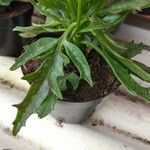
Kalanchoe laciniata
Christmastree plant · Christmas tree kalanchoe · Kalanchoe
Description
Source: leafsnapKalanchoe laciniata, commonly known as the Christmas tree plant, is a succulent native to Madagascar. It is popular as a houseplant due to its striking appearance and low maintenance needs. The plant features thick, fleshy green leaves with serrated edges that resemble the branches of a Christmas tree. These leaves grow in rosettes and can reach up to 6 inches in length. During the winter months, Kalanchoe laciniata produces small clusters of tubular flowers that are pink or red. These flowers attract pollinators such as bees and butterflies. The plant thrives in bright, indirect sunlight but can also tolerate low light conditions. It requires well-draining soil and moderate watering during its growing season, from spring to fall. However, it is important to allow the soil to dry out between waterings. Kalanchoe laciniata is easy to propagate from stem or leaf cuttings, making it a great choice for beginner gardeners or anyone seeking an easy-to-care-for houseplant with unique foliage. It is important to note that all parts of the Kalanchoe genus are toxic if ingested by humans or pets, so caution should be exercised when handling this plant around children or animals.
Care Guide
💧 Water Every 7 days
☀️ Light Full sun
Originating from arid areas, the Christmas tree plant does best in full sun, as its native habitat is marked by intense sunlight and little shade. It will also tolerate partial sun, giving it some flexibility in growth.
🌡️ Temperature 20–37.8°C
The Christmas tree plant prefers warm conditions and needs higher temperatures during the growing season to stimulate growth and metabolic activity. It likes plenty of sunlight, proper moisture, and good ventilation, but can be damaged by very low temperatures and by overwatering. Maintaining balance is important, and excessively high temperatures or overly dry conditions should also be avoided.
💨 Humidity dry (<40%)
This plant prefers dry conditions, so don't mist it. However, watering it less often can also thrive in higher humidity.
🪴 Soil 6-7
🌱 Fertilizer
For the Christmas tree plant, use light doses of fertilizer once or twice a year during the growing season. Do not fertilize in winter or summer when the plant is dormant. Cut back on fertilizer for repotted plants and wait a couple of months after repotting before you start fertilizing. Fertilizing promotes healthy growth and encourages blooms.
🪴 Pot & Repot Every 2 years
When repotting a Christmas tree plant, pick a pot slightly larger than the current one that has good drainage. Use a gritty, well-draining cactus or succulent mix. Gently take the plant out of its old pot, brush off excess soil, and plant it at the same depth. Wait several days before watering so any root damage can heal. Repot in spring or fall and keep it in a brightly lit location.
✂️ Pruning
🌿 Propagating
🐛 Diseases & pets
☠️ Toxicity
Characteristics
- Plant Type
- Succulent, Herb
- Life Cycle
- Perennial
- Genus
- Kalanchoe
- Family
- Crassulaceae
- Hardiness Zone
- 10-12
- Mature Height
- 30 cm
- Mature Spread
- 30 cm
- Leaf Color
- Light Green, Medium Sea Green
- Leaf Type
- Evergreen
- Flower Color
- Orange, Yellow
- Flower Size
- 1.02 cm to 1.52 cm
- Bloom Time
- Winter
- Planting Time
- Spring, Summer
- Harvest Time
- Spring
- Native Area
- Sri Lanka, Saudi Arabia, Somalia, India, Angola, Namibia, Zambia, Sudan, Eritrea, Yemen, Kenya, Uganda, Tanzania, Zimbabwe, Benin, Chad, Mozambique, Myanmar, Ethiopia, Congo (DRC), Congo