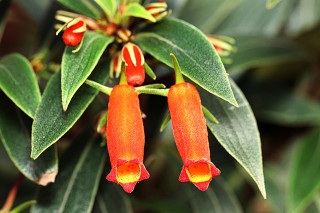
Kalanchoe manginii
Beach bells · Madagascar wax-bells · Kalanchoe - Freedom Bells
Description
Source: leafsnapBeach bells(Kalanchoe manginii) is an evergreen succulent perennial, native to Madagascar. During it's bloom season in late winter to early spring, it grows arching branches that produce scentless, reddish-orange, bell-shaped flowers that droop above the low-growing foliage. The plant grows up to a height of 1-3 feet tall , and spreads as wide as 2-3 feet. Its stems produce tiny, round, shiny-green leaves that reach a height of 1-3 cm and 0.6-1.5 cm wide. In maturity, the stems begin to trail and after bloom, the flowers experience overcrowding with tiny plantlets. Beach bells is highly regarded as an ornamental plant; to beautify the gardens and provide pollen for bees.
Care Guide
💧 Water Every 1-2 weeks
Beach bells, a popular indoor plant, thrives in dry conditions due to its high drought tolerance. It typically requires watering every 2-3 weeks. For optimal growth, allow the soil to dry out between waterings to prevent excessive moisture around the roots. Careful moisture management during the growing season supports its healthy development.
☀️ Light Full sun
Beach bells thrive with abundant sunlight and can also tolerate moderate sun, mirroring their native habitat where unobstructed rays are common. Excessive sun can scorch the leaves, while too little light may produce weak growth and pale foliage.
🌡️ Temperature 20–37.8°C
Beach bells naturally occurs in areas where temperatures usually fall between 68 and 100 °F (20 to 38 ℃). It does best under those temperature conditions. If temperatures change with the seasons, you may need to change the plant’s placement or care routine to keep it at its ideal warmth.
💨 Humidity normal (40-60%)
This plant will thrive in moderate humidity, which is probably the level in your home. However, misting it a few times a week can be very beneficial. Make sure the room has good ventilation.
🪴 Soil 6-7
🌱 Fertilizer
For Beach bells, give light doses of fertilizer one to two times a year during the growing season. Do not fertilize in winter or in summer when the plant is dormant. Cut back on fertilizer for repotted plants and wait a couple of months after repotting before fertilizing. Fertilizing promotes healthy growth and encourages blooms.
🪴 Pot & Repot Every 2 years
When repotting Beach bells, choose a pot slightly larger than the current one that has good drainage. Use a gritty, well-draining succulent or cactus mix. Gently remove the plant from its old pot, brush off excess soil, and set it in at the same depth. Wait a few days before watering to let any root damage heal. Repot in spring or fall and place it in a brightly lit spot.
✂️ Pruning
To maintain an attractive shape, prune any redundant or dense branches of beach bells in the spring and autumn using scissors or a knife. For propagation, cut stout stems with 5 to 6 leaves, seal the cuts with sulfur powder, and allow them to heal before planting. Ensure the soil for cuttings is slightly moistened.
🌿 Propagating
🐛 Diseases & pets
☠️ Toxicity
All members of the family of Kalanchoe are toxic to dogs, cats and a variety of livestock, and so are the beach bells. If ingested, the toxins in this plant can cause vomiting and diarrhoea in cats, while the cardiac glycosides can cause abnormal heart rhythms in dogs. Use protective gloves while caring for beach bells that have broken stems, and keep out of reach of children and pets.
Characteristics
- Plant Type
- Succulent
- Life Cycle
- Perennial
- Genus
- Kalanchoe
- Family
- Crassulaceae
- Hardiness Zone
- 9-11
- Mature Height
- 30 cm
- Mature Spread
- 30 cm
- Leaf Color
- Green
- Leaf Type
- Evergreen
- Flower Color
- Red
- Flower Size
- 2.54 cm
- Bloom Time
- Late spring, Early summer, Mid summer
- Planting Time
- Spring, Autumn
- Harvest Time
- Mid summer
- Native Area
- Madagascar