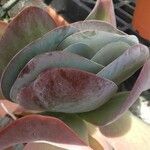
Kalanchoe tetraphylla
Flapjack · Paddle plant
Description
Source: leafsnapKalanchoe thyrsiflora (also known as paddle plant, flapjacks, desert cabbage, white lady, geelplakkie, meelplakkie, or plakkie) is a species of flowering plant native to Botswana, Lesotho, South Africa and Swaziland.
💡 Paddle plant leaves are light green and have a thick coating of white powder. The leaves feature shades of green and grey, accented by curved red lines along the edges. During cold seasons, exposure to sunlight causes red spots to appear, enhancing their ornamental value.
🌳 The paddle plant is a popular choice for succulent, Mediterranean, and coastal gardens because of its distinctive and attractive appearance. It is valued for its uniquely shaped leaves, seasonal color variations, and low maintenance requirements. Often used as a filler or accent plant, it complements other succulents such as Senecio, Crassula, and Sedum varieties.
🎭 Eagerness and sunlight
Care Guide
💧 Water
The paddle plant is well-suited for arid environments, as it efficiently stores water and demonstrates drought tolerance with its succulent leaves. To care for a paddle plant, water it every three weeks and ensure the soil dries out completely between waterings. It is best to plant it in a well-draining container, as this helps prevent root rot. The paddle plant thrives indoors with minimal water.
When should I water my paddle plant?
Timely watering is vital for the paddle plant's health, influencing its vibrant leaf coloration and overall vitality. You should water when the top inch of soil is dry, indicated by wrinkled or wilt leaves, greyish leaf hue, slowed growth, or curling edges on the leaves. Beware of over or under-watering, as it can stress the plant and lead to root rot or dehydration. Observing the plant's health and soil dryness will guide you in maintaining the right watering balance.
How should I water my paddle plant?
The paddle plant, being a succulent, has unique watering needs that prevent overwatering. The best watering technique is the soak and dry method, which involves thoroughly soaking the soil and allowing it to completely dry out before watering again. Use a moisture meter to accurately determine when the soil has dried and a long, thin spout watering can for precise soil watering, avoiding the leaves. Misting is beneficial during dry conditions but do so lightly to prevent leaf rot.
How much water does paddle plant really need?
The paddle plant needs thorough watering until excess drains out, only when the soil is completely dry, typically every 10-14 days depending on conditions. Factors like pot size, root depth, and environmental conditions influence the watering frequency. Ensure the entire root ball is moistened. Signs of proper hydration include plump, firm, and glossy leaves. Overwatering leads to yellow, mushy leaves, while underwatering causes wrinkled, shriveled leaves. Besides watering, occasional misting in dry indoor environments aids the plant's health.
What kind of water is best for paddle plant?
Paddle plants thrive on distilled, rainwater, or treated tap water free from harmful minerals and contaminants. If using tap water, let it stand for 24 hours to allow chlorine to evaporate. Using filtered or tepid water is advisable to prevent plant shock and cater to paddle plant's sensitivity towards chlorine, fluoride and other tap water contaminants. High-quality water helps prevent leaf scorch or rot, ensuring healthy soil conditions and nutrient absorption.
How do paddle plant's watering needs change with the seasons?
Paddle plant watering needs vary seasonally. In spring, water enough to prevent soil from drying out completely, transitioning to thorough yet infrequent watering in summer. During autumn, reduce watering and allow soil to completely dry out between sessions. Watering in winter should be minimal, maintaining barely moist soil. Seasonal changes highlight the importance of adjusting watering patterns to support the plant's health, considering its active and dormant phases.
☀️ Light Full sun
The paddle plant grows best in places with abundant sunlight. Getting sun every day boosts its health and growth. As a tough species, it can still do well when sunlight is somewhat reduced. Native to plains with plentiful sunshine, inadequate light can cause stunted growth. On the other hand, too much exposure can cause leaf scorch.
What are the sunlight requirements for a paddle plant?
The paddle plant, also known as Kalanchoe tetraphylla, thrives in environments with abundant sunlight. It requires full sun, defined as above 6 hours of direct sunlight daily, for optimal health and growth. However, it can also tolerate partial sun, which means about 3-6 hours of direct sunlight. It's important to watch how sunlight moves through your garden or indoor space to choose spots that provide the right balance of light and shade, ensuring the plant's happiness.
Can a paddle plant grow with artificial lighting?
Yes, paddle plants can grow with artificial lighting, especially when natural sunlight is insufficient, such as during winter or in less sunny indoor spaces. Artificial lights, such as LED lights, can be customized to provide specific wavelengths of light that plants need. For full sun plants, 30-50W/sq ft of artificial light is required; partial sun plants need 20-30W/sq ft; and full shade plants should have 10-20W/sq ft. The light source should be placed 12-36 inches above the plant to mimic natural sunlight, and most plants need 8-12 hours of light per day.
What are the symptoms of inadequate light in paddle plants?
Paddle plants may show several symptoms when exposed to suboptimal lighting conditions. These include lighter-colored or pale new leaves indicating a lack of chlorophyll, leggy or sparse growth giving the plant a stretched-out appearance, smaller than usual new leaves, faster leaf drop to conserve resources, slower or halted growth, and chlorosis (leaves losing their green color). Symptoms of overexposure to sunlight include sunscald, leaf curling as a defense mechanism, wilting due to increased water loss, and leaf scorching characterized by brown, dry, and crispy leaf edges.
How can I address lighting issues for my paddle plant?
To optimize your paddle plant's exposure to light, gradually move the plant to a sunnier location each week until it receives at least 6 hours of direct sunlight daily. For indoor plants, a south-facing window is ideal, and keeping curtains open during the day will maximize sunlight exposure. If the plant is large or not easily movable, consider using artificial light, such as desk lamps or professional plant grow lights, for at least 8 hours daily. Outdoor plants should also be moved gradually to prevent shock and sunburn. Reducing obstructions like pruning trees can help increase sunlight, and transplanting smaller plants to sunnier areas during their dormant period can encourage healthier growth. Note that parts of the plant affected by insufficient sunlight may not recover, but new growth after increasing light exposure will be healthy.
🌡️ Temperature 20–37.8°C
The paddle plant plant is native to Madagascar and prefers a temperature range of 68 to 100 ℉ (20 to 38 ℃). It can tolerate temperatures as low as 50 ℉ (10 ℃) and as high as 104 ℉ (40 ℃) for short periods of time. During the summer, it is advisable to grow it in a shaded area and ensure the soil is well-drained to prevent the roots from overheating.
What is the native habitat of the Paddle plant, and what temperatures does it prefer?
The Paddle plant (Kalanchoe tetraphylla) is native to Madagascar and thrives in a temperature range of 68 to 100°F (20 to 38°C). It can tolerate lower temperatures down to 50°F (10°C) and higher temperatures up to 104°F (40°C) for short periods. To promote healthy growth, especially during its growing season in winter, it's crucial to maintain temperatures above 20°C. When temperatures fall below 0°C, the plant should be moved indoors to a well-lit area. In summer, it's advisable to grow the plant in a shaded area to protect it and ensure the soil is well-drained to avoid overheating the roots.
What are the symptoms and solutions when a Paddle plant is exposed to low temperatures?
Paddle plants show intolerance to extremely cold temperatures. They thrive best between 20°C and 38°C, and winter temperatures should be kept above 0°C to avoid damage. Exposure to temperatures below -5°C can lead to water-soaked necrosis and wilting of the leaves, with eventual leaf drop following mild frost damage after about a week. To mitigate frost damage, trim off frostbitten areas, move the plant to a warmer indoor setting, or establish a makeshift greenhouse for protection against the cold. If located indoors, the plant should be near a south-facing window to ensure it receives ample sunlight, and if in a makeshift greenhouse, ensure good ventilation to prevent decay.
How should a Paddle plant be cared for in high temperatures?
During the summer, when temperatures climb, a Paddle plant should ideally be kept in conditions below 38°C. Exposure to temperatures exceeding 43°C can cause the plant to enter a dormant state, increasing its susceptibility to rot, particularly in high humidity. To care for a Paddle plant in such conditions, remove any dry or rotten parts and relocate the plant to a partially shaded spot, away from direct sunlight during the most intense midday and afternoon heat. Additionally, during periods of extreme heat, it's advisable to halt watering until the weather cools down.
💨 Humidity
🪴 Soil 6-7
🌱 Fertilizer
For Paddle plant, light applications of fertilizer once or twice a year during the growing season are sufficient. Avoid fertilizing in winter and in summer when it is dormant. Reduce fertilizer for repotted plants and wait a couple of months after repotting before fertilizing. Fertilizing supports healthy growth and encourages blooms.
🪴 Pot & Repot Every 2 years
When repotting a Paddle plant, choose a pot slightly larger than the current one that has good drainage. Use a gritty, well-draining succulent or cactus mix. Gently remove the plant from its old pot, dust off excess soil, and set it in the new pot at the same depth. Wait a few days before watering so any root damage can heal. Repot in spring or fall, and place it in a brightly lit area.
✂️ Pruning
To keep large succulent plants like the paddle plant well-shaped and healthy, prune them in the spring and autumn. Focus on removing dense or redundant branches during this process. If you want to propagate the plant, cut stems that have 5 to 6 leaves on them. Be sure to treat the cut wounds with sulfur powder to prevent infection or decay. Allow the cuttings to heal before planting them. When you're ready to plant the cuttings, use slightly moist soil.
🌿 Propagating
🐛 Diseases & pets
☠️ Toxicity
Characteristics
- Plant Type
- Succulent, Herb
- Life Cycle
- Perennial
- Genus
- Kalanchoe
- Family
- Crassulaceae
- Hardiness Zone
- 9-12
- Mature Height
- 0.49 m to 1.52 m
- Mature Spread
- 76 cm
- Leaf Color
- Red, Green
- Leaf Type
- Evergreen
- Flower Color
- Pink, Orange
- Flower Size
- 1.02 cm to 2.03 cm
- Bloom Time
- Spring
- Planting Time
- Spring, Autumn, Winter
- Harvest Time
- Early summer, Mid summer
- Native Area
- Madagascar