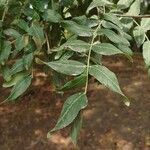
Kirkia acuminata
White Seringa · Umvumile · White syringa
Description
Source: leafsnapKirkia acuminata is a tree species belonging to the family Kirkiaceae, commonly found in the tropical regions of Africa, particularly in countries such as Tanzania, Kenya, and Mozambique. The tree can grow up to 20 meters tall and features a straight trunk with a diameter of up to 60 cm. The leaves of Kirkia acuminata are simple, alternate, and elliptical, tapering at both ends. They are dark green on the top and lighter underneath, with prominent veins on both sides. The flowers are small, white or cream-colored, and arranged in clusters at the ends of branches. The fruit produced by Kirkia acuminata is a woody capsule containing several seeds, which are dispersed by wind or animals such as birds and monkeys. Kirkia acuminata has various uses among local communities where it grows naturally. Its bark contains tannins that can be used for tanning leather, while its wood is used for making furniture, tool handles, or as fuelwood for cooking fires. In traditional medicine practices across Africa, its bark extracts have been used to treat various ailments, including diarrhea, while its leaves serve as an antiseptic agent for wound infections, among other uses. Overall, the Kirkia acuminata plant plays an important ecological role by providing habitat for wildlife species like birds and monkeys. It also contributes significantly to soil conservation through nitrogen fixation processes, enriching the soil with nutrients and promoting biodiversity. Thus, it supports conservation efforts across different ecosystems within its natural range in Africa.
Care Guide
💧 Water Every 7 days
White seringa is native to regions with moderate rainfall, where it strikes a balance between drought tolerance and a preference for humidity. For optimal care, water the plant every 2-3 weeks, mimicking its natural growing conditions. Although primarily grown outdoors, white seringa can also thrive as an evergreen in containers. In this case, be mindful of watering practices, especially during its growth cycles.
☀️ Light Full sun
White seringa comes from open habitats, such as sunny meadows and forest margins, which supply abundant light. It performs best in Full Sun but also tolerates Partial Sun, adapting readily to different light levels.
What are the sunlight requirements for White Seringa (Kirkia acuminata)?
White Seringa thrives in environments that mimic its natural habitat of sunny meadows and forest edges, requiring full sun, which is defined as more than 6 hours of sunlight per day, but can also tolerate partial sun - about 3-6 hours of sunlight per day. It's important to monitor the movement of sunlight through your garden to ensure that your plants get the perfect balance of light and shade, enhancing their growth and wellbeing.
How can artificial lighting be used for indoor White Seringa plants?
When natural sunlight is inadequate, especially during winter or in less sunny spaces, artificial lighting becomes essential for the growth of indoor White Seringa plants. LED lights are recommended due to their ability to mimic the sunlight spectrum needed for plant growth. For full sun plants, 30-50W/sq ft of light is required, whereas partial sun plants need 20-30W/sq ft, and full shade plants need 10-20W/sq ft. The artificial light source should be placed 12-36 inches above the plant, ensuring it receives 8-12 hours of light a day to simulate natural daylight hours.
What are some common symptoms of light deficiency in White Seringa?
White Seringa may exhibit several symptoms when it receives insufficient light, including smaller new leaves, leggy or sparse growth, faster leaf drop, slower or no new growth, and lighter-colored new leaves. Additionally, chlorosis may occur, leading to yellowing leaves due to a breakdown of chlorophyll, as well as sunscald, leaf curling, wilting, and leaf scorching as consequences of inadequate sunlight exposure or excessive sunlight.
What solutions can help improve light conditions for White Seringa?
To address light deficiencies for White Seringa, gradual relocation to sunnier spots is advised, ensuring at least 6 hours of direct sunlight daily for outdoor plants and using south-facing windows for indoor ones. Artificial lighting such as desk lamps or grow lights can supplement light for indoor plants. Outdoor plants should be moved gradually to avoid sunburn. Observing the environment to reduce obstructions like pruning obstructive tree branches and transplanting smaller plants during their dormant period to sunnier locations with good drainage can also help to improve light availability.
🌡️ Temperature 20–37.8°C
White seringa comes from tropical areas where the climate is usually warm and humid. Consequently, it is well suited to high temperatures and humidity. It is sensitive to sudden temperature changes and prefers a steady temperature, so it's important to prevent temperature fluctuations indoors. It generally cannot tolerate cold and needs warmer conditions to grow. If the ambient temperature falls too low, the plant may stop growing or even die.
💨 Humidity dry (<40%)
This plant prefers dry conditions, so don't mist it. However, watering it less often can also thrive in higher humidity.
🪴 Soil 6-7
🌱 Fertilizer
The best time to fertilize a White seringa is in early spring, when it breaks dormancy. This supports overall growth and flower development. Fertilizing improves the foliage, stems, and branches, and encourages flowers that are large, vibrant, and long-lasting. It also helps move nutrients from the roots to the flowers and enhances the plant's health and resistance to disease.
🪴 Pot & Repot
✂️ Pruning
To promote the health and shape of white seringa, it is best to prune from early to late winter. Start by removing dead wood and thinning out crowded branches to improve airflow and maintain a balanced form. Use clean, sharp tools to minimize damage, which encourages healthier growth and more vibrant flowering.
🌿 Propagating
🐛 Diseases & pets
☠️ Toxicity
Characteristics
- Plant Type
- Tree
- Life Cycle
- Perennial
- Genus
- Kirkia
- Family
- Kirkiaceae
- Hardiness Zone
- 10-12
- Mature Height
- 20.12 m
- Mature Spread
- 4.88 m to 7.92 m
- Leaf Color
- Dark Green, Olive Drab
- Leaf Type
- Evergreen
- Flower Color
- Yellow, Green
- Flower Size
- 0.25 cm to 0.51 cm
- Bloom Time
- Mid fall, Late fall
- Planting Time
- Spring, Summer, Autumn
- Harvest Time
- Winter
- Native Area
- Malawi, Angola, Mozambique, South Africa, Zambia, Eswatini, Namibia, Congo (DRC), Botswana, Zimbabwe