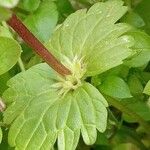
Lamium amplexicaule
گزنه سفید ساقهآغوش (Henbit deadnettle) · Henbit deadnettle · Henbit · Henbit Dead-nettle · Greater Henbit
Description
Source: leafsnapLamium amplexicaule, commonly known as henbit or deadnettle, is a herbaceous plant belonging to the mint family. Originally native to Europe and Asia, it has now spread throughout North America and other regions of the world. This plant has a square stem that can reach up to 40 cm in height and produces small, pink or purple flowers in clusters at the top. The leaves are opposite, heart-shaped, and have toothed edges with a slightly hairy texture. Henbit prefers moist soils but can thrive in various soil types, including sandy loam and clay loam. It grows well in conditions ranging from full sun to partial shade. For centuries, henbit has been used for its medicinal properties, particularly for its anti-inflammatory benefits. It is also edible, with its leaves consumed raw in salads or cooked like spinach. Importantly, henbit serves as a crucial food source for bees during early spring when other plants have not yet begun to bloom. However, it can be considered a weed due to its invasive nature, often spreading uncontrollably in lawns and gardens. In summary, Lamium amplexicaule is a fascinating plant with a range of uses, making it both beneficial and potentially problematic depending on its growth environment.
🌳 Remarkably, henbit has been studied as a bioindicator of soil metal concentrations because it can accumulate certain elements. Its occurrence can indicate elevated zinc and lead levels in the soil, offering a natural assessment tool for environmental monitoring.
🎭 Offering hope, weathering hardships, surmounting obstacles, persistence
Care Guide
💧 Water Every 3 days
Henbit deadnettle flourishes in moist conditions and requires regular watering to ensure lush growth. It thrives with consistent moisture levels, avoiding both drought and waterlogging. During the growing season, this plant responds positively to sufficient water, which promotes abundant flowering.
When should I water my Henbit Deadnettle?
Watering Henbit Deadnettle at the right time is essential for its vitality and bloom potential. Check the soil; if it's dry 1-2 inches deep, it's time to water. Leaves that are wilting, curling, or changing color indicate a need for water, while yellow or brown leaves may suggest overwatering. Henbit Deadnettle needs more frequent watering in hotter, sunnier conditions. A droopy plant usually needs water, but excessive watering can also cause limpness. Ignoring these signs can lead to over or underwatering, resulting in poor growth, susceptibility to pests, and diseases, or even root rot.
How should I water my Henbit Deadnettle?
Henbit Deadnettle can tolerate a range of watering conditions but prefers consistent moisture without being waterlogged. Use a long spout watering can to water directly at the base, avoiding the leaves to prevent fungal diseases. Bottom-watering is another effective method, especially in dry conditions. A moisture meter can help avoid over or under watering, and a drip irrigation system might be beneficial in drier regions. It's crucial to focus on the root zone and ensure good drainage. Misting should be avoided as it can promote fungal diseases.
How much water does Henbit Deadnettle really need?
Henbit Deadnettle prefers consistently moist soil without being waterlogged. The amount of water needed depends on factors like pot size and plant size. Typically, water thoroughly when the top inch of soil feels dry, using 200-300 milliliters for small pots, and up to 500-750 milliliters for larger pots. The right hydration will result in lush, green leaves, sturdy stems, and abundant, vibrant flowers. Over or underwatering can cause yellowing or wilting leaves, root rot, or stunted growth. Regularly monitoring soil moisture and providing adequate drainage can help maintain optimal hydration.
What kind of water is best for Henbit Deadnettle?
Distilled or rainwater is ideal for Henbit Deadnettle due to its purity. However, it can tolerate tap water if necessary. The plant is sensitive to chlorine, so if using tap water, let it sit for 24-48 hours to allow chlorine to evaporate. Henbit Deadnettle doesn't have a notable sensitivity to fluoride but can suffer from excessive amounts. Avoid using hard water frequently due to minerals that can build up in the soil. Room temperature water is preferred to prevent root shock. When using tap water, dechlorinating it can boost the plant's health.
How do Henbit Deadnettle's watering needs change with the seasons?
Henbit Deadnettle requires different watering approaches throughout the year. In spring, ensure consistent soil moisture to support growth. Summer's heat increases evaporation, requiring regular checks to maintain soil moisture. Autumn requires slightly reduced watering as temperatures drop and the plant prepares for seed production. During winter dormancy, water needs decrease significantly; water sparingly only to prevent the soil from fully drying out. Seasonal changes in temperature and plant growth phases necessitate adjustments in watering frequency and volume.
☀️ Light Partial sun
Henbit prefers moderate light but is hardy enough to tolerate both strong sunlight and low-light conditions. Its occurrence across a variety of habitats gives it this adaptability. Too little light can stunt its growth, while too much can cause leaf scorch.
What are the sunlight requirements for henbit deadnettle?
Henbit deadnettle flourishes in conditions varying from partial sun, requiring about 3-6 hours of sunlight, to full sun or shade, which is above 6 hours of sunlight daily. It's important to watch how sunlight moves through your garden to find spots that offer an ideal balance between light and shade, ensuring your plants thrive.
How does moderate light exposure affect henbit deadnettle?
Henbit deadnettle can adapt to both ample sunlight and scarce luminosity conditions thanks to its origins in various habitats. This moderate light exposure makes henbit deadnettle robust, though insufficient light can stunt its growth, and overexposure might lead to leaf scorch. In less sunny spaces or during winter, artificial lighting such as LED lights can be crucial for indoor plants, with requirements ranging from 10-20W/sq ft for full shade plants to 30-50W/sq ft for full sun plants.
What symptoms indicate insufficient or excessive sunlight in henbit deadnettle?
Symptoms of insufficient sunlight in henbit deadnettle include smaller new leaves, leggy or sparse growth, accelerated leaf drop, slower or halted new growth, lighter-colored new leaves, and symptoms of too much sunlight, such as chlorosis, sunscald, leaf curling, wilting, and leaf scorching. These symptoms provide insight into whether the plant needs adjustments in its lighting conditions.
How can I optimize sunlight exposure for henbit deadnettle?
To optimize sunlight exposure for henbit deadnettle, gradually adapt the plant to changing light conditions by shifting it to sunnier spots each week until it receives 3-6 hours of direct sunlight daily. For indoor plants that are not easily movable or too large, supplement with additional artificial light, keeping a desk or ceiling lamp on for at least 8 hours daily or investing in professional plant grow lights. Outdoors, move plants gradually to avoid shock and sunburn. If needed, reduce obstructions to sunlight by pruning trees or transplanting the plant to a sunnier location with ample sunlight and good drainage.
🌡️ Temperature 0–35°C
Henbit naturally occurs in areas where temperatures are usually between 68 and 95 °F (20 and 35 ℃). It thrives best within that range, though seasonal adjustments may be needed to deal with temperature variations.
What is the optimal temperature range for the growth of Henbit deadnettle?
Henbit deadnettle, botanically known as Lamium amplexicaule, prefers environments where temperatures are between 68 to 95 \u00b0F (20 to 35 \u2103) for optimal growth. This range is crucial for its development, though it is adaptable to seasonal temperature fluctuations.
Does Henbit deadnettle require frost protection measures during winter?
Henbit deadnettle exhibits strong cold resistance and typically does not require special frost protection measures. However, if winter temperatures are expected to plummet below -35\u00b0C, it's important to protect the plant by covering it with soil or straw. Additionally, watering the plant abundantly before the first freeze of autumn to keep the soil moist can help prevent drought and water scarcity during winter and early spring.
What happens to Henbit deadnettle when exposed to temperatures below 20\u00b0C and how can it be managed?
When temperatures fall below 20\u00b0C, Henbit deadnettle remains cold-tolerant and should ideally be kept above 0\u00b0C to thrive. In conditions where the temperature drops below -35\u00b0C, the plant might show no noticeable changes initially, but a decrease in sprouting or even a lack of sprouting may be observed in spring. In response, it's recommended to remove any parts of the plant that have failed to sprout in spring.
How does high temperature affect Henbit deadnettle and what are the remedies?
Henbit deadnettle should not be exposed to temperatures above 35\u00b0C during the summer. Exposure to temperatures exceeding 41\u00b0C can cause the leaves to lighten in color, become prone to curling, suffer from sunburn, and in severe cases, cause the entire plant to wilt and dry out. To mitigate these effects, trim away any sunburned or dried-up parts, move the plant to a shaded location particularly during midday and afternoon, or use a shade cloth. Ensure the soil remains moist by watering the plant in the morning and evening.
💨 Humidity
🪴 Soil 6-7
🌱 Fertilizer
Henbit does well with regular, light applications of fertilizer to encourage healthy leaf development. Fertilize Henbit roughly once a month during the summer. Nitrogen is important for foliage, and adding nitrogen-rich sources helps Henbit thrive.
🪴 Pot & Repot
✂️ Pruning
To encourage fast growth in henbit deadnettle branches, remove the top shoots after they have bloomed or in early spring. In late summer, prune dense branches by one-third to improve air circulation and light exposure. After blooming, quickly cut back the scapes to prevent mold, and trim away any diseased leaves to minimize pests.
🌿 Propagating
🐛 Diseases & pets
☠️ Toxicity
Mildly toxic to dogs.
Characteristics
- Plant Type
- Herb
- Life Cycle
- Annual, Biennial
- Genus
- Lamium
- Family
- Lamiaceae
- Hardiness Zone
- 3-10
- Mature Height
- 10 cm to 30 cm
- Mature Spread
- 10 cm
- Leaf Color
- Green, Red
- Leaf Type
- Deciduous
- Flower Color
- Pink, Purple
- Flower Size
- 7.62 cm to 15.24 cm
- Bloom Time
- Spring
- Planting Time
- Spring
- Harvest Time
- Late spring, Early summer, Mid summer
- Native Area
- Turkey, Austria, Sweden, Slovakia, Pakistan, Morocco, Belarus, Uzbekistan, Iraq, Estonia, Romania, Latvia, Belgium, Moldova, Netherlands, Tajikistan, Tunisia, Czech Republic, Cyprus, Bulgaria, Poland, Armenia, Greece, Ukraine, Lebanon, Lithuania, Norway, Syria, Kyrgyzstan, Kazakhstan, Switzerland, Finland, Israel, Iran, Albania, Ireland, Azerbaijan, Hungary, Turkmenistan