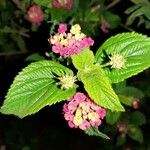
Lantana camara
شاه پسند · Lantana · West Indian Lantana · Wild Lantana · Bush Lantana
Description
Source: leafsnapLantana camara, commonly known as the Lantana plant, is a species of flowering shrub that belongs to the Verbenaceae family. Native to tropical regions of Central and South America, it has been introduced and naturalized in many other parts of the world. The plant typically reaches up to 2 meters in height and has a bushy appearance with dark green leaves arranged oppositely on its stems. The Lantana plant produces clusters of small, brightly colored flowers in flat-topped clusters at the ends of its branches. These flowers come in a variety of colors, including red, orange, yellow, pink, and white. They bloom throughout the year but are most abundant during the summer. Known for its hardiness, the Lantana plant can thrive under various conditions, including drought and poor soil quality. It is often used as an ornamental garden plant due to its attractive appearance but can also be found growing wild along roadsides and in other disturbed areas. Despite its popularity with gardeners for its vibrant colors and low maintenance requirements, it is important to note that some species within this genus can be toxic if ingested by humans or animals. Therefore, caution should always be exercised when handling them.
🌳 Lantana's bright appearance frequently signals changes in nutrient levels within ecosystems. Scientists examine the plant's behavior as a bioindicator of soil health and apply it in phytoremediation to help restore balance in disturbed environmental conditions.
🎭 Strictness, dignity
Care Guide
💧 Water Every 7 days
Common lantana thrives in humid environments and should be watered every 1-2 weeks for optimal health. Adapted to tropical regions, it can withstand both heavy rains and dry periods. As an evergreen plant, common lantana maintains its lush appearance throughout the year, even during drier seasons.
When Should I Water My Common Lantana?
Watering your common lantana at the right time is crucial for its health. Check the top 1 to 2 inches of soil for dryness to decide whether it's time to water. Wilting leaves, a sign of the plant’s need for water, should be addressed promptly to avoid permanent damage. If the leaves appear dull or the plant shows stunted growth, it may also indicate a need for more water. Wrong watering times can lead to root rot or dehydration. Ignoring these signs can severely impact the plant's health, leading to reduced bloom production and even death.
How Should I Water My Common Lantana?
To properly water your common lantana, consider bottom-watering by placing the plant pot in a tray of water, allowing the roots to absorb moisture from the bottom, which minimizes the risk of fungal diseases. If using a watering can, choose one with a narrow spout to direct water to the base of the plant without wetting the foliage, promoting targeted hydration at the root level.
How Much Water Does Common Lantana Really Need?
Common lantana, adapted to hot and wet climates, requires a moderate amount of water to thrive. The specific amount depends on the size of the plant and the pot. Water thoroughly until it begins to drain at the bottom, ensuring the roots are soaked. Use the finger test, inserting it two inches into the soil; dry soil at this depth indicates it's time to water. Overwatering can cause root rot, while underwatering leads to wilting and stunted growth. Ensure the pot has good drainage to avoid standing water.
What Kind of Water is Best for Common Lantana?
Well-drained water is best for common lantana, with rainwater being an optimal choice due to the plant's preference. Tap water, often hard, should be avoided; instead, use filtered or distilled water. Common lantana is sensitive to chlorine, fluoride, and minerals found in hard water, which can damage it. Letting tap water sit out for 24 to 48 hours can reduce chlorine, but may not remove fluoride. Room temperature water is ideal to prevent shock.
How Do Common Lantana's Watering Needs Change with the Seasons?
Common lantana's watering needs vary with the seasons. In spring, as it exits dormancy, increase water to support new growth. Summer's heat necessitates deep, thorough watering. Reduce water in autumn as the plant prepares for dormancy, focusing on keeping the soil slightly moist. In winter, maintain dryer soil, watering just enough to prevent complete dryout, to support the plant's recovery and subsequent spring bloom.
☀️ Light Full sun
The lantana grows best in places that get plenty of sunlight all day, encouraging vigorous growth. Nevertheless, the lantana is tough and can stay healthy in locations with less abundant light. Too much or too little light usually does not harm the plant, because it comes from habitats with a range of sunlight conditions.
What are the sunlight requirements for Common Lantana (Lantana camara)?
Common Lantana requires full sun, characterized by more than 6 hours of direct sunlight daily, to thrive and display robust growth. However, it can also tolerate partial sun, which amounts to about 3-6 hours of sunlight. Observing how sunlight moves through your garden and choosing spots that provide the right balance of light and shade is crucial for the plant's health and happiness.
How does artificial lighting affect the growth of indoor plants, including Common Lantana?
For indoor plants like Common Lantana that may not receive sufficient natural sunlight, especially during winter or in less sunny spaces, artificial lighting serves as an essential growth aid. Choose the right type of light, such as LED, which can be customized to supply specific light wavelengths needed by plants. Full sun plants require 30-50W/sq ft, partial sun plants need 20-30W/sq ft, and full shade plants need 10-20W/sq ft of artificial light. Place the light source 12-36 inches above the plant and ensure it receives 8-12 hours of light per day to mimic natural sunlight conditions.
What are some common symptoms of insufficient sunlight in Common Lantana, and how do they manifest?
Common symptoms of light deficiency in Common Lantana include leggy or sparse growth, marked by increased spaces between leaves or stems, which makes the plant appear thin and stretched. Additionally, insufficient sunlight can negatively impact flowering and fruiting, cause chlorosis or the loss of leaf greenness, lead to sunscald with pale or necrotic areas on the plant, result in leaf curling as a defense against excessive sunlight, induce wilting from loss of turgor pressure, and cause leaf scorching characterized by brown, dry edges on leaves.
What solutions can be applied to alleviate symptoms of light deficiency in Common Lantana, both indoors and outdoors?
To counteract light deficiency in Common Lantana, gradually increase its sunlight exposure—aim for at least 6 hours of direct sunlight daily by moving it closer to a south-facing window or using artificial grow lights for indoor plants that are large or hard to move. Outdoors, transitioning plants to sunnier spots gradually prevents sunburn. For obstructed outdoor plants, pruning or transplanting during the dormant period can help. While parts of the plant that suffered due to insufficient light may not recover, exposing new growth to adequate light ensures its health.
🌡️ Temperature 15–41.1°C
Lantana is commonly found in habitats with temperatures between 68 and 106 °F (20 to 41 ℃). As a thermophilic plant, it prefers warmer climates. Across seasons, modest adjustments may be required to keep conditions within this temperature range for optimal growth.
What is the optimal temperature range for growing Common lantana?
Common lantana thrives in environments where temperatures range from 68 to 106 °F (20 to 41 °C). It loves heat and prefers warmer climates, making it necessary to make moderate adjustments seasonally to maintain this temperature window for optimal growth. During the winter, it is beneficial to keep temperatures above the specified minimum suitable growth temperature, while ensuring the plant is not exposed to temperatures nearing the minimum tolerable growing temperature, as this can be detrimental.
How should Common lantana be cared for in colder temperatures?
Common lantana, being extremely heat-loving, does not tolerate cold temperatures well. It thrives when the temperature is consistently above the suitable growth temperature minimum. In winter, ensure the plant's environment stays above the tolerable growing temperature minimum. When temperatures fall below the limit growth temperature, the leaves may lighten in color and eventually turn brown or black after frost damage, leading to wilting and drooping. To protect the plant from cold, it's advised to trim off the frost-damaged parts and move it indoors to a warm environment, preferably near a south-facing window for ample sunlight while avoiding placement near heaters to prevent air dryness.
What should be done if Common lantana experiences high temperatures?
During summer, it's important to ensure that Common lantana is kept below the suitable growth temperature maximum. When temperatures exceed the tolerable growing temperature max, the plant's leaves may lighten in color and become susceptible to sunburn. In such situations, trim away the sunburned and dried-up parts of the plant. Relocate the plant to a spot where it can be shaded from the midday and afternoon sun. Additionally, water the plant in the morning and evening to maintain soil moisture, helping to mitigate the effects of high temperatures.
💨 Humidity normal (40-60%)
This plant will thrive in moderate humidity, which is probably the level in your home. However, misting it a few times a week can be very beneficial. Make sure the room has good ventilation.
🪴 Soil 6-7
🌱 Fertilizer
The best time to fertilize a Lantana is in early spring, when it breaks dormancy. This encourages overall growth and the development of flowers. Fertilizing improves the foliage, stems, and branches, and encourages flowers that are bigger, more vivid, and longer-lasting. It also helps move nutrients from the roots to the blooms and enhances the plant’s health and resistance to disease.
Why should I put fertilizer on my Common lantana?
Ensuring the overall health and well-being of your Common lantana involves fertilization. This helps with the development of healthy foliage, sturdy stems, and branches. Gardeners particularly value the flowers of a Common lantana, which can be enhanced through fertilization. By providing the right kind of fertilizer, the plant can efficiently transfer nutrients from its roots to its flowers, resulting in larger, vibrant, and long-lasting blooms. Additionally, proper fertilization helps maintain the plant's general health, making it more resilient against diseases.
When should I fertilize my Common lantana?
To optimize the growth and flowering of your Common lantana, it is best to fertilize it during the early spring as it transitions out of dormancy. This provides the plant with ample energy to support its development. However, it is not limited to just one feeding. Giving it an additional feeding in the fall can also benefit the plant, although it does not have to be as substantial as the spring feeding. Some gardeners may choose to fertilize their Common lantana during planting, but this is not always required.
When should I not put fertilizer on my Common lantana?
During the winter, Common lantana does not require fertilization due to its dormant phase. This phase means the plant doesn't need much energy from the soil to grow. Fertilizing it during winter increases the risk of overfertilization. The best times to feed Common lantana are early spring and fall. Therefore, during most of the spring and summer, the plant doesn't need fertilizer. It's also wise to avoid feeding it if the plant is exposed to excessive heat or dry conditions.
What kind of fertilizer does my Common lantana plant need?
Using a general-purpose fertilizer with equal amounts of nitrogen, phosphorus, and potassium is usually alright. However, Common lantana plants tend to do better with a specific type of fertilizer. The most important nutrients for Common lantana are nitrogen and phosphorus, so the fertilizer you use should have higher amounts of these compared to potassium. A fertilizer with an N-P-K ratio of 10-10-8 or similar should work well. Additionally, it can be helpful to use organic material like compost for one of your annual feedings. If you do use fertilizer, granular fertilizer is commonly used for Common lantana.
How do I make my Common lantana grow better?
Applying fertilizer for your Common lantana is easy, even for inexperienced gardeners. To feed your plant with granular fertilizer, simply sprinkle it onto the soil after moistening it with water. Alternatively, you can amend the soil by adding compost or manure. To do this, place the material on top of the soil and use a hand rake to gently work it into the top few inches without disrupting the plant's roots.
🪴 Pot & Repot 2-3 years
When repotting Lantana, select a pot 1–2 inches (2.5–5.1 cm) larger with ample drainage. Use a well-draining potting mix. Repot in spring or fall, making sure the root ball sits slightly below the rim of the flower pot. Water thoroughly after repotting and put it in a warm location with indirect sunlight.
✂️ Pruning
Common lantana is a vibrant shrub known for its colorful flowers. To keep the plant healthy and prevent it from becoming leggy, prune it in early spring by removing up to one-third of its growth. Use sharp, clean tools to minimize the risk of disease, which will help improve both the plant's overall health and its bloom production.
🌿 Propagating
🐛 Diseases & pets
☠️ Toxicity
Characteristics
- Plant Type
- Shrub
- Life Cycle
- Perennial
- Genus
- Lantana
- Family
- Verbenaceae
- Hardiness Zone
- 8-13
- Mature Height
- 0.91 m to 2.13 m
- Mature Spread
- 1.83 m
- Leaf Color
- Green
- Leaf Type
- Evergreen
- Flower Color
- Yellow, Red, Orange, Pink, White, Purple, Lavender, Gold
- Flower Size
- 1.52 cm to 2.54 cm
- Bloom Time
- Late spring, Summer
- Planting Time
- Spring, Autumn
- Harvest Time
- Summer, Fall
- Native Area
- Belize, Honduras, Mexico, Guatemala, Peru, Trinidad and Tobago, Panama, Jamaica, Uruguay, Colombia, Cuba, Bolivia, Venezuela, Brazil, Guyana, El Salvador, Nicaragua, Suriname, Costa Rica