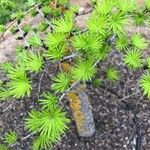
Larix kaempferi
Japanese larch · Ниппонісь лисвень (KOI)
Description
Source: leafsnapLarix kaempferi, commonly known as Japanese larch, is a deciduous coniferous tree native to Japan. This medium to large-sized tree can grow up to 40 meters tall, with a trunk diameter reaching up to 1 meter. The tree features grayish-brown, scaly bark, and bright green needles that turn yellow in autumn before they fall. Japanese larch trees are often planted as ornamental trees in parks and gardens due to their attractive foliage and conical shape. They are also valued commercially for their high-quality timber, which is used in construction, furniture making, and paper production. Japanese larch prefers moist, well-drained soils but can tolerate a variety of soil types, including sandy and clay soils. The tree grows best in full sun but can also tolerate partial shade. This species has been introduced to many countries, including North America, where it has become naturalized in some areas. However, it is worth noting that Japanese larch is susceptible to various pests, such as bark beetles, which can cause significant damage if not managed properly. Overall, Larix kaempferi is an attractive deciduous coniferous tree with significant commercial value for its high-quality timber and widespread appeal as an ornamental plant due to its aesthetic qualities.
Care Guide
💧 Water Every 7 days
Originating from mountainous regions, the Japanese larch thrives in conditions of balanced hydration and good drainage. It typically requires watering every 1-2 weeks, depending on the season. During winter dormancy, its water needs are reduced, while in spring and summer, they increase to support growth. Once established, the Japanese larch demonstrates impressive drought tolerance.
How should I water my Japanese larch tree?
Watering your Japanese larch is a straightforward task. You can simply turn on your garden hose and use it to soak the soil slowly. This is the ideal method for watering mature Japanese larch trees that require a high volume of water. For smaller trees, a watering can or another smaller tool will suffice. It is important to avoid overhead watering as it can lead to disease, especially for young trees.
What should I do if I give too much or too little water to my Japanese larch tree?
Overwatering can occur when the soil is not able to effectively drain water, leading to a decline in your Japanese larch. To fix this, you can improve the soil's drainage or move the plant to a better location. If you are growing your Japanese larch in a pot, you may need to repot it with looser soil in a container that allows for better drainage. Overwatering can also make the plant susceptible to diseases, so immediate treatment is necessary. On the other hand, if your Japanese larch is underwatered, simply water it more frequently to help it recover and regain health. To determine if your Japanese larch is overwatered, check its foliage, particularly the new growth. Discolored or easily breakable new growth indicates excess moisture. Additionally, if you notice standing water or slow drainage in the plant's growing area, it's a sign of overly moist soil. For underwatered Japanese larch trees, their foliage may become sparse and brown. Considering recent rainfall or high temperatures can help you assess if lack of water is the issue.
How often do I need to water my Japanese larch tree?
A mature Japanese larch is quite drought tolerant and typically only needs rainwater to survive. During the hottest months, you may need to water it once a week, but in other seasons, no watering is necessary. The exception is when the tree is newly planted, in which case regular watering is needed to establish the roots. However, it is crucial to avoid overwatering, as Japanese larch does not tolerate standing water. When unsure, it's best to lean towards not watering the tree rather than risking excessive watering.
How much water does my Japanese larch tree need?
During the height of summer, your Japanese larch may need watering. Usually, it requires about one inch of water per week. However, the amount can vary based on rainfall. If it has rained one inch or more that week, you don't need to water the larch. For newly planted larch, especially during the establishment period, you should water it more frequently. This usually means watering once every one to two weeks for the first few growing seasons.
How should I water my Japanese larch plant throughout the year?
During the summer months when it's hottest, the Japanese larch tree requires the most water. You should water it about once per week if there is no rainfall. In other seasons, this tree can often survive without water. In the spring and fall, you might need to provide water if the weather is exceptionally hot, but this is rare. Unlike many other plants, the Japanese larch doesn't go into full dormancy in winter, so it continues to grow even in the coldest months. However, the water requirements during winter are low because the cool temperatures don't cause the soil to dry out quickly.
☀️ Light Full sun
The Japanese larch thrives in places that are continuously exposed to sunlight. Native to environments with plentiful sun, it has adapted well to those conditions. Neither a deficiency nor an excess of solar energy greatly restricts its growth. However, the best development occurs under steady sunlight.
What are the sunlight requirements for the Japanese Larch?
The Japanese Larch thrives in full sunlight, requiring above 6 hours of sunlight daily, but can also grow under partial sun, with about 3-6 hours of sunlight. It's important to watch how sunlight moves through your garden to choose spots that provide the right balance of light and shade, ensuring the plants' optimal growth.
How does the Japanese Larch adapt to different lighting conditions?
Originating from sun-rich habitats, the Japanese Larch has adapted well to environments with abundant sunlight. Despite this, it doesn't significantly suffer from lack or excess of sunlight. For optimal development, consistent exposure to sunlight is preferred. Inadequate natural light can be compensated with artificial lighting, particularly in less sunny spaces or during winter. LED lights, mimicking natural sunlight in intensity and duration, are recommended for indoor growth.
What are the symptoms of light deficiency in the Japanese Larch?
Symptoms of light deficiency in Japanese Larch include smaller new leaves, leggy or sparse growth, faster leaf drop, slower or halted growth, and lighter-colored new leaves. Chlorosis, sunscald, leaf curling, wilting, and leaf scorching are also symptoms that could indicate either excessive sunlight or insufficient light exposure.
What solutions can mitigate light deficiency symptoms in Japanese Larch?
To combat light deficiency in Japanese Larch, gradually increase sunlight exposure to at least 6 hours daily. This can be done by positioning the plant near a south-facing window or using artificial lights like desk or ceiling lamps for 8 hours daily. For outdoor plants, moving them to sunnier locations gradually helps prevent sunburn. Minimizing obstructions like pruning trees can also help increase light exposure. For smaller plants, consider transplanting during their dormant period to a brighter location with good drainage.
🌡️ Temperature 20–37.8°C
The Japanese larch is native to temperate regions and needs temperatures between 68 and 100 °F (20 and 38 ℃) to prosper. It adapts to seasonal temperature changes, though it favors warmer conditions.
What are the essential care conditions for Japanese larch?
Japanese larch, or Larix kaempferi, thrives in temperate zones and prefers temperatures between 68 to 100 °F (20 to 38 °C) to thrive optimally. It is very adaptable to seasonal temperature fluctuations, favoring warmer conditions. Despite its heat-loving nature, cold temperatures can be detrimental. In autumn, if grown outdoors, it is advisable to bring the Japanese larch indoors, placing it near a bright window but away from direct heat sources like heaters. It's crucial to maintain indoor temperatures above 20°C during winter to ensure healthy plant growth, as temperatures nearing 0°C can harm the plant.
How should I care for Japanese larch in low temperatures?
Japanese larch is sensitive to cold and thrives best in temperatures above 20°C, needing to be kept above 0°C during the winter. Exposure to temperatures below -5°C may cause its leaves to lighten in color, eventually turning brown or black following frost damage, accompanied by wilting and drooping. To manage frost damage, you should trim off the affected parts and move the plant to a warm spot indoors, ideally near a south-facing window for ample sunlight. It's also important to avoid placing the larch near heaters or air conditioning vents to prevent the air around it from becoming too dry.
What care does Japanese larch need in high temperatures?
In high temperature conditions, during summer, it's crucial to ensure that the Japanese larch's environment stays below 38°C. Exposure to temperatures over 43°C can cause the leaves to lighten and increase the plant's susceptibility to sunburn. If sunburn occurs, trim away the damaged parts. Relocate the plant to an area shaded from the intense midday and afternoon sun for protection. Additionally, maintaining soil moisture is important; watering the plant in the morning and evening helps keep the soil perfect for the Japanese larch's needs.
💨 Humidity
🪴 Soil 5-6
🌱 Fertilizer
Japanese larch has specific nutrient needs and does not require heavy fertilization. Spring is the best time to apply fertilizer for optimal growth. Providing nutrients improves its health, increases resistance to pests and diseases, and helps maintain a long lifespan.
Why should I add fertilizer to my Japanese larch?
To encourage healthy growth, it is recommended to fertilize Japanese larch in the spring. Remember that this plant has a long lifespan and requires support. By adding nutrients to the soil, you can improve the plant's health and make it more resistant to common pests and diseases, which can otherwise hinder its growth or shorten its lifespan.
When should I fertilize my Japanese larch tree?
Japanese larch is unique because it doesn't need many extra nutrients unlike typical garden plants. The growing medium might not provide enough nutrients for healthy growth. To fertilize Japanese larch, it is best to do so in the spring before new growth emerges.
When is it not a good idea to fertilize my Japanese larch?
While some plants benefit from regular fertilization either on a monthly or weekly basis, the Japanese larch has different needs. It doesn't require excessive nutrients and can actually suffer if given too much fertilizer. To avoid this, it's recommended to only apply fertilizer in the spring and avoid doing so during the summer, fall, and winter seasons. Additionally, it's advisable to refrain from adding any fertilizer or organic matter to the soil during these times.
What kind of fertilizer does my Japanese larch tree need?
The age of your plant is important when choosing fertilizer. For Japanese larch, they don't need a lot of extra nutrients. Look for a balanced plant food that will support healthy root development and growth, but avoid fertilizers high in nitrogen.
How can I give nutrients to my Japanese larch plant?
When fertilizing Japanese larch, it is crucial to consider both the method and timing. For best results, apply the fertilizer once during spring, focusing on the base of the plant. Be careful not to get any fertilizer on the trunk. In case you are using granulated fertilizer, make sure to cover the pellets with a thin layer of soil. This technique aids in the proper absorption of the fertilizer into the soil.
🪴 Pot & Repot
✂️ Pruning
The Japanese larch is a deciduous conifer characterized by its needle-like leaves and pyramidal shape. For optimal health, prune it in early spring. Focus on removing dead branches and thinning the tree to improve air circulation. Avoid heavy pruning; instead, opt for light trimming, which helps maintain the tree's health and structure. Always use clean, sharp tools to minimize damage to the tree.
🌿 Propagating
🐛 Diseases & pets
☠️ Toxicity
Characteristics
- Plant Type
- Tree
- Life Cycle
- Perennial
- Genus
- Larix
- Family
- Pinaceae
- Hardiness Zone
- 9-11
- Mature Height
- 15.24 m to 21.34 m
- Mature Spread
- 7.62 m to 11.89 m
- Leaf Color
- Green, Yellow, Gold, Orange
- Leaf Type
- Deciduous
- Flower Color
- Yellow, Pink, Purple, Red, Brown, Orange
- Flower Size
- 1.02 cm to 2.03 cm
- Bloom Time
- Early spring, Mid spring
- Planting Time
- Spring
- Harvest Time
- Late summer, Early fall, Mid fall
- Native Area
- Japan