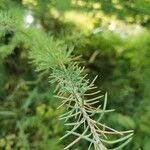
Larix laricina
Tamarack · Alaskan Larch · American Larch · Eastern Larch · Hackmatack
Description
Source: leafsnapLarix laricina, commonly known as the tamarack or American larch, is a deciduous coniferous tree native to North America. Typically reaching a height of 20-30 meters, this tree has a narrow conical shape with drooping branches. Its soft blue-green needles turn yellow in the fall before shedding for the winter. The bark of the tamarack is thin and scaly, displaying a reddish-brown hue. Tamaracks prefer moist soils and are commonly found in wetlands such as bogs, swamps, and marshes throughout Canada and parts of the United States. This species is important for wildlife habitat, providing cover for birds like grouse and woodpeckers. The wood of Larix laricina is highly valued for its strength, durability, and resistance to decay. It has been used in construction for centuries due to its ability to withstand harsh weather conditions. Overall, Larix laricina plays a crucial ecological role in wetland ecosystems while also offering valuable resources for human use.
🌳 Tamarack is a small, dense conifer that is perfect for planting near streams, ponds, and swampy areas. Its bright bluish-green needles turn a striking yellow in the fall, adding a pop of color to the scenery. The tree's branches add structure to the visual landscape, and it creates the most impressive effect when planted in large groups.
Care Guide
💧 Water Every 7 days
Tamarack thrives in moist, cool environments like its natural wetland habitat. It requires moderate moisture, so it's best to water it every 1–2 weeks, ensuring the soil remains damp but not waterlogged. When grown outdoors, tamarack enters a deciduous phase, during which it sheds its needles in preparation for winter dormancy, reducing its water needs.
How should I water my Tamarack tree to keep it healthy?
Watering your Tamarack tree is a simple task. To do it, all you need to do is turn on your garden hose and slowly soak the soil around the tree. This method works best for mature Tamarack trees, which require a larger amount of water. For smaller trees, using a watering can or another smaller tool will suffice. One important thing to remember is to avoid overhead watering, as it can lead to disease, particularly in young trees.
What should I do if I give my Tamarack tree too much or too little water?
Sometimes, overwatering can happen because of poor soil conditions. If the soil where your Tamarack is planted does not allow proper drainage, it can lead to the plant's decline. In such cases, you have two options: either improve the soil's drainage by amending it or move your Tamarack to a better location for growth. If you are growing your Tamarack in a pot, you may need to repot it with looser soil in a container that drains well. Overwatering can also make the plant susceptible to diseases, which should be treated promptly. On the other hand, if your Tamarack is underwatered, the solution is simple - water it more frequently, and it will regain its health. To determine if your Tamarack has been overwatered, examine the foliage, especially the new growth. Excess moisture may cause discoloration or fragile new growth. Another indication of overly moist soil is standing water or slow drainage in the plant's area. Underwatered Tamarack trees will show symptoms in the foliage as well, such as sparse or brown leaves. In such cases, consider if there has been excessive rainfall or consistently high temperatures, which will help you determine the appropriate course of action.
How frequently should I water my Tamarack tree?
A mature Tamarack tree is drought tolerant and can survive on rainfall alone. During the hottest months, you may need to water it once a week, but in other seasons, you probably won't need to water it at all unless it's newly planted. Newly planted Tamaracks should be watered regularly to establish their roots. However, it's important to avoid standing water, so it's better to under-water than to over-water your Tamarack.
How much water does my Tamarack tree need?
During the height of summer, your Tamarack will need watering. Usually, it requires about one inch of water per week. However, this amount may vary if it has rained significantly. If it has rained one inch or more in a week, you don't need to water your Tamarack. Keep in mind that newly planted Tamaracks need more water during the establishment period. Generally, you should water them once every one to two weeks for the first few growing seasons.
How do I properly water my Tamarack tree throughout the year?
The Tamarack tree requires the most water in the summer when it is hot. During this time, water it once a week if it doesn't rain. In other seasons, the plant can often survive without any water. Occasionally, in spring and fall, you may need to give some water if it's unusually hot, although this is rare. Unlike other plants, the Tamarack doesn't fully hibernate in winter, so it continues to grow even in the coldest months. However, its water needs during winter are low because the cool temperatures don't dry out the soil quickly.
☀️ Light Full sun
Tamarack prefers plentiful sunlight to grow well. Nevertheless, it can adjust to settings with only moderate sun. Its stage of development does not alter its sunlight requirements. Coming from a region characterized by clear skies, it tolerates variations in sunlight exposure. Too much sunlight does not damage it; however, too little light slows its growth cycle.
What are the sunlight requirements for Tamarack?
Tamarack requires abundant solar exposure for its healthy growth, thriving in conditions where it can bask in the sun's rays for long periods. However, this resilient plant is also capable of adapting to moderate sunlight conditions. Regardless of its growth stage, Tamarack's need for sunlight doesn't change, thanks to its origins in environments known for clear skies. While it can handle variations in sunlight intake, and too much sun won't harm it, not getting enough sunlight can delay its growth cycle. For indoor Tamarack plants, artificial lighting can serve as an alternative to natural sunlight, especially during winter or in less sunny spaces. LED lights are recommended, with requirements varying by the type of plant in terms of wattage per square foot and the duration and distance of the light source, to best mimic natural sunlight conditions.
What are the symptoms of insufficient or excessive sunlight in Tamarack?
When Tamarack does not receive adequate sunlight, it can exhibit several symptoms indicating light deficiency. These symptoms include smaller new leaves, leggy or sparse growth, faster leaf drop, slower or no new growth, lighter-colored new leaves, and in cases of excessive sunlight, chlorosis, sunscald, leaf curling, wilting, and leaf scorching. Each of these symptoms reflects the plant's struggle to adapt to its lighting conditions, whether it's battling with too little light to sustain growth or too much light causing physical damage to its leaves and stems.
How can one address sunlight-related issues in Tamarack?
To tackle sunlight-related issues in Tamarack, whether grown indoors, outdoors, or in the ground, a strategic approach is required. For indoor plants, gradually moving them to sunnier locations to ensure at least 6 hours of direct sunlight daily is beneficial, alongside the use of artificial light for additional support. Outdoors, it's important to acclimate plants to brighter spots gently, to avoid sunburn. Pruning surrounding trees or obstacles that shade the plant can also help increase sun exposure. If plants are small enough to move, transplanting them during their dormant period to a sunnier location with good drainage can significantly improve sunlight access. While parts of the plant that have been previously affected by inadequate light may not recover, new growth should be healthy once the light conditions are improved.
🌡️ Temperature 0–32.2°C
For optimal growth, the tamarack prefers temperatures between 32 and 90 ℉ (0 to 32 ℃). It is native to cooler climates and can withstand very low temperatures during the winter, but may struggle in hot, dry summers. For best results, keep the soil moist throughout the growing season.
What is the ideal temperature range for the growth of Tamarack?
The Tamarack prefers a temperature range of 32 to 90°F (0 to 32°C) for optimal growth. Originating from cooler climates, Tamarack is extremely cold-tolerant, capable of enduring very low winter temperatures. Although it thrives in cooler conditions, the Tamarack may face challenges during hot, dry summers. To maintain its health, it's important to keep the soil moist throughout the growing season. There is no need for additional frost protection measures in winter. However, to mitigate the risk of drought and water scarcity in winter and early spring, it’s advisable to water the plant generously before the first freeze of autumn, ensuring the soil stays moist and enters a frozen state.
What should be done if the Tamarack experiences temperatures below -40°C?
While the Tamarack is well-known for its cold tolerance, winter temperatures below -40°C can pose a threat. Under such extreme conditions, there might not be immediate visible damage during the winter; however, come spring, the plant may exhibit brittle and dry branches, with no new shoots emerging. The solution to this issue is relatively straightforward: in springtime, it is recommended to prune away any dead branches that have failed to produce new leaves, promoting the health and vitality of the Tamarack.
How does the Tamarack respond to high temperatures, and what measures can be taken?
The Tamarack is not well-suited to high temperatures, particularly those exceeding 32°C. Such conditions can cause the tree to lose leaves significantly, and in extreme cases, the plant may wither and die. To address this, it's advised to trim away the sunburned and dried-up parts of the plant. Relocating the Tamarack to a shadier location or employing a shade cloth to protect it from the midday and afternoon sun can be beneficial. Additionally, to ensure the soil remains moist and to support the tree's health, water the plant in the morning and evening, especially during periods of high heat.
💨 Humidity
🪴 Soil 5-6
🌱 Fertilizer
Tamarack has specific nutrient needs and does not require heavy fertilization. Spring is the best time to apply fertilizer for optimal growth. Providing nutrients enhances its health, increases resistance to pests and diseases, and helps preserve its long lifespan.
Why should I use fertilizer on my Tamarack?
To promote healthy growth in Tamarack, it is recommended to fertilize the plant in the spring. Given its long lifespan, it is necessary to provide support. Additionally, enhancing the soil with nutrients can boost the plant's overall health, enabling it to better defend against pests and diseases that can hinder growth and longevity.
When should I fertilize my Tamarack tree for optimal results?
Tamarack is different from your typical garden plants because it doesn't need a lot of extra nutrients. The growing medium might not provide enough nutrients for healthy growth, but Tamarack doesn't require much. If you want to fertilize Tamarack, the best time to do it is in the spring before new growth starts.
When is the best time to not give my Tamarack plant fertilizer?
Tamarack is not like other plants that need frequent fertilization. It actually does well with limited nutrients, so be cautious with fertilizer. Applying it only in the spring is sufficient. Avoid using fertilizer or adding organic matter to the soil during summer, fall, and winter seasons.
What kind of fertilizer does my Tamarack tree need?
The age of your plant is important when choosing fertilizer. Tamarack doesn't need too many nutrients. Look for a balanced plant food to promote healthy root development and growth, but avoid fertilizers high in nitrogen.
How can I give nutrients to my Tamarack plant?
It's important to fertilize Tamarack properly to maximize its growth. Add the fertilizer once in the spring, around the plant's base, but be careful not to get any fertilizer on the trunk. If you're using granulated fertilizer, cover the pellets with a thin layer of soil to enhance absorption into the soil.
🪴 Pot & Repot 2-3 years
When repotting Tamarack, select a pot 1-2 inches (2.5–5.1 cm) larger with ample drainage. Use a well-draining potting mix. Repot in spring or fall, making sure the root ball sits slightly below the rim of the flower pot. Water thoroughly after repotting and place it in a warm spot with indirect sunlight.
✂️ Pruning
The Tamarack tree has deciduous needles and a conical shape. For best results, prune in early spring to remove dead or crossing branches, which will help improve airflow and light penetration. Although minimal pruning is typically required, thinning the tree can help prevent disease and improve its structure, ultimately enhancing its growth and longevity. Consult horticultural guides for additional best practices.
🌿 Propagating
🐛 Diseases & pets
☠️ Toxicity
It's not toxic, no. There are numerous medical uses for tamarack. Tea can be made from its boughs, bark, and bare branches throughout the fall and winter. The tea can treat an upset stomach, fight lethargy, and reduce cold symptoms including a scratchy throat and congestion. Tamarack is a source of vitamin C and encourages overall health.
Characteristics
- Plant Type
- Tree
- Life Cycle
- Perennial
- Genus
- Larix
- Family
- Pinaceae
- Hardiness Zone
- 2-7
- Mature Height
- 10.06 m to 20.12 m
- Mature Spread
- 3.96 m to 9.14 m
- Leaf Color
- Green, Yellow, Blue, Orange
- Leaf Type
- Deciduous
- Flower Color
- Yellow, Pink, Purple, Red
- Flower Size
- 1.02 cm to 2.03 cm
- Bloom Time
- Mid spring, Late spring
- Planting Time
- Spring, Autumn
- Harvest Time
- Mid summer
- Native Area
- Northern North America