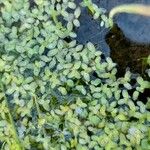
Lemna valdiviana
Pale Duckweed · Valdivia duckweed · Valdivia's duckweed · Small duckweed · Least duckweed
Description
Source: leafsnapLemna valdiviana, commonly known as Valdivian duckweed, is a small aquatic plant in the family Araceae. Native to South America, it thrives in freshwater environments such as ponds, lakes, and slow-moving streams. The Valdivian duckweed has a simple structure, lacking stems or leaves. Instead, it consists of small, oval-shaped fronds that float on the water's surface, connected by thin roots hanging below. These fronds are typically green but can sometimes exhibit reddish or brownish hues. This plant is crucial to aquatic ecosystems, serving as food for various aquatic animals, including fish and waterfowl. It also contributes to water purification by absorbing excess nutrients like nitrogen and phosphorus. In traditional South American medicine, Valdivian duckweed has been employed for its anti-inflammatory properties. Furthermore, it is currently being studied for its potential use as a biofuel due to its high lipid content. Overall, Lemna valdiviana is a fascinating plant with numerous ecological benefits and potential applications, far beyond just being a simple floating green frond on the surface of freshwater bodies in South America.
Care Guide
💧 Water Every 7 days
☀️ Light Full sun
Valdivia duckweed comes from habitats with plenty of sunlight, such as the shallow margins of ponds and lakes. It prefers full sun, although it can also tolerate partial sun.
🌡️ Temperature 15–37.8°C
Valdivia duckweed comes from tropical areas, where the climate is generally warm and humid. Consequently, it is adapted to high heat and moisture. It is sensitive to abrupt temperature changes and prefers a steady thermal environment, so preventing temperature fluctuations indoors is important. It typically does not tolerate cold and needs relatively high temperatures to grow. If the ambient temperature falls too low, the plant can stop growing or even die.
💨 Humidity
🪴 Soil
🌱 Fertilizer
🪴 Pot & Repot
✂️ Pruning
🌿 Propagating
🐛 Diseases & pets
☠️ Toxicity
Characteristics
- Plant Type
- Herb
- Life Cycle
- Perennial
- Genus
- Lemna
- Family
- Araceae
- Hardiness Zone
- 7-11
- Mature Height
- 0 cm to 1 cm
- Mature Spread
- 0 cm to 1 cm
- Leaf Color
- Light Green, Yellow Green
- Leaf Type
- Evergreen
- Bloom Time
- Late spring, Summer, Early fall, Mid fall
- Planting Time
- Spring, Summer, Autumn
- Harvest Time
- Summer, Fall
- Native Area
- Belize, Honduras, Mexico, Guatemala, Peru, Panama, Jamaica, Colombia, Cuba, Bolivia, Venezuela, Brazil, El Salvador, Nicaragua, Ecuador, Costa Rica