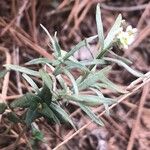
Lepidium graminifolium
Tall pepperwort · Grassleaf pepperweed · Grass-leaved pepperwort
Description
Source: leafsnapLepidium graminifolium, commonly known as grass-leaved pepperweed, is a small annual herbaceous plant in the Brassicaceae family. Native to North America, it thrives in various habitats such as grasslands, meadows, and disturbed areas. The plant features a slender stem that can reach up to 30 cm in height, topped with small white flowers. Its narrow, linear leaves, which are 1-3 cm long, are alternately arranged along the stem. Historically, Native Americans have utilized Lepidium graminifolium for its medicinal properties to treat ailments such as coughs, colds, fever, and stomach issues. The plant contains several bioactive compounds, including flavonoids, which have antioxidant properties. Beyond its medicinal uses, Lepidium graminifolium also provides an essential food source for wildlife, including birds and small mammals. In summary, Lepidium graminifolium is an intriguing herbaceous plant with significant medicinal properties and serves as an important food source for wildlife in North America's grasslands.
Care Guide
💧 Water Every 7 days
Grassleaf pepperweed, native to temperate regions, thrives in moderate moisture and can withstand brief dry periods. It prefers consistent, balanced watering and should be irrigated weekly. As an herbaceous plant, its growth season aligns with the availability of water, flourishing when irrigation complements the natural rainfall patterns.
What's the difference in how you water Grassleaf pepperweed inside and outside?
Most Grassleaf pepperweed plants prefer to grow outdoors for a few reasons. Firstly, they tend to grow quite tall. Additionally, these plants require a significant amount of daily sunlight, which may be lacking in most indoor environments. However, if you can provide a suitable indoor growing location, you may need to water your Grassleaf pepperweed more frequently than if it were growing outdoors. This is because indoor spaces tend to be drier, due to HVAC units, and the soil in containers can dry out quickly too.
How should I water my Grassleaf pepperweed?
There are various ways to water Grassleaf pepperweed, including using a garden hose with a spray nozzle, a watering can, or any other common watering tool. This plant isn't particularly particular about its water source, as it can survive on rainwater, tap water, or filtered water. However, it's best to avoid watering from above as this can harm the leaves and flowers and potentially introduce disease. Instead, a drip irrigation system is often the most effective method, as it delivers water directly and evenly to the soil. For container-grown Grassleaf pepperweed, you can follow a similar watering approach using a cup, watering can, or tap to water the soil directly.
What should I do if I give too much or too little water to my Grassleaf pepperweed plant?
To combat underwatering of Grassleaf pepperweed, the solution is simple: water it more consistently when you detect it lacks moisture. However, overwatering can have more severe consequences, leading to diseases that can ultimately cause the plant's decline and death. To prevent such issues, it is essential to select an appropriate location for the plant's growth. This location should have ample sunlight to aid in soil drying and ensure good drainage to prevent water accumulation. If you are overwatering your potted Grassleaf pepperweed, it may be necessary to transfer it to a new pot with better soil drainage and sufficient drainage holes. During the repotting process, use loose soil and a pot that efficiently drains excess water.
How often should I give water to my Grassleaf pepperweed?
Grassleaf pepperweed requires regular watering throughout the growing season. In the spring, water once a week, and as the weather gets warmer, increase watering to two or three times a week. However, be careful not to exceed this rate as it can harm the plant. It's important to keep the soil relatively moist but not wet, regardless of the watering frequency. When watering Grassleaf pepperweed in a pot, you'll need to water more often compared to plants in the ground. Generally, water container-grown pepperweed a few times per week, whereas in-ground plants only need to be watered once a week.
How much water does my Grassleaf pepperweed plant need?
There are a few ways to determine how much water to give to your Grassleaf pepperweed. One method is to feel the soil for moisture and water until the first six inches are moist. Another option is to use a set measurement, like two gallons per week, considering factors like heat and soil dryness. However, strict guidelines may cause overwatering if your plant needs less. When growing in a container, you should moisten all dry soil layers or check for moisture by sticking your finger in the soil. Additionally, you can water until excess water trickles from the drainage holes.
☀️ Light Full sun
Grassleaf pepperweed performs best in abundant sunlight and tolerates areas with diffused light. Its native habitat is defined by those light conditions rather than by specific geographic locations. If it gets too little or too much sun, growth abnormalities or fading foliage can occur.
What are the sunlight requirements for Grassleaf pepperweed?
Grassleaf pepperweed requires a specific balance of sunlight to thrive, generally falling into two categories: full sun and partial sun. Full sun means the plant should receive above 6 hours of sunlight daily, while partial sun refers to about 3-6 hours of sunlight. The plant's optimal growth is achieved under abundant sunshine exposure, and it can withstand light diffusion well. However, both deprivation and overexposure to sunlight can lead to growth abnormalities or fading of the foliage. Observing how sunlight moves through your garden to identify areas that offer the right balance of light and shade is crucial for the plant's health.
Can Grassleaf pepperweed be grown with artificial lighting?
Yes, Grassleaf pepperweed can be grown with artificial lighting, especially when natural sunlight is insufficient, like during winter or in less sunny spaces. Artificial lights, such as LED lights, are beneficial as they can be customized to provide specific wavelengths of light needed by the plants. The requirements vary with full sun plants needing 30-50W/sq ft, partial sun plants requiring 20-30W/sq ft, and full shade plants needing 10-20W/sq ft of artificial light. The light source should be placed 12-36 inches above the plant to mimic natural sunlight, and most plants need 8-12 hours of light per day.
What symptoms indicate Grassleaf pepperweed is receiving inadequate sunlight?
Symptoms of inadequate sunlight exposure in Grassleaf pepperweed include smaller new leaves, leggy or sparse growth, faster leaf drop, slower or no new growth, lighter-colored new leaves, chlorosis, sunscald, leaf curling, wilting, and leaf scorching. These symptoms reflect either a lack of chlorophyll and essential nutrients due to insufficient sunlight or damage from excessive sunlight exposure, negatively affecting the plant's ability to photosynthesize and maintain good health.
How can I address sunlight-related issues in Grassleaf pepperweed?
To address sunlight-related issues in Grassleaf pepperweed, follow these solutions: For indoor plants, gradually move them to a sunnier location each week to receive at least 6 hours of direct sunlight daily, or use artificial light if the plant is large or not easily movable, keeping a lamp on for at least 8 hours daily. For outdoor plants, also gradually move them to sunnier locations to avoid sunburn, adjusting to light intensity gradually. To reduce obstructions outdoors, prune trees or bushes blocking sunlight and consider transplanting smaller plants during their dormant period to sunnier spots with good drainage. Note that parts of the plant affected by insufficient sunlight may not recover, but new growth will be healthy after adjusting light exposure.
🌡️ Temperature 10–35°C
Grassleaf pepperweed can tolerate a wide range of temperatures, though its distribution may still be restricted by particular combinations of moisture and heat. It performs best in warm summer climates with sufficient rainfall or irrigation. Extended periods of cloudy, rainy weather or prolonged high temperatures increase the likelihood of Grassleaf pepperweed dying. In winter, protecting it from the cold can improve its survival rate.
💨 Humidity
🪴 Soil 6-7
🌱 Fertilizer
Grassleaf pepperweed responds well to frequent, weak fertilizer applications to encourage healthy leaf growth. Apply fertilizer roughly once a month during the summer. Because nitrogen is important for foliage, providing nitrogen-rich sources helps Grassleaf pepperweed thrive.
🪴 Pot & Repot
✂️ Pruning
Grassleaf pepperweed benefits from regular pruning from early to late spring to maintain its shape and encourage growth. Prune by removing dead or damaged stems, thinning crowded areas, and cutting back spent flowers to encourage more blooms. Additionally, make sure to meet the plant's soil and moisture needs to prevent stress and promote a robust, healthy plant.
🌿 Propagating
🐛 Diseases & pets
☠️ Toxicity
Characteristics
- Plant Type
- Herb
- Life Cycle
- Annual, Perennial
- Genus
- Lepidium
- Family
- Brassicaceae
- Hardiness Zone
- 6-9
- Mature Height
- 0.2 m to 1.22 m
- Mature Spread
- 20 cm to 40 cm
- Leaf Color
- Green, Dark Green
- Leaf Type
- Semi-evergreen
- Flower Color
- White
- Flower Size
- 0.20 cm to 0.25 cm
- Bloom Time
- Summer, Early fall
- Planting Time
- Spring, Summer, Autumn
- Harvest Time
- Late summer, Fall
- Native Area
- Turkey, Austria, Montenegro, Croatia, Morocco, Slovenia, Russia, Germany, Romania, France, Portugal, Bulgaria, Greece, Serbia, Syria, Italy, Spain, Switzerland, Albania, Algeria, Hungary