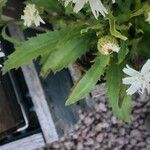
Leucanthemum × superbum
Shasta Daisy · Leucanthemum x superbum
Description
Source: leafsnapLeucanthemum × superbum, the Shasta daisy, is a commonly grown flowering herbaceous perennial plant with the classic daisy appearance of white petals (ray florets) around a yellow disc, similar to the oxeye daisy Leucanthemum vulgare Lam, but larger. It originated as a hybrid produced in 1890 by the American horticulturist Luther Burbank from a number of daisies. First, he crossed Leucanthemum vulgare with Leucanthemum maximum; this double hybrid was itself crossed with Leucanthemum lacustre. The resulting Leucanthemum triple hybrid was crossed with Nipponanthemum nipponicum, creating an intergeneric cross of species from three continents. It was named after Mount Shasta, because its petals were the color of the snow. Some members of the genus are considered noxious weeds, but the Shasta daisy remains a favorite garden plant. Many cultivars are suitable for cut flowers, such as 'Becky', 'Esther Read', 'Silberprinzesschen' (Silver Princess), 'Snow Lady', 'Tinkerbell', 'Wirral Pride', 'Wirral Supreme'. The cultivars 'T.E. Killin' and 'Wirral Supreme' have gained the Royal Horticultural Society's Award of Garden Merit.
Care Guide
💧 Water Every 3-7 days
Shasta daisies prefer moist conditions, but ensuring the soil is well-drained is essential. While they appreciate moisture, they are sensitive to soggy soil and overwatering. Therefore, it is better to slightly underwater rather than overwater these daisies. Once Shasta daisies are established, they have a certain drought tolerance for short periods. Therefore, please provide them with approximately 1 inch of water weekly to keep them healthy and hydrated. This amount is generally sufficient to meet their moisture needs without overwatering.
☀️ Light
🌡️ Temperature
Becky Shasta daisy plants have fairly good heat and cold tolerance within their growing zones. However, extremely high temperatures can stress the plants and cause them to produce fewer flowers. The ideal temperature range for Becky Shasta daisies is between 60 and 70 degrees Fahrenheit. This daisy prefers a humidity level of 60 percent or below and does not tolerate extremely humid climates.
💨 Humidity
🪴 Soil
🌱 Fertilizer
Becky shasta daisy only requires fertilizer if you have very lean soil. In this instance, work a few shovels of organic compost or steer manure into your existing garden bed before planting. Repeat this annually in the spring for best results.
🪴 Pot & Repot
✂️ Pruning
Becky shasta daisy can be pruned at any time during its growing season to remove dead stems and flowers. Deadheading (removing shriveled flowers) encourages more blooms and lengthens the bloom time. Deadheading also helps control the spread of this aggressive perennial that easily propagates through seed. In the late fall, prune the plant all the way back to 3 inches above the ground to overwinter.
🌿 Propagating
🐛 Diseases & pets
☠️ Toxicity
Becky shasta daisy is considered mildly toxic to people and pets. Eating large amounts of daisies could cause vomiting, drooling, and even muscle spasms or convulsions, in your pet.
Characteristics
- Plant Type
- Perennial
- Genus
- Leucanthemum
- Family
- Asteraceae
- Hardiness Zone
- 5-9
- Bloom Time
- Spring, summer
- Native Area
- North America