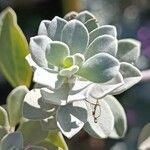
Leucophyllum candidum
Brewster County barometerbush
Description
Source: leafsnapLeucophyllum candidum, commonly known as Texas sage or white cloud, is a small evergreen shrub native to the southwestern United States and northern Mexico. This plant belongs to the Scrophulariaceae family and can grow up to 6 feet tall and 6 feet wide. It features a dense, bushy growth habit with silvery-gray leaves that are covered in fine hairs. When crushed, the leaves emit a pleasant aroma. In late summer or early fall, Texas sage produces beautiful white or pale lavender flowers that attract bees, butterflies, and hummingbirds. The flowers are tubular-shaped with five petals arranged in a funnel shape around the stamens. Once established, this plant is drought-tolerant but prefers well-drained soil with moderate moisture during the growing season. It thrives best in full sun but can also tolerate partial shade. Historically, Native Americans have used Texas sage for its medicinal properties, primarily due to its anti-inflammatory effects. The leaves were often used as an herbal remedy for respiratory ailments such as asthma and bronchitis. Overall, Leucophyllum candidum is an attractive ornamental shrub that requires minimal maintenance once established. It offers beautiful blooms from late summer into the fall and supports pollinators like bees, butterflies, and hummingbirds. This makes it an excellent addition to any garden or landscape design!
Care Guide
💧 Water Every 7 days
☀️ Light Full sun
Brewster county barometerbush is native to open environments, such as sunny meadows and forest edges, which supply abundant light. It does best in Full Sun but will also tolerate Partial Sun, showing good adaptability to different sunlight conditions.
🌡️ Temperature 15–37.8°C
Brewster county barometerbush comes from tropical areas, where the climate is usually warm and humid. Consequently, it is well suited to high heat and humidity. It does not tolerate sudden temperature shifts and prefers a steady temperature, so avoiding indoor temperature fluctuations is important. It typically cannot withstand cold and needs warmer conditions to grow. If the surrounding temperature falls too low, the plant may stop growing or even die.
💨 Humidity normal (40-60%)
This plant will thrive in moderate humidity, which is probably the level in your home. However, misting it a few times a week can be very beneficial. Make sure the room has good ventilation.
🪴 Soil 6-8
🌱 Fertilizer
The ideal time to fertilize a Brewster county barometerbush is in early spring, as it comes out of dormancy. This encourages overall growth and flower development. Fertilization improves foliage, stems, and branches, and promotes large, vibrant, long-lasting flowers. It helps transfer nutrients from the roots to the flowers and enhances the plant's health and resistance to disease.
🪴 Pot & Repot
✂️ Pruning
🌿 Propagating
🐛 Diseases & pets
☠️ Toxicity
Characteristics
- Plant Type
- Shrub
- Life Cycle
- Perennial
- Genus
- Leucophyllum
- Family
- Scrophulariaceae
- Hardiness Zone
- 8-11
- Mature Height
- 30 cm to 91 cm
- Mature Spread
- 1.22 m
- Leaf Color
- Silver, Light Gray
- Leaf Type
- Evergreen
- Flower Color
- Lavender
- Flower Size
- 2.03 cm to 3.05 cm
- Bloom Time
- Summer, Fall
- Planting Time
- Spring, Summer, Autumn
- Harvest Time
- Late summer, Fall, Early winter
- Native Area
- Mexico