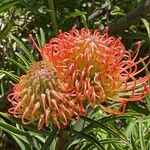
Leucospermum lineare
Narrow-leaf pincushion · Needle-leaf pincushion
Description
Source: leafsnapLeucospermum lineare is an evergreen shrub with linear leaves and is assigned to the Proteaceae. There are two distinct forms that have not been formally recognized as separate taxa. There is an upright form with orange flower heads of up to 2 m (6.6 ft) high, and a sprawling form of 2–3 m (6.6–9.8 ft) in diameter with yellow flower heads. Its common name is needle-leaf pincushion, or narrow-leaf pincushion, in English and smalblaarspeldekussing in Afrikaans. The orange-flowered form is called tangerine pincushion or assegaaibos pincushion. Flowering occurs in the first half of the southern hemisphere season, but peaks in September and October. It is an endemic species that can only be found in the southwest of the Western Cape province of South Africa.
Care Guide
💧 Water
The Flame plant becomes drought-tolerant once it is established. Initially, water the plant after planting and then regularly during the first two years. For loamy soils, water 2-3 times a week. In contrast, plants in sandy soil or pots need daily watering in dry conditions. To prevent diseases, water at the base of the plant.
☀️ Light Full sun
Flame is native to open habitats, such as sunny meadows and forest margins, where light is plentiful. It performs best in Full Sun but can also tolerate Partial Sun, adapting well to a range of light conditions.
What are the sunlight requirements for a plant named Flame (Leucospermum lineare)?
The Flame plant, scientifically known as Leucospermum lineare, thrives under specific sunlight conditions. It requires 'Full sun' for optimal growth, which means it should be placed in a location where it receives more than 6 hours of sunlight daily. Alternatively, it can also grow under 'Partial sun', needing about 3-6 hours of sunlight. It's crucial to monitor how sunlight moves through your garden throughout the day to find spots that offer a balanced environment of light and shade, ensuring your plant's health and happiness.
🌡️ Temperature 20–37.8°C
Flame adjusts well to varying temperatures, tolerating heat and large temperature swings. In hot weather, be careful to water regularly and provide some shade to avoid sunburn. On the other hand, Flame is not very cold-tolerant: it can handle mild chill, but very low temperatures can cause frost damage.
💨 Humidity
🪴 Soil 6-7
🌱 Fertilizer
Proper timing is important when fertilizing Flame. Fertilize in early spring and continue monthly until early summer. Fertilizer promotes attractive blooms and supplies energy during both dormant and active growth phases.
🪴 Pot & Repot
✂️ Pruning
The Flame plant showcases bright, pincushion-shaped flowers and needle-like leaves. To encourage blooming, lightly prune the plant in early spring. Removing any dead or crossing branches will also improve its overall health. Be careful to avoid heavy pruning, as it can hinder the plant's recovery. With regular maintenance, you can enhance airflow and sunlight exposure, promoting vibrant blossoms.
🌿 Propagating
🐛 Diseases & pets
☠️ Toxicity
Characteristics
- Plant Type
- Shrub
- Life Cycle
- Perennial
- Genus
- Leucospermum
- Family
- Proteaceae
- Hardiness Zone
- 9-11
- Mature Height
- 0.91 m to 2.13 m
- Mature Spread
- 0.91 m to 1.52 m
- Leaf Color
- Dark Green
- Leaf Type
- Evergreen
- Flower Color
- Orange, Yellow
- Flower Size
- 5.08 cm to 6.35 cm
- Bloom Time
- Late summer, Early fall, Mid fall
- Planting Time
- Spring, Summer, Autumn
- Harvest Time
- Late fall, Early winter, Mid winter
- Native Area
- South Africa